
The interview started out gently, with a mutual “How are you?” But it turned probing when the medical resident asked, “Have you ever attempted suicide?”
My husband Tim and I were consulting a university medical school — their perinatal psychiatry clinic — in December 2019. We wanted to start a family. We longed to experience the profound love between parent and child. I also wanted to birth a new life that I thought would redeem my old, a life beautiful enough to motivate me to keep going in the face of psychosis.
According to combined national survey data collected by the Substance Abuse and Mental Health Services Administration from 2008 to 2014, 18% of parents in the U.S. had experienced a mental health condition in the previous year. I have schizoaffective disorder, and though I’d been stable for four years, I felt compelled to be completely honest.
“Yeah,” I said. “I have no idea how many there have been. Multiple.” The attempts blur together in my mind.
Tim reached for my hand. I clutched his. The resident’s steel eyes seemed to saw through my skull. “Have you ever had strong beliefs that other people said didn’t make sense?”
“Five years ago,” I replied. “I’d stopped my antipsychotic cold turkey because I hated the weight gain.” I did my best to describe the delusions that had traumatized me.
“You thought you were being recruited by the CIA?” the resident asked. “And your dad was a criminal mastermind trying to kill you?”
“Yes.” I sound batshit crazy.
I’d been shattered by psychosis— how could I ever be whole enough to bring a child into the world?
The supervising psychiatrist entered. We discussed how I’d resumed the antipsychotic medication, how it had stabilized me and made my happy, healthy life possible.
“Ma’am, I have a duty to say this,” the doctor said, his brown eyes gentle in a way the resident’s hadn’t been. “Very little is known about this medication in pregnancy.” But, he added, “It seems to cause miscarriages in rats.”
Like many antipsychotics, my medication, one of the second generation of atypical antipsychotics developed after the initial discovery of Haldol and Thorazine in the 1950s, hadn’t been well studied in pregnancy, he said. Some research links atypical antipsychotics to miscarriage; other studies find no risk.
For me — as for so many women — the dangers of stopping the medication outweighed any potential risk to a baby, he told us. Pregnancy with a psychotic disorder isn’t just complicated by the illness itself, but by the gaps in care and the lifestyle challenges that so often come with it. I faced heightened odds of developing gestational diabetes, having a preterm birth or delivering an infant with low birth weight. More research was desperately needed, the doctor continued, especially since women with schizophrenia and schizoaffective disorder become mothers at roughly the same rate as everyone else.
Tears began to run down my cheeks. Tim rubbed my back. His touch couldn’t comfort me.
The psychiatrist threw his hands wide. “So many women in our hospital who are on these medications have beautiful babies. But there’s a risk.”
I developed mental illness as a teenager and attempted suicide for the first time when I was 21. In the following years, I suffered breakdown after breakdown, until, at age 30, when I stopped my antipsychotic and spiraled into delusions, I received a new diagnosis of schizoaffective disorder. My parents sought guardianship and moved me to a group home.
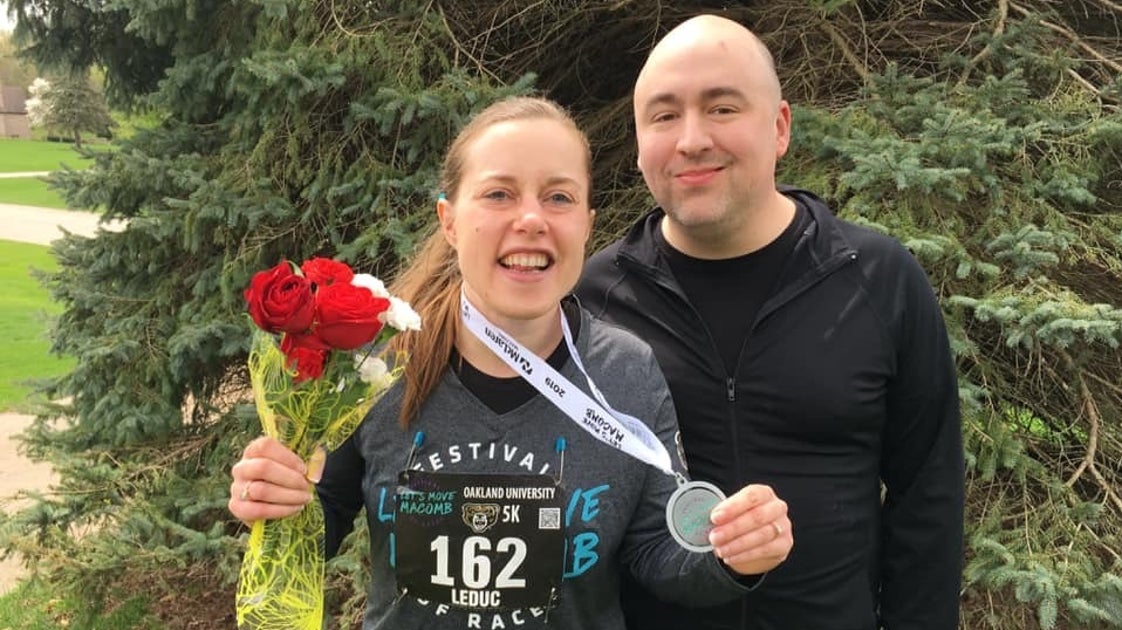
But I was resilient. I became medication compliant, moved home and found volunteer work that transitioned into a job. I started running and competed in 5Ks. Seeing my progress, my parents eventually terminated the guardianship. Later, I earned a master’s degree and bought my first home.
I met Tim when I was 34. He was intelligent and funny, gentle and stable — and we fell head over heels for each other. With him, I hoped to start a family.
During our engagement, on a bright spring day, the daffodils’ yellow stars strewn profusely across the lawn, I told my dad that Tim would make a good father.
“And you’d make a wonderful mom, honey,” he told me. “I wouldn’t have said that even two or three years ago, but you’ve proven me wrong. I couldn’t be happier.”
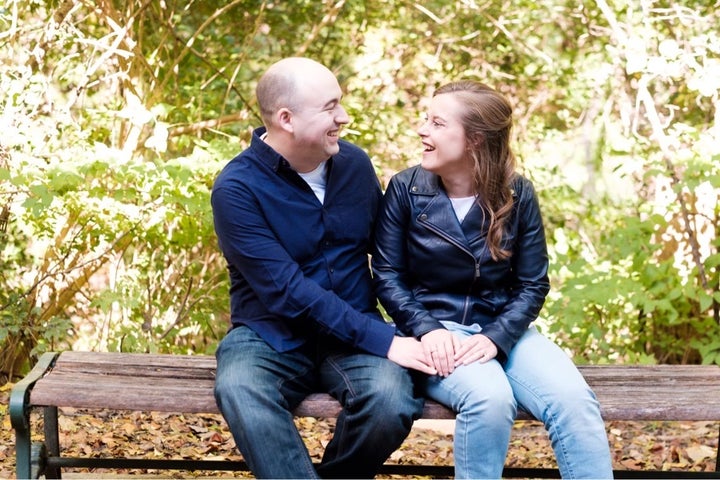 The author and her husband pictured during their engagement in 2018.
Of course, I worried about passing on my illness. Children of parents with severe mental illnesses have a 1 in 3 chance of developing a psychotic or major mood disorder by adulthood. Schizoaffective disorder manifests in late adolescence, so I wouldn’t know for nearly two decades whether I had passed on my condition.
Tim and I discussed the possibility that sleep deprivation and stress might cause me to destabilize. We also talked about the long-term implications if I required hospitalization during our child’s formative years. Tim once said to me, “I’m scared I’ll have to take care of two people — you and a baby.”
I knew support would be crucial. I investigated doulas and child care and enlisted a commitment to help from my parents. I planned to leave my full-time job and work part-time from home. I also took comfort from the examples of friends with mental and physical disabilities who were wonderful parents. They told me that parenting was both the hardest thing they’d ever done and the most rewarding.
Research demonstrates that even people with conditions as serious as mine can make great parents. An eight-year study cited by the American Psychological Association found that the adult children of parents with various disabilities generally showed high self-esteem and had positive childhood experiences.
At the clinic, the specialist outlined a plan: I’d gradually taper off several of my medications to prepare my body for pregnancy, while remaining on the vital antipsychotic.
Later, back in our apartment, Tim and I talked and talked, weighing the potential risk to my mental health, as well as the risk of miscarriage. We decided to go for it.
In April 2020, after the first taper had begun, I found myself sobbing over the sweet potatoes I was slicing for dinner. I could only think of lying down and letting an overdose-induced sleep close over my head forever.
Once again, I willed my own death. But this time, I fought. In what has been my only hospitalization in the past nine years, I checked myself into a local behavioral health unit and sobbed myself to sleep. Knowing that I desperately needed to stabilize, I resumed the medication. At that point, I was in no shape to become a mom.
“Tim once said to me, ‘I’m scared I’ll have to take care of two people — you and a baby.’”
In the years that followed, I researched adoption from foster care and domestic infant adoption. Tim and I attended orientations, and I made endless cold calls to adoption agencies to ask if they would consider facilitating an adoption by a woman with a history of psychiatric hospitalization. Receptionists hung up. I became more strategic. They still hung up.
Finally, on a late autumn afternoon in 2024, a social worker leveled with me: My severe psychiatric history meant that no agency would adopt to us, despite my years of stability.
The reproductive health needs of women with severe mental illnesses are complex and still largely go unmet. But we’re not the only ones for whom the need for reproductive psychiatry is pressing. In pregnancy or postpartum, 1 in 5 women will experience a psychological disorder. More than 13% of all pregnant women take psychotropic medication, and about 1 in every 100 pregnancies is exposed to atypical antipsychotics.
In winter 2025, Tim and I returned to the university’s perinatal psychiatry clinic, where the specialists gave us good news: None of my medications were clearly contraindicated. Not even the antipsychotic, though its effects on pregnancy remained mysterious. I made an appointment to get my IUD removed.
By early spring, I felt nauseous. My stomach cramped so badly I clutched a heating pad. My breasts grew larger, and the nipples changed color.
It was too soon for a pregnancy test. Still, my primary care doctor said it was possible to have all these symptoms at such an early stage of pregnancy. I was excited. At home, I smiled into Tim’s eyes: “I think you’re going to become a dad.”
Days later, my period started.
I was sure I had been pregnant. But as the days passed, I worried how I would react if I miscarried again. Could I handle more loss? Or would I spiral until I lost myself?
Throughout that winter and early spring, I’d had nightmares that I gave birth to a child with a psychotic disorder or landed myself back in a psychiatric inpatient unit. I wanted to be brave enough to go out and grab the beautiful life I craved, but deep down, I was terrified.
I reflected on the miracle that Tim and I already shared a happy, stable home. And I was healthy. My mom said to me, during one of the long phone conversations we had that spring, “Meggie, you can choose wellness.”
I valued my health even more than my dream of motherhood, I realized. I could choose my own wellness — and wellness would make attaining other dreams possible. Tim and I held each other as I told him I didn’t want to put myself through another try.
“It’s all right, Meggie,” he whispered back, smoothing my hair.
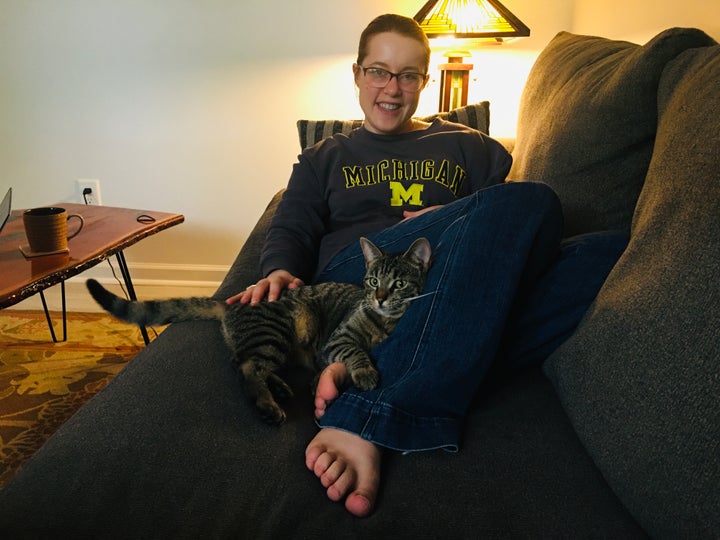 The author relaxes with her cat Zooey at home in 2021.
Photo courtesy of Meg LeDuc
There are other ways to nurture besides motherhood. On a recent family vacation, I stacked alphabet blocks with my 4-year-old niece, my twin brother’s daughter, into words she read aloud: “car,” “balloon,” “banana.” Her 18-month-old brother bumped a toy truck against my shin. Vroom, vroom. I smiled down at my tiny niece and ruffled her hair.
“It spells ‘girl’!” she crowed.
Looking at her, my heart breaks. But it also sings. Most times, I take joy in my gorgeously good little life: me, my husband, our brood of rescue kitties. As time goes on, its goodness only grows. Where I once wished for death, I found a desire to live. I gave up my hope of having a baby, but still created the beautiful life I’d dreamed.
If you or someone you know needs help, call or text 988 or chat 988lifeline.org for mental health support. Additionally, you can find local mental health and crisis resources at dontcallthepolice.com. Outside of the U.S., please visit the International Association for Suicide Prevention.
Do you have a compelling personal story you’d like to see published on HuffPost? Find out what we’re looking for here and send us a pitch at pitch@huffpost.com.