
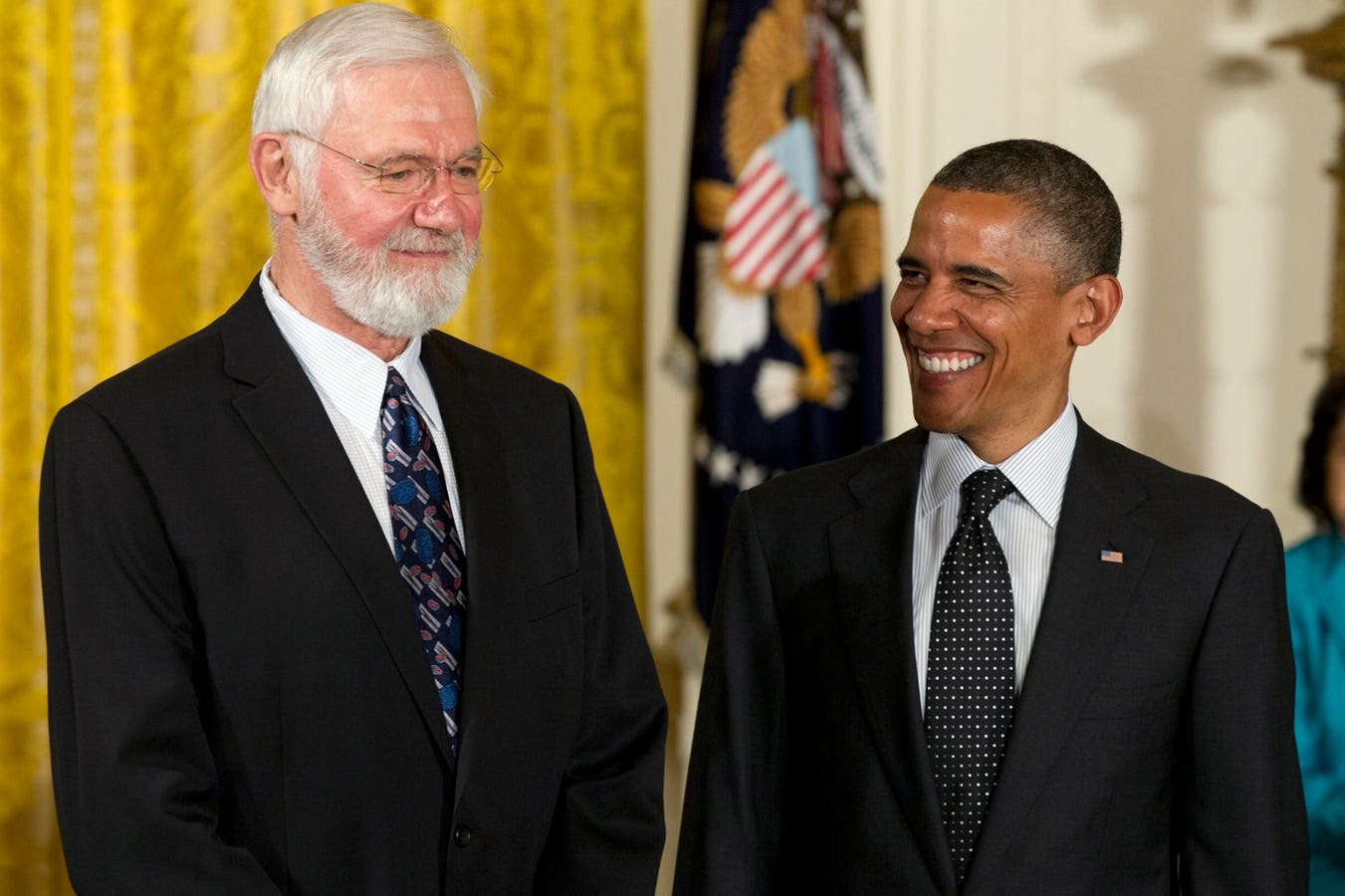
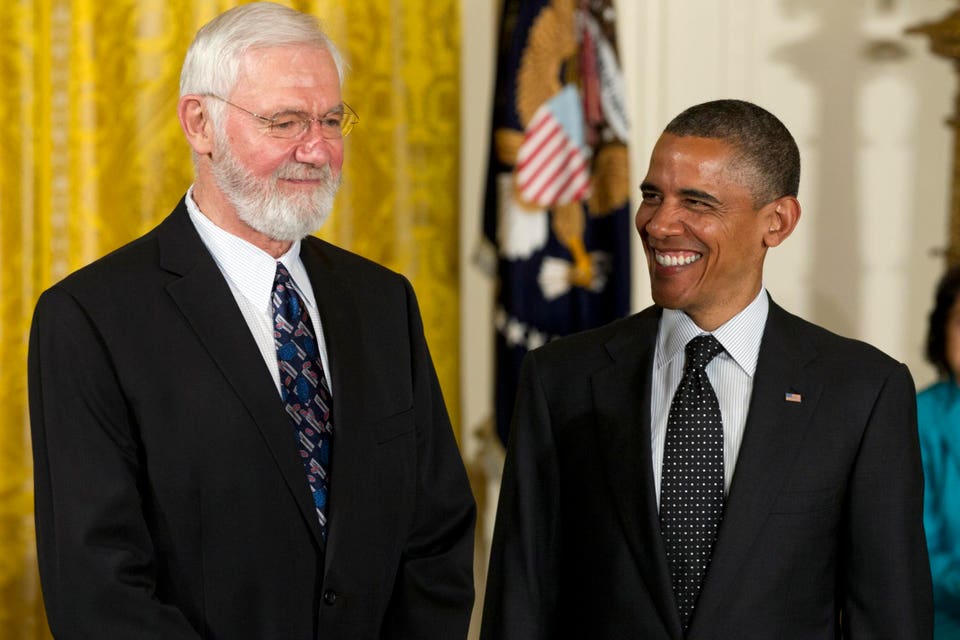
President Barack Obama looks to Bill Foege who was credited with the eradication of smallpox as he awards him the Presidential Medal of Freedom in the East Room of the White House, Tuesday, May 29, 2012, in Washington. (AP Photo/Carolyn Kaster)
Copyright 2012 AP. All rights reserved.
Dr William H. Foege, a legend in global public health, passed away on 24 January 2026, at the age of 89. He was recipient of the Medal of Freedom award in 2012, and a recipient of the 2007 Jimmy and Rosalynn Carter Award for Humanitarian Contributions to the Health of Humankind. He previously served as the Director of the Centers for Disease Control and Prevention (CDC).
Few people in public health have had a bigger impact than Dr Bill Foege. He is widely known for his pioneering work on smallpox eradication, especially in India, where he lived and worked for many years. This story can be found in his 2011 book House on Fire.
Over a decade ago, I had reached out to Dr Foege about his book, House on Fire. He was kind enough to respond and send me a signed copy which I still treasure (photo). In his books and his other writings and speeches, he offer several lessons that continue to be highly relevant for anyone working in public and global health. In this post, I highlight five lessons that are invaluable, especially at a time when science, multi-lateralism, and public health are under intense attack.
House on Fire, The Fight to Eradicate Smallpox, was published by Dr William H. Foege in 2011 (University of California Press)
Madhukar PaiGood leaders lead with humility
What I found most inspiring about Dr Foege was his humility and his ability to elevate others. The foreword to House on Fire was written by Dr David Sencer, another public health legend, and former Director of the CDC. In the foreword, Sencer wrote about how Foege told “stories not about what he has done, but about what others have done.” Dr Sencer called his trait “ego suppression.”
A striking example of this form of humble leadership was narrated by Dr Sencer in his foreword. In the mid 1970s, as India was nearing its goal of getting rid of smallpox, Dr Foege decided to leave India and return to the United States with his family. Dr Sencer, his boss, asked him to stay on and be a part of the big celebration that was planned, once the country was certified to be free of smallpox.
Dr Foege responded to Dr Sencer as follows: “I realize that this is going to happen, but if I remain in India, too much attention would be directed toward the external support that India received, and it is very important that recognition be given to the accomplishments of the hundreds of thousands of Indians who really did the work. This is why I am coming home.” In 1977, India was certified free of smallpox, and in December 1979, the whole world was declared smallpox free.
Dr Arthur Reingold, now an emeritus professor at the University of California, Berkeley, had worked closely with Dr Foege, his boss, during Reingold’s tenure at the CDC. “Bill taught me that being humble about your abilities and accomplishments and having a sense of humor are not antithetical to having an impact or to helping make the world a better place,” he said.
Public health rests on good science
“Public health solutions rest on good science,” Foege wrote in House on Fire. Without good science and data, smallpox would not have been eradicated. To him, the purpose of public health surveillance was to discover the truth. “Knowledge is power, and even a little knowledge of the truth goes a long way,” he wrote.
Science needs a moral compass
In 2006, the University of Washington, Seattle, unveiled its new William H. Foege Building. Speaking at the ceremony, Dr Foege remarked “there is something better than science and that is science with a moral compass, science in the service of humanity.” In his book, House on Fire, he wrote: “the purpose of public health is to promote social justice.”
These statements clearly show how Foege lived a live of purpose and moral ambition. His goal was not about advancing his career or building his personal reputation, but to contribute to the society at large.
Change is possible
The successful eradication of smallpox convinced Dr Foege that great things can be achieved, but they never happen by accident. In his book, he wrote “Humanity does not have to live in a world of plagues, disastrous governments, conflict, and uncontrolled health risks. The coordinated action of a group of dedicated people can plan for and bring about a better future. The fact of smallpox eradication remains a constant reminder that we should settle for nothing less.” His most recent (2024) book, Change is Possible, expanded on this theme.
Global efforts are possible and inherently good
Dr Foege used the smallpox example to argue for multi-laterialism, global solidarity, and global cooperation. “Smallpox was a shared risk, and its removal required a shared effort. Pursuing such programs is worth effort both because of the inherent good in solving them and because they provide practice in working together and breaking down unnecessary and unproductive social barriers,” he wrote. He was a huge believer in the power of building coalitions and trust among teams.
A legacy of hope
The world of global health and development is currently in a state of turmoil, with several western nations cutting back on aid, and with the United States disengaging from the World Health Organization and several other multi-lateral initiatives and organizations. In these uncertain times, Dr William Foege’s life and legacy offers us some hope – that we can fight for social justice, retain our moral compass, continue to be guided by science, and work in solidarity with others to achieve meaningful change.