
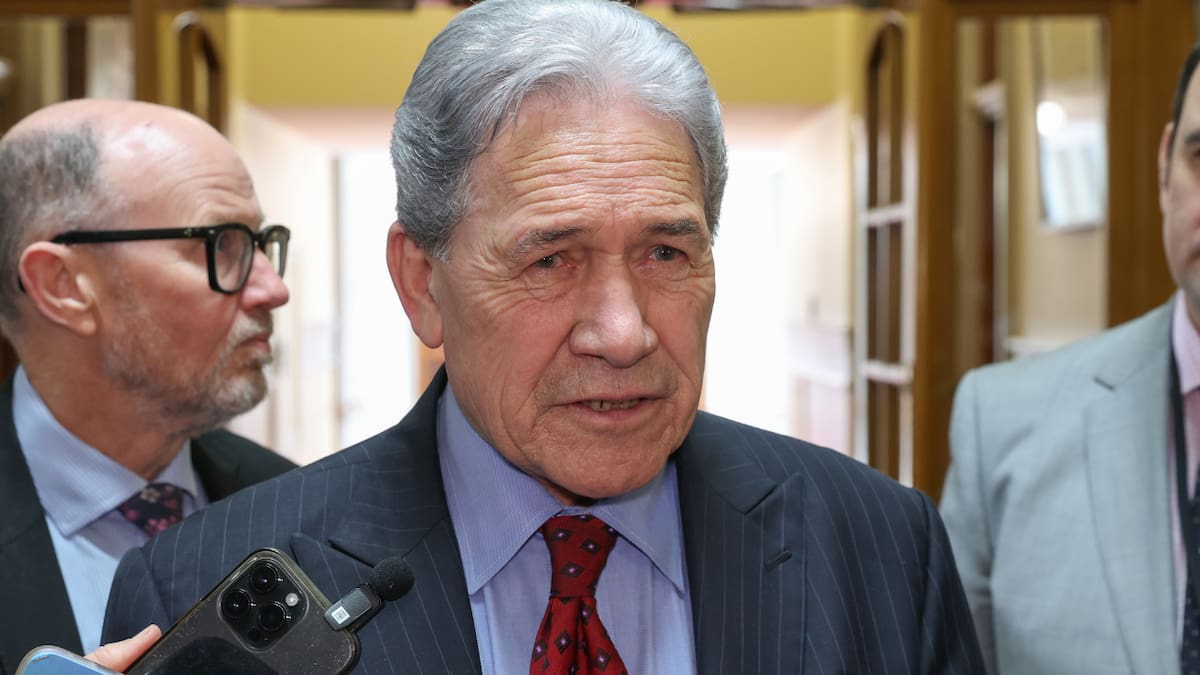
Sometimes it’s the little things – like Winston Peters’ recent rebuke of Anna Breman, the recently appointed Reserve Bank governor. Breman signed a statement of support for Jerome Powell, chair of the US Federal Reserve, who is at war with Donald Trump after he resisted the President’s demands to lower
interest rates.
Trump is using one of his favourite tactics – “lawfare” – threatening to bring criminal charges against Powell over the cost of renovating government buildings. Central bankers around the world signed a letter of support for Powell; Breman did not take ministerial advice before signing the letter and Peters took to social media to announce, “The RBNZ has no role, nor should it involve itself, in US domestic politics. We remind the governor to stay in her New Zealand lane and stick to domestic monetary policy.”
It seems like a normal day in the coalition government: someone said or did something and Peters attacked them. It’s well known he guards his beloved foreign affairs portfolio like a crocodile at a waterhole, savaging anyone foolish enough to stray too close. It’s also understood New Zealand is desperate to avoid the dread gaze of the US President lest we become like Venezuela or Greenland – toys for his imperial amusement. But there’s a subtext to the incident that tells us much about our moment in politics – and Peters’ central role in it.
Opposite poles: Findings from the 2023 Election Study. The circles for each party indicate where its supporters sit on a range of values.
Central feasting
The 2023 New Zealand Election Study asked more than 1800 voters a battery of questions about their political values. The chart above maps them along two dimensions: economic policy (left to right) and social attitudes (liberal to conservative). The ovals show where each party’s voters cluster. Two things to keep in mind: the circles don’t correspond to vote count (National’s party vote was six times New Zealand First’s), and voters aren’t distributed evenly – they cluster around the middle. (The economic right and social liberal quadrant – classical liberalism – is mostly empty.)
New Zealand First occupies the centre. This can be a dangerous place. When a major party is ascendant – led by a Jacinda Ardern or a John Key – it can crowd Peters out of Parliament. Strong leaders can take their parties with them while they occupy the centre, while weaker ones get brought to heel by their donors and activists. So this year, Peters is free to paddle languidly through the swamps of New Zealand politics, basking wherever the sun falls warmest and feasting on available voters at his leisure.
The economic left/social conservative region of the chart is well populated: this is the traditional working class, a cohort that has been the source of much anxiety and endless commentary around Western democracies during the past 15 years. The left-wing parties they used to vote for were captured by the educated class or the managerial class or, as Peters likes to call them, the woke elites, leaving those voters politically bereft. Now, they’ve empowered populist-right parties such as NZ First, to the outraged bafflement of the intelligentsia in the bottom left of the chart.
Populists denounce the economy in much the same terms as the modern left: Peters has been attacking neoliberalism for longer than Chlöe Swarbrick has been alive. But they also have a political critique: that liberal democracies are failing because they’re not democratic enough. They’ve vested too much power in technocrats, judges and senior officials – like independent central bankers.
The technocrats are supposed to act in the interests of their country, but populists see them as members of a global order that ruthlessly advance their own self-interest. They’re supposed to be scrupulously apolitical; populists accuse them of being aggressively political – they impose neoliberal economic conditions, mass immigration and woke ideology on the public and operate beyond democratic accountability.
Reserve Bank Governor Anna Breman in the bank’s Wellington boardroom. Photo / NZME
To have the newly appointed European governor of New Zealand’s central bank comment on US politics, criticising a populist right leader – conducting their own foreign policy! While Peters is Foreign Minister! – would have seemed a glaring validation of this world view.
The populist critique is not entirely wrong, but the old way of doing things, in which politicians set the interest rates to suit themselves, was far worse. It would be nice to go back to the very recent past when technocrats at least attempted to appear apolitical. The Reserve Bank seems to struggle with this issue more than most public institutions.
Peters is fond of repeating that the other members of his right-wing coalition are globalists while his party is nationalist, and his is the party of the workers. Some commentators think this rhetoric indicates a possible detente with Labour – an invitation to indulge in the much-loved which-way-will-Winston-go? game. But Peters is fixated on capturing voters, not signalling to commentators.
He’ll be more inclined to return to the current coalition arrangement: his voter overlap with National is larger than the one with Labour, and it’s more convenient for him to rule alongside easily managed novices like Luxon (as with Ardern in 2017). Chris Hipkins is stubborn, confrontational and an experienced minister. Peters has ruled Labour out as long as Hipkins is leader.
Populists rule
Given the success of populist politics – in Australia, One Nation is polling at 19%; in the UK, Reform is at 24%; Donald Trump is US President – and the weakness of our major parties, we can wonder why NZ First isn’t more popular. There’s an awful lot of voters in that top-left square who no one else is talking to.
Perhaps this will change: Peters often surges during campaigns. He’s a master of retail politics – the town halls and media dramas. There are cohorts of soft-Labour and soft-National voters who like to invest in New Zealand First, both as a check against major-party dominance and to diminish the influence of the more radical parties on the left and right.
But perhaps Peters is less appealing than other populists because he’s a known quantity. Disgruntled voters in Australia and the UK can contemplate Pauline Hanson and Nigel Farage – genuine outsiders – and imagine how wonderful things will be once they’re running the country and have purged the hated elites. Hope requires mystery and Peters has been in Parliament for nearly 50 years; a minister in five governments.
New Zealand has Actual Existing Populism at the heart of the coalition that has delivered Peters as Foreign Minister, Shane Jones and his corporate welfare schemes, an occasional anti-woke member’s bill that comes to nothing – none of which signals any kind of meaningful change. The crocodile is content to rule the swamp rather than drain it.
SaveShare this article
Reminder, this is a Premium article and requires a subscription to read.
Copy LinkEmailFacebookTwitter/XLinkedInReddit
Tags:
- after
- anna
- appointed
- as
- bank
- breman
- chair
- danyl
- demands
- Donald
- federal
- for
- governor
- his
- interest
- its
- jerome
- kiwi
- like
- limitations
- little
- lower
- mclauchlan
- New Zealand
- News
- NewZealand
- NZ
- partys
- peters
- powell
- presidents
- Rates
- rebuke
- recent
- recently
- reserve
- resisted
- signed
- sometimes
- statement
- support
- things
- to
- trouble
- Trump
- up
- wake
- winston
- with
- workers