
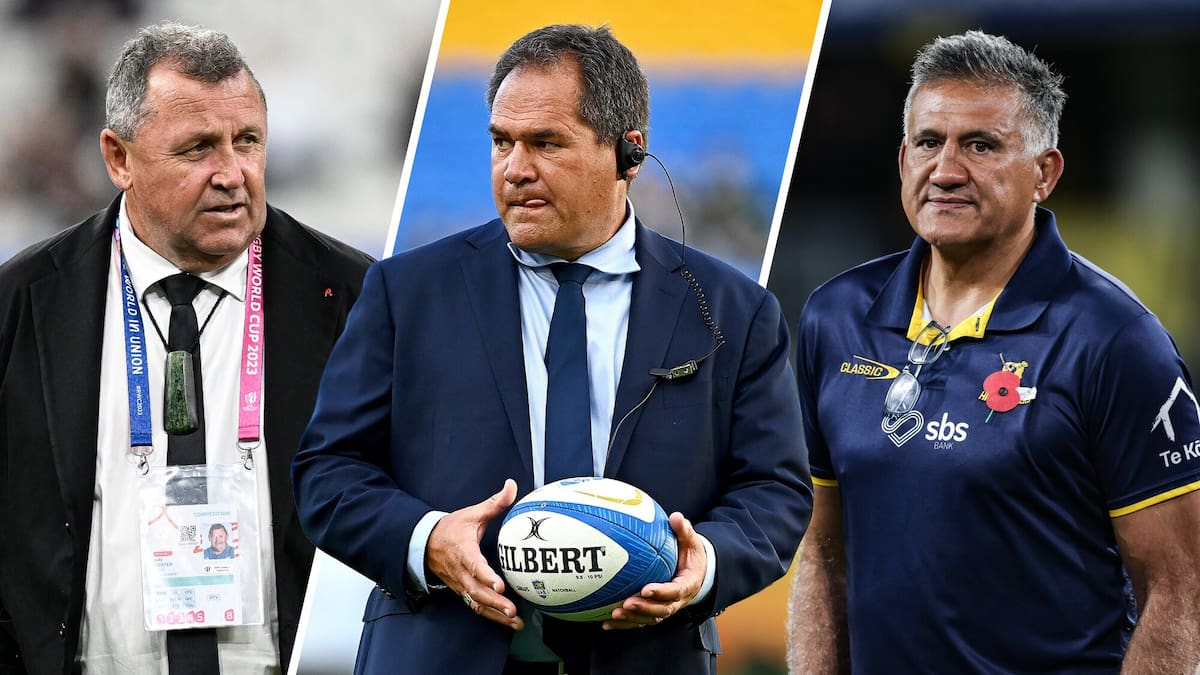
Cotter has confirmed that he will be leaving the Blues at the end of this Super Rugby Pacific campaign to join the Queensland Reds, and arguably, Gatland and Mitchell are non-starters despite meeting the tight criteria.
Gatland has minimal experience coaching in New Zealand and enjoyed even less success, and Mitchell, despite enjoying a good win record as All Blacks head coach between 2001-2003, also has limited experience of the New Zealand set-up and a few question marks over the way his time at both the Western Force and the Golden Lions ended.
Deans has enjoyed ample success in Japan since he shifted there in 2013 and is a smart and skilled operator, but he’s been stepping back from frontline commitments and seems unlikely to want a job that comes with relentless demands.
Dave Rennie is a contender for the All Blacks coaching role. Photo / Photosport
Realistically, the number of credible candidates with a desire to do the job is likely two – Joseph and Rennie – and therefore while it is an entirely valid process to determine which of them will be nominated head coach, it seems equally important to end the process with the unsuccessful candidate sold on the idea of still being involved and part of the coaching team.
The question would be not so much about compatibility of vision and philosophy, more what portfolio could the unsuccessful candidate fulfil, because assistant roles demand high-detail, specific knowledge.
Typically though, coaches such as Rennie and Joseph with high rugby intelligence and international experience can upskill quickly, and the prospect of having those two together is more enticing than having to pick between one or the other.
The past decade or so has shown that the greater the combined coaching intellectual property (IP), the better the results.
Jamie Joseph is a contender for the All Blacks coaching role. Photo / Photosport
It’s not seemingly possible for the All Blacks to have too much coaching experience in the mix and there is a hankering to return to the same sort of heavyweight triumvirate of old when Sir Graham Henry, Sir Wayne Smith and Sir Steve Hansen took the team to World Cup glory in 2011.
And so if Joseph and Rennie can work together, NZR would be mad not to encourage it and equally, if Foster was willing to join those two – or either Joseph or Rennie, if those two are not a compatible combination – then the All Blacks would carry a greater sense of possibilities.
Foster was never a firm fan favourite when he was head coach between 2019-2023, but he took the All Blacks to the 2023 World Cup final and conducted himself with such dignity and poise to have exited the role with universal respect.
He had initially planned to work with Joseph in the 2019-2023 cycle, but the latter pulled out when Japan offered the Highlanders man an improved financial offer to stay.
It’s not known whether the two would be willing to work together now in a reversal of roles where Joseph is the head coach and Foster an assistant, but the latter has little ego and a deep love of the All Blacks.
He was also the man who oversaw the All Blacks’ attack between 2012 and 2019 when he was an assistant to Hansen and is respected by the current senior playing cohort.
A Joseph-Rennie-Foster combination feels about as close as the All Blacks are going to get to emulating the Henry-Smith-Hansen alliance that worked so well. While NZR is following the right process by focusing exclusively on appointing a head coach first and not asking them to present with a predetermined wider team in place, it’s hard not to wonder whether it should just ask those three if they could work together and sort out between themselves who is doing what.
Gregor Paul is one of New Zealand’s most respected rugby writers and columnists. He has won multiple awards for journalism and written several books about sport.