
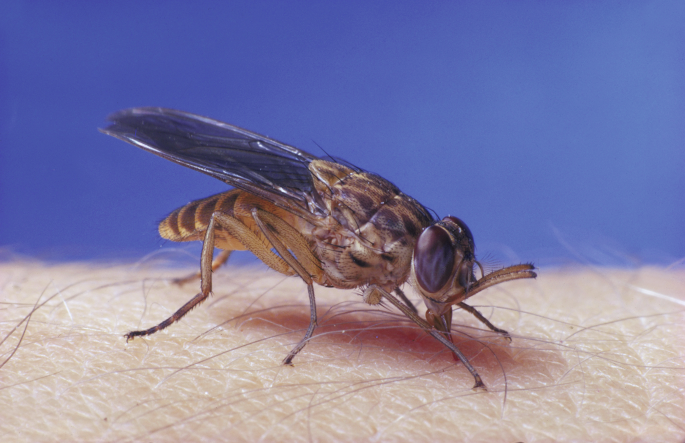
Tsetse flies (genus Glossina) are the sole biological vectors of African trypanosomes, a group of protozoan parasites that cause human African trypanosomiasis (also known as sleeping sickness), which is almost always fatal without treatment. The reproductive strategy of tsetse flies is characterized by lactation and birthing of live young (obligate viviparity); females produce only one larva every 9–10 days. Moreover, tsetse flies are obligate blood-feeders, with both males and females requiring blood meals every few days for survival, and they do not swarm. The very low reproductive rate and their solitary host-seeking behaviour have made it possible to conceptualize tsetse fly control as a feasible method to manage trypanosomiasis.
The study involved elaborate experiments to identify colour preferences, as well as the interaction between olfactory and visual factors, to improve the efficacy of trapping devices. The author conducted experiments with electric grids around traps and targets to estimate attraction and assess landing responses. Black and red traps were found to be attractive but inefficient, although these colours proved very successful when placed inside traps. By contrast, blue was both attractive and efficient. Landing responses were found to be strongest on black surfaces and weakest on white. Building on these findings, blue became the colour of choice for tsetse fly traps, with black colour used to encourage landing.