
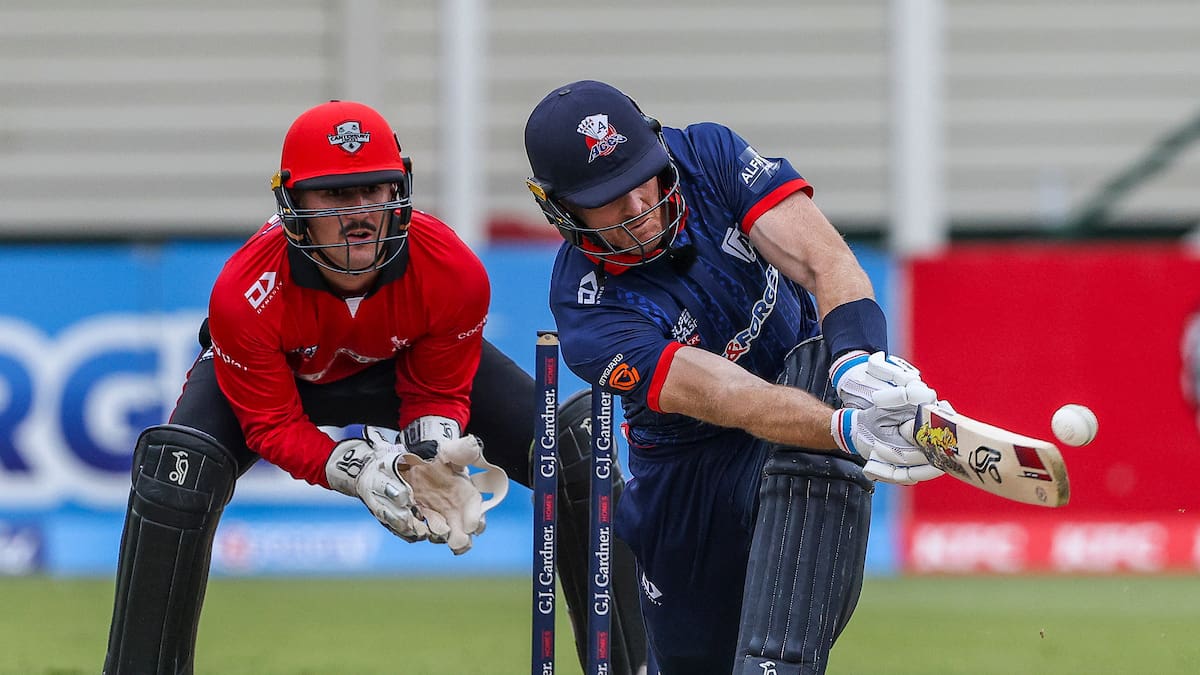
But that Thursday, as Auckland took on Northern Districts at Eden Park’s Outer Oval, the Aces named Martin Guptill (age 39) and Colin Munro (38) at No 3 and No 4 respectively.
In a league designed to give the next generation a chance to play professional cricket, Auckland naming a three-four punch with a combined age of 77 shows that the Super Smash is no longer doing its job.
Martin Guptill bats for Auckland against Canterbury in the Super Smash. Photo / Photosport
By no means is that a slight on either of those players. Guptill should go down as the greatest white ball player to represent the Black Caps, while no New Zealander has amassed more runs in the shortest format than Munro.
Both have earned the right to turn out for their home team at the peak of the Kiwi summer, especially with no international cricket being played.
That’s not the point, though. The point is that Auckland – the country’s biggest region – did not have any other options than to go back to two players clearly finished at international level, when the likes of Bevon Jacobs and Lachie Stackpole, among others, have shown that the next generation is ready to step up.
For years, NZC’s reasoning for having a development league was sound. The game in Aotearoa couldn’t support a franchise-based model, even if it wanted to.
That, though, has now seen New Zealand fall behind, in more than one form of the game.
Throughout the Black Caps’ golden generation of the 2010s and 2020s, players performing on debut was a regular occurrence.
Kane Williamson, Jimmy Neesham, Tom Blundell, Devon Conway all scored centuries on test debut. Tim Southee, Ajaz Patel and Colin de Grandhomme all took five-wicket hauls.
That showed two things: First, the culture of the team was good enough for players to be comfortable to perform right away, and second, that they were stepping up from domestic cricket ready to perform.
In more recent times, when you take into account Zak Foulkes and Will O’Rourke both took five-fors against Zimbabwe and a weakened South Africa respectively, Conway was the last player to succeed on debut, approaching five years ago.
Since then, any real opportunities for Black Caps to learn from their peers has been restricted to players plying their trade in other leagues around the world.
As a result, this season of the Super Smash has been played with Williamson, Conway, Trent Boult and Adam Milne in South Africa’s SA20, Finn Allen and Tim Seifert in Australia’s Big Bash League, Lockie Ferguson in the UAE’s ILT20, and Jimmy Neesham in the Bangladesh Premier League.
Finn Allen celebrates his century for the Perth Scorchers against the Melbourne Renegades. Photo / Photosport
Speaking before he won the Big Bash, Allen even said that his time in Australia wasn’t about money, it was about getting better as a cricketer. And after a season that saw him hit the most runs, and a record number of sixes, you’d say Allen has gotten his wish.
The biggest indicator of how far the Super Smash has fallen, is the fact that as things stand, this year could well be its last.
While Sky have paid to acquire the rights to cricket from TVNZ for the 2026 summer onwards, the Super Smash is not part of the deal. What’s more, as of yet, no other broadcaster has come in for them.
If the game is to maintain any kind of professionalism in T20, no broadcast deal should have alarm bells ringing at NZC.
At the time of writing, consultants from Deloitte are working to ascertain the best way forward for the T20 game. The NZ20, backed by players, as well as New Zealand entries into the Big Bash are both on the table, as is making no change whatsoever.
One thing is clear, though, it cannot – and will not – continue like this for much longer.
Alex Powell is a sports journalist for the NZ Herald. He has been a sports journalist since 2016.