
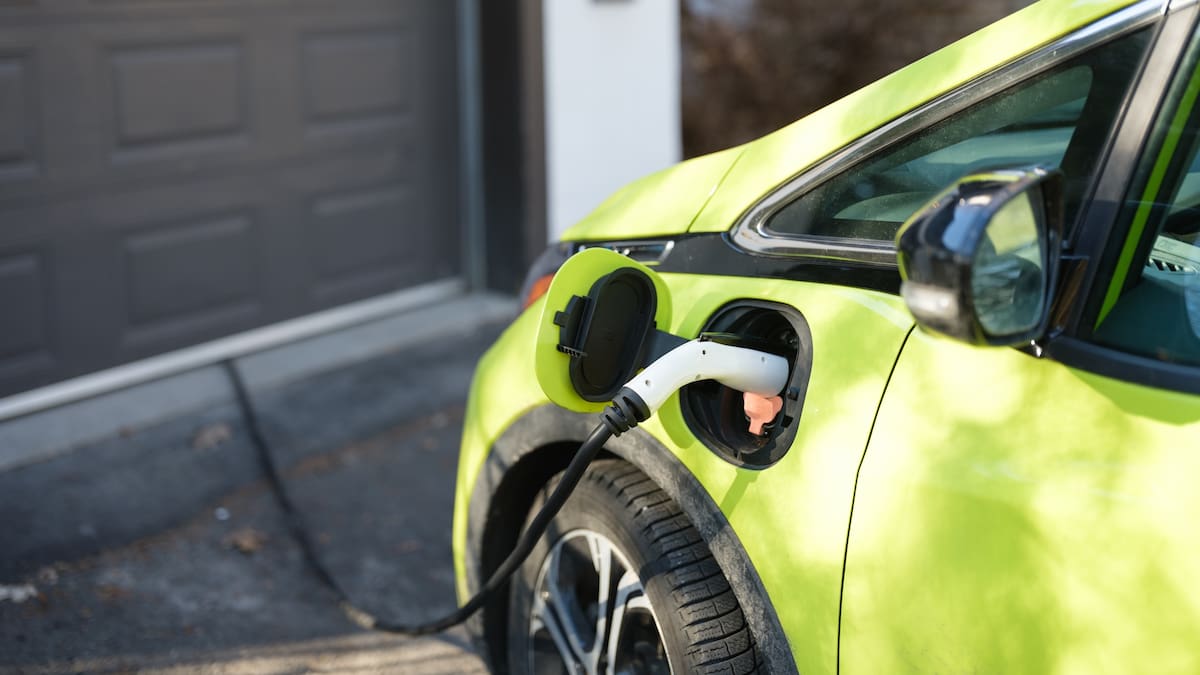
“Cars store a lot of energy. When that’s in a petrol tank, it’s not good for much else than driving.
“With electric cars, you’re now getting a battery that can be used to power your home or your business. A new electric car has about three or four days of household energy in its battery,” Queenstown Electrification Accelerator co-lead Josh Ellison said.
“With electric cars, you’re now getting a battery that can be used to power your home or your business. A new electric car has about three or four days of household energy in its battery.”
That’s about five times the capacity of the type of household battery often installed with a solar and battery set-up, Ellison said.
The trial is being funded by Crown agency the Energy Efficiency and Conservation Authority (EECA), with participation from local lines company Aurora and others.
Those others include various local electricians who will help out with the installation of the special “bidirectional” (two-way) chargers that will enable V2G for volunteer households , converting the direct current stored in an EV’s batteries to alternating current (AC) that can run a home’s appliances.
EECA V2G lead Murray Bell sees key benefits, including the ability to keep cooking and using your household appliances if wild weather brings the lines down in your area.
But easing pressure on the grid at peak times is a central focus as his agency looks for ways to shave billions from New Zealand’s future infrastructure spend. He sees it as part of the puzzle.
Ellison says for Queenstown, the disaster relief element has increased in significance.
“Queenstown has about a 75% chance of a high-magnitude earthquake in the next 50 years – and we only have one power line coming into the region, which could easily go down for weeks or even months,” he said.
“The region is not prepared for this. Local solar combined with vehicle-to-grid and other batteries could provide the secure energy supply to keep people’s lights on and homes warm.
“While diesel to run generators might need the roads and bridges to be open and likely will only go to a fraction of critical buildings, solar and batteries can save buildings money every day, and then in a disaster refill from the sun rather than a diesel delivery.”
Today, about 3% of New Zealand’s fleet is electric, with around 92,000 battery electric vehicles and 42,000 plug-in hybrid electric vehicles or “PHEVs” on our streets (various models of PHEV, including the Mitsubishi Outlander and Eclipse, support V2G).
Sales stalled after the Clean Car Rebate was wiped at the end of 2023 and road user charges for EVs were introduced in early 2024 – but have been reanimated over the past few months by keenly-priced new Chinese models.
Source / Queenstown Electrification Accelerator
In December, there were 9304 new vehicle registrations, with 633 (6.8% of the market) battery electric vehicles and 649 (7.0%) PHEVs.
Looking forward to a future where adoption is closer to 50%, Ellison says: “If just half of New Zealand’s light vehicles were electric and plugged into V2G, they would be able to push out the equivalent power of all of our nation’s power stations combined.
“This has the potential to lower and stabilise power prices, and provide more energy security to the country.”
Tesla’s Powershare Home Back-up vehicle-to-grid system is so far only available for its Cybertruck – which is so far only available for left-hand drive markets. Photo / Tesla
At this stage, “potential” is the operative word. Power stations have continuous output, while a “virtual power station” of EVs parked in various driveways around the country would be variable and require a lot of management.
It’s still to be determined how EV owners will behave and what tech complications could emerge. Ellison says those are exactly the type of things that the Queenstown trial, and similar efforts overseas, are looking to shake out with this very new technology.
Educating households and the market, and nudging things along, are also key aims. He wants V2G capability to be a key feature that people look for when they go window-shopping for an EV.
The fish hooks
Ellison says regulatory hurdles have been eliminated.
He says EV warranties are perhaps the biggest remaining barrier – and certainly it emerged as such during an Australian trial that started a few months ago, as it became clear that using an EV’s battery for vehicle-to-grid voided its warranty – across nearly all makes and models.
That’s a big issue, given the rule of thumb that batteries account for around a third of the cost of an EV.
Vehicle-to-load (V2L, or using an EV to charge an appliance) and vehicle-to-vehicle (V2V or using one EV to partially-charge another) are increasingly common features today.
Ellison says many can also be used for V2G, but are not optimised for the feature – making it outside their standard use and thus outside the warranty.
Here, BYD owners have been among early sign-ups for the Queenstown trial (BYD being the rising Chinese giant that recently eclipsed Tesla as the world’s largest maker of EVs).
BYD New Zealand general manager Warren Willmot says his firm has so far secured five special warranty exemptions for the Queenstown trial.
He’s angling for up to 20. A Zeekr (one of the raft of new Chinese EV brands in the Giltrap stable) is also among the early sign-ups, also with a warranty exemption.
Across the Tasman, Hyundai and Kia owners also got warranty exemptions.
Willmot says BYD will include V2G as a standard, warranty-covered feature across all models by 2027.
Tesla did not respond to a request for comment. Its website says only one model supports its native bidirectional, vehicle-to-grid technology, branded Powershare Home Back-up: the Cybertruck, which allows its owner to draw 11.5kW (kilowatts) to power a home for up to three days.
An 11kW bidirectional charger provides about 70km of range per hour, meaning if you’ve got an average commute, the rest of the night could be used for storing charge that could be used to power your home in the evening.
Another major EV owner concern that emerged from Australia’s trial was that batteries could be degraded.
The EECA’s Bell said: “While any impact on battery life is something we want to look at, indications from other research are that the battery life for modern EVs should not be significantly impacted.”
“We will be carefully selecting participants who understand that this is a research trial and working with them to make sure there is a detailed design for each participant – including well-matched chargers and cars to ensure they get the best outcome.
“The findings of this trial will inform broader rollout. There could also be significant benefits for vehicle owners in terms of their energy use.”
Money out
The EECA has bought four bidirectional chargers for the Queenstown trial so far, all from global player StarCharge (local EV maker Evnex does not have a bidirectional model in its line-up at this point, but is working on the technology).
Bell says multiple makes and models will be purchased for the trial (there is no hardware or installation cost for trialists, but they still have to foot their power bill as usual).
The agency hasn’t given a per-unit cost, but bidirectional chargers run from around $8000 to $15,000, minus install costs (for comparison, Evnex’s entry-level smart chargers, for taking advantage of off-peak rates, start at $799).
Some countries, notably the UK, offer subsidies for smart chargers at home. Here, the Government has put $68.5 million on the table for chargers – but it is all earmarked for a drive to increase public chargers to 10,000 by 2030.
Money in
Presuming you have to lump the cost of a bidirectional charger, how soon could you earn it back?
The amount you can earn selling power back to the grid runs from 8c per kilowatt hour to as much as 60c, depending on factors including the power plan and wholesale pricing that shifts with the weather.
A September 2025 vehicle-to-grid report by Concept Consulting, and funded by EECA, using a conservative 7.4kW output from an EV and similated, averaged wholesale pricing, said: “For light vehicles, we estimate an economic value from V2G (that is, injecting power to either premises or grid) of up to $2000 per car per year … a meaningful amount for a household energy budget.”
It qualified that: “This value is dynamic and will change over time – most notably if stationary batteries at premises, or distributed through electricity networks, step into the same role.”
That means households and businesses with rooftop solar storing surplus power in batteries then selling it back to the grid, and power companies stockpiling power in giant battery packs during good times, to deploy it during crunch times.
Growth in either could suppress buyback rates.
Do it for your country
Concept notes project that New Zealand’s power demand will increase 60% by 2050 (ironically with electrification of New Zealand’s vehicle fleet as the largest single contributor, with the qualifier that around $3.9 billion would be saved per year if petrol imports are all but eliminated).
It says peak demand could increase by as much as 75% in its base scenario, “which assumes limited smart charging and V2G. But with greater deployment of smart charging and V2G, peak demand only grows by 40%”.
It added: “At a high-level, we estimate a difference in electricity supply cost in 2050 between these two scenarios as $310m per year, comprising $40m per year from lower generation costs and $270m per year from lower network costs.”
If you’re up for being a guinea pig in the very early stages of that journey, the EECA is looking for 30 to 40 households to volunteer for its Queenstown trial. You can sign up at https://qea.nz/v2g.
Chris Keall is an Auckland-based member of the Herald’s business team. He joined the Herald in 2018 and is the technology editor and a senior business writer.