
Astronomers using the Event Horizon Telescope — a planet-scale array of eight ground-based radio telescopes — have identified the likely starting point of a massive cosmic jet in the heart of Messier 87.
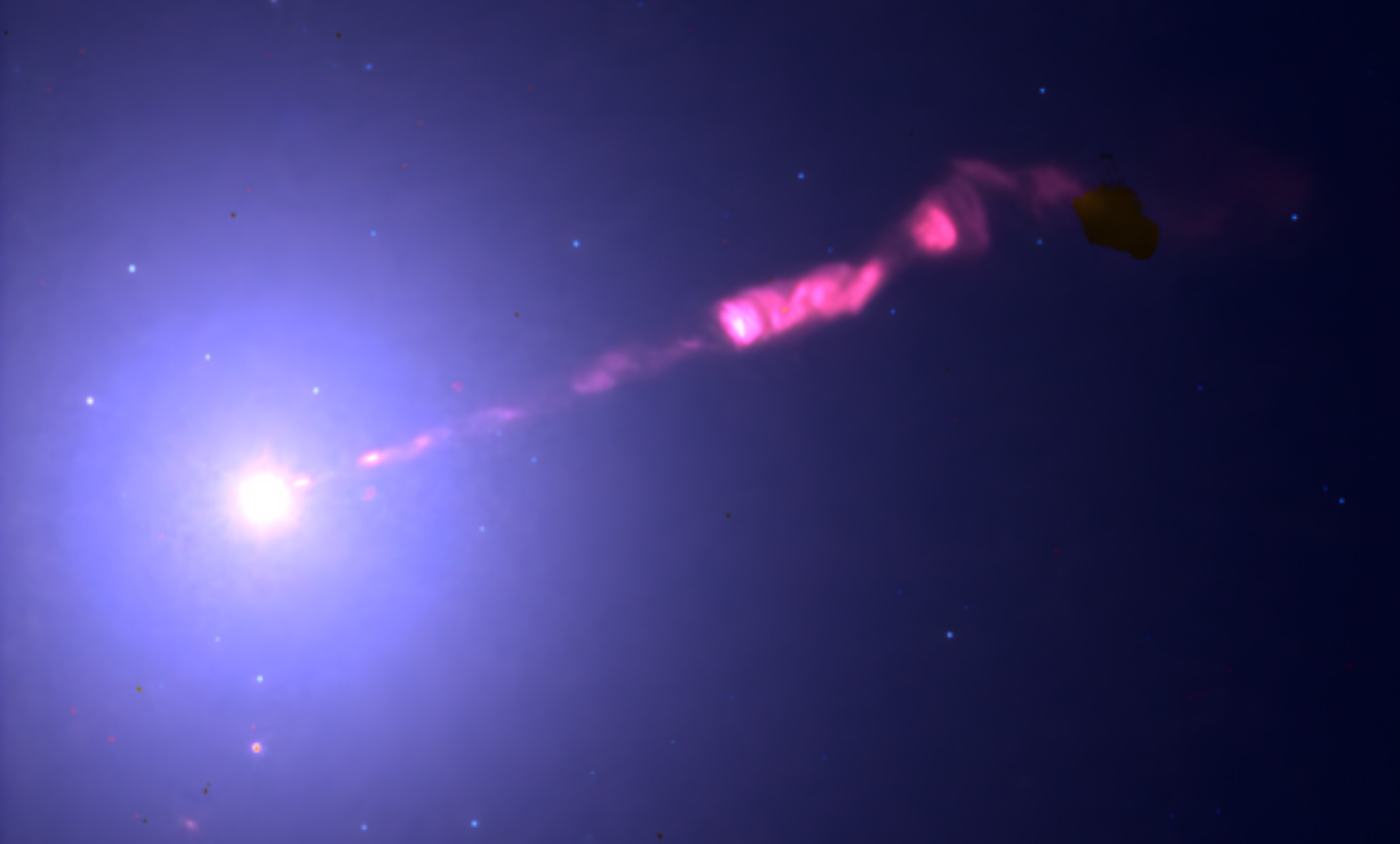
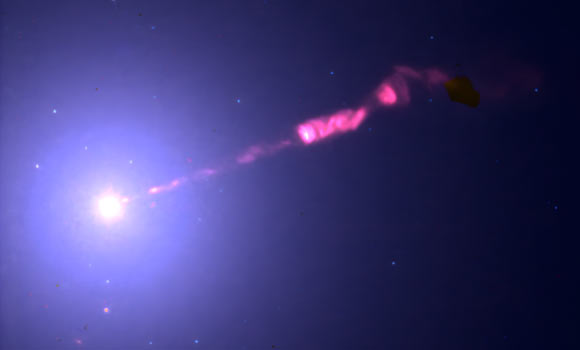
This Webb/NIRCam image shows a cosmic jet in Messier 87. Image credit: Jan Röder / Maciek Wielgus / Joseph B. Jensen / Gagandeep S. Anand / R. Brent Tully.
Messier 87 is a giant elliptical galaxy located some 53 million light-years away in the constellation of Virgo.
Also known as M87, Virgo A or NGC 4486, it hosts a supermassive black hole with a mass roughly six billion times that of our Sun.
This black hole powers a bright, narrow jet of particles that blasts out of the galaxy’s core and stretches for about 3,000 light-years into space.
To study regions this small so far away, astronomers link radio telescopes around the globe into a virtual Earth-sized telescope known as the Event Horizon Telescope (EHT).
Using the EHT observations of M87 from 2021, they compared how bright the radio emission appears on different spatial scales.
They found that the glowing ring around the black hole cannot by itself explain all of its radio light, and an additional compact source, about 0.09 light-years from the black hole, matches the expected location of the jet’s base.
“By identifying where the jet originates and how it connects to the black hole’s shadow, we are adding key pieces to the puzzle,” said Saurabh, a Ph.D. student at the Max Planck Institute for Radio Astronomy and a member of the EHT Collaboration.
“Newly observed data — now being processed with support from our international partners — will soon include even more telescopes and thus intermediate baselines,” said Dr. Sebastiano von Fellenberg, an astronomer at the Canadian Institute for Theoretical Astrophysics.
“This will bring an even sharper view of the jet launching region within reach.”
“We aren’t just calculating where these structures are anymore; we are moving toward being able to image them directly.”
“The jets are theorized to be launched tapping the rotational energy of the black hole through electromagnetism, such that they are a laboratory where general relativity and quantum electrodynamics act together,” said Professor Bart Ripperda, also from the Canadian Institute for Theoretical Astrophysics.
“Seeing how jets are launched so close to the event horizon of the black hole is a major step in the understanding of black holes!”
“Observational data allows scientists to test their theories on how gravity and magnetism interact in the most extreme environments in the Universe, bringing us one step closer to understanding the ‘engines’ that shape entire galaxies.”
The results were published on January 28, 2026 in the journal Astronomy & Astrophysics.
_____
Saurabh et al. 2026. Probing jet base emission of M87* with the 2021 Event Horizon Telescope observations. A&A 706, A27; doi: 10.1051/0004-6361/202557022