

When Ireland rose to the giddy status of the number one-ranked team in the world between July 2022 and October 2023, the golden harp of Leinster effortlessly translated into the green shamrock of Ireland. The East coast province has dominated the composition of the national team for so long that even the memory of Champions Cup-winning Munster side of 2006 and 2008 has been dumped upstairs, in the cobwebbed attic of the past.
Andy Farrell will be back after his Lions sojourn, but otherwise it will be a case of ‘as you were’ with as many as 10 Leinster players starting the Six Nations opener in Paris on Thursday evening, and three more doing bench duty.
Tadhg Furlong’s recovery seems to have come too late in the day to count in round one, but another Leinsterman from the younger generation will still be ready to step up and start in his place. Ireland’s top three choices on the other side of the front row – Andrew Porter, Paddy McCarthy and Jack Boyle – all play for the Dublin province, and now Ireland will have to dig deep, all the way back to their Munster muscle-memory for the fourth and fifth options.
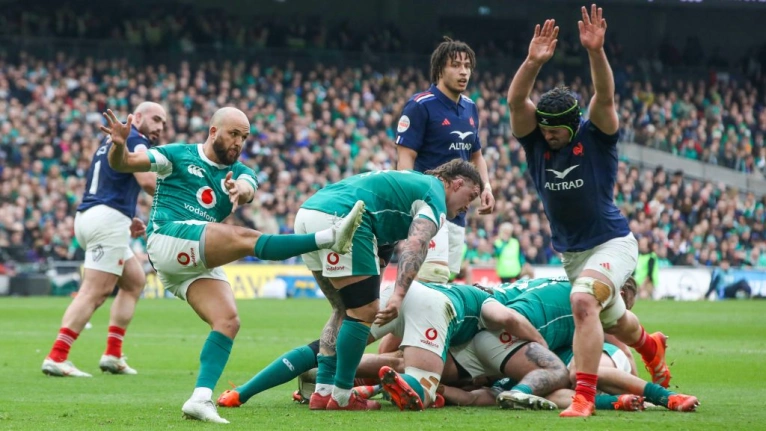 Ireland were dismantled by France in last year’s Dublin match (Photo by PAUL FAITH/AFP via Getty Images)
Is the translation from provincial to national representation, from Leinster to Ireland still as seamless as it was two or three seasons ago? Ex-Ulster and Ireland hooker Rory Best thought not on a recent Ireland Rugby Social podcast.
“Leinster in the last number of years up until this year have played very similarly to how Ireland have played, hence why [ex-Leinster assistant] Andrew Goodman came in to be the Ireland attack coach,” he said.
“You’re lifting these players from one team into the other with the same system. Leinster this season more than last are playing differently, they’re kicking the ball a lot more. Even against Ulster at the Aviva [Stadium], you never would have seen Leinster get into the opposition 22 and put the ball up. Andy is definitely not going to do that.
“They will kick the ball a lot, because away from home, you need to. When you get in the pressure of the Stade de France, you will go into the automatic response which is what you’ve been trained every day at your club.
“The fact they’re so separate, it will take them a bit of time to get them back into that groove of slightly different running lines, staying slightly tucked and when to come on to the ball. How quickly they can use their time in Portugal, with it being France in Paris, just makes it so difficult.”
While the kicking claim is hard to support with stats – Leinster average 25 kicks per game up until round 11 of the URC season, while Ireland have averaged 30 over the past three Six Nations tournaments – Best’s comments do raise an intriguing ghost in the selection machine.
Under the stewardship of South African World Cup-winning coach Jacques Nienaber, Leinster have diverged increasingly from the attacking formula which made the province [and Ireland] so successful up until the last global tournament in 2023. Heresy of heresies, Leinster now scrum for penalties: a +9 differential at the last count, shaded for success only by three South African connoisseurs of the dark arts at the set-piece, the Stormers, the Bulls and the Sharks.
Current Leinster set exactly the same number of rucks per game as 2025 Six Nations Ireland at 90 per game, but that is well short of the numbers posted by the men in green in their last two Grand Slam and championship-winning years.
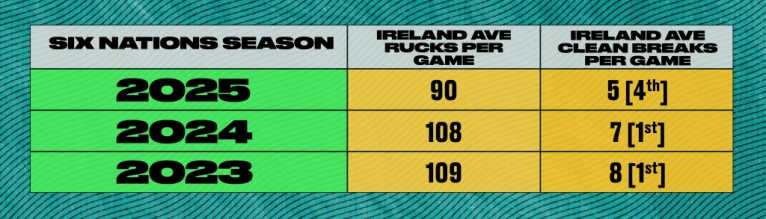
As prime Ireland built more rucks, so they built rhythm into their game and created more clear line-breaking opportunities. Those stats appear even more significant when juxtaposed with a comparison of their fourth quarters versus France over the last three years.
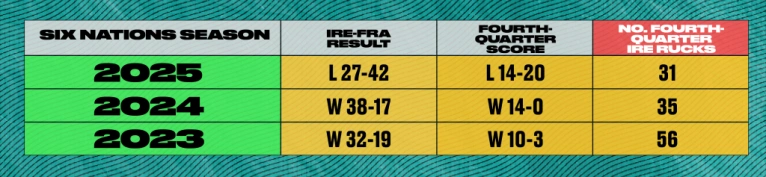
Those 56 rucks set in the fourth quarter of the 2023 match represent the bulk of the breakdowns most teams will look to build in an entire game, but Ireland achieved the same degree of ball-control in only 20 minutes. France shifted from a 6/2 bench split in 2023 and 2024 to a 7/1 in 2025, while Ireland moved from 5/3 in 2023 to 6/2 for the following two encounters.
One of Farrell’s most urgent priorities in Paris will be to regain the initiative in the final 20 minutes of the game. The ball-control which comes from quick, consistent ruck-building may still be his best option to achieve that aim.
Farrell will also need to find a way to expand his team’s scoring options with ball in hand. While France’s ability to counter-attack off kicks and turnovers has remained constant at around 40% of all their tries scored for the past three seasons, Ireland’s sense of purpose in that area has evaporated.
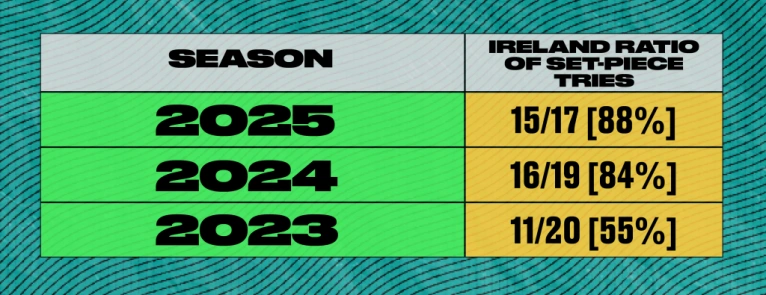
Back in 2023 Ireland were a side who could score from a wider variety of scenarios, but over the [ast two seasons their capacity to score tries from any situation bar a set-piece has melted away, almost to nothing. Two Ulstermen in the shape of Stuart McCloskey and Jacob Stockdale may be just the medicine the doctor ordered. Both are very big backs who offload naturally in the tackle, and so is their team-mate Jude Postlethwaite, who was been added to the squad in place of Bundee Aki. Between them, that trio has made 19 offloads in URC 2025-26 play to date.
With Farrell back at the helm and Simon Easterby restored to defensive specialist rather than coaching multi-tasker, there is every hope the defensive stats which doubled in the former’s absence – from 60 points and seven tries conceded in 2024 to 117 points and 14 tries one year later – will return to a more stingy ‘normal’.
Farrell will also be encouraged by the selection of a French matchday 23 more likely to feature a 6/2 bench split than a 7/1. Ireland’s 6/2 may be able to outlast France’s version of the same bench.
Wind the clock back to the same game in 2024, and Ireland were able to score two tries directly from five-metre lineout drives in the final quarter to put Les Bleus to the sword. That weakness in lineout defence may still be there.
— William Bishop (@RPvids1994) February 3, 2026
— William Bishop (@RPvids1994) February 3, 2026
The men in green need that kind of ball-control inside the French 22 to succeed again. Ultimately, they will have to reach back even further in time to find their boldness in a broken field. Ireland will come away empty-handed from the game if they are not bold enough to take their chances whenever the ball changes hands, however and wherever on the pitch they arise.
At the very end of the November tour window, the Wallabies kept pace with Les Bleus on the scoreboard by milking the most out of every kick or turnover return, or tapped penalty going.
— William Bishop (@RPvids1994) February 3, 2026
— William Bishop (@RPvids1994) February 3, 2026
— William Bishop (@RPvids1994) February 3, 2026
Right now, Wallaby prop Angus Bell must be one of the best finishers in world rugby! The only pity is the Ulster loose-head will not be available for the country in which he plies his trade on Thursday evening.
Someone give Angus Bell a No.14 shirt ⚡️
📺 Watch all the action LIVE on Premier Sports 🏉#BKTURC #URC | #ULSvCAR pic.twitter.com/FMIlATvA8a
— BKT United Rugby Championship (URC) (@URCOfficial) January 31, 2026
Bell or no Bell, Ireland will still be smarting from an end-of-year international campaign where the train came so spectacularly off the rails against the Springboks. They will be itching to set the record straight, and there is no better place to do that than Paris – if not in the early springtime, then in the last embers of winter.
France are currently running hot, 7-to-1 on favourites. You might get better odds for finding a four-leaf clover in the garden. Nonetheless, there are solid grounds for believing Ireland can turn the tables on the casino, even allowing for the decimation of their Leinster cohorts on the left side of the front row.
If they can match benches, 6/2 for 6/2, find their old ruck-building, lineout-driving identity in the final quarter of the game, and make the most of every turnover of possession, they have a chance to win. That clover on the badge may yet grow an extra leaf.