
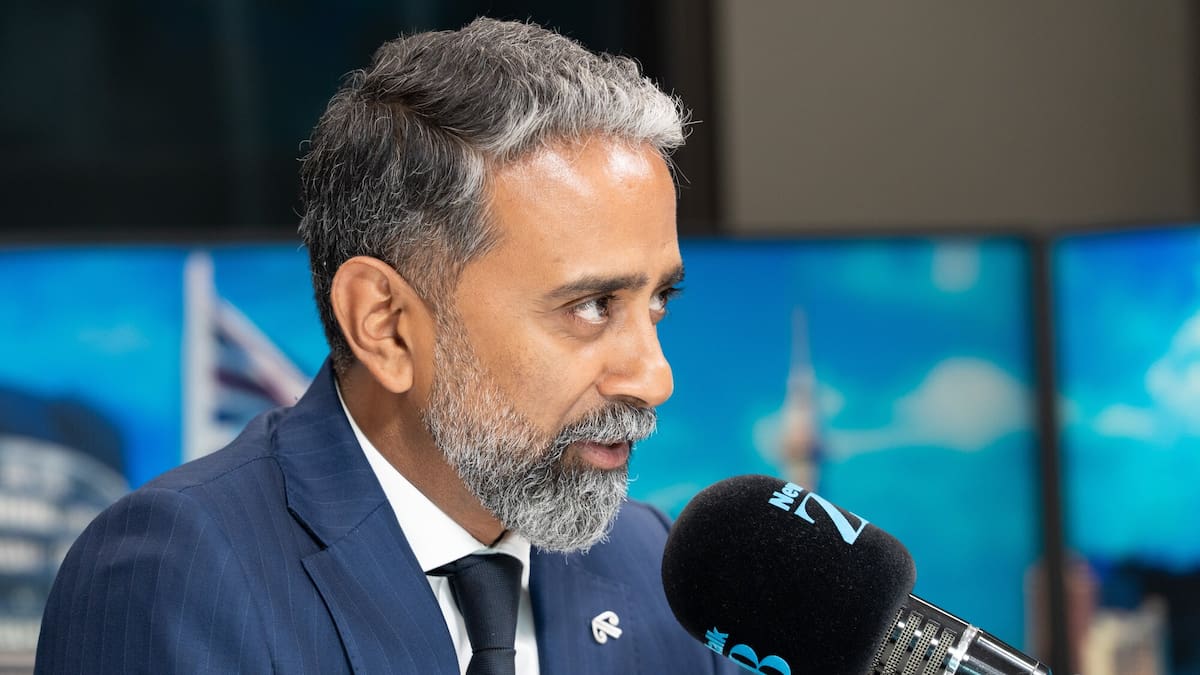
“We’re pretty clear that we’re very supportive of the strategy work that they’re doing. It’s the right thing to do, having a really good look at their internal costs.”
Chief executive Nikhil Ravishankar told the Herald the airline was planning for multiple scenarios and could not rule out layoffs during its comprehensive “reset”.
“We understand they’re looking at the whole business and that is a big exercise,” Moore said.
Airports and the airline are often at loggerheads over landing fees but Moore said Air New Zealand was crucial for airports.
“Our interests are in them succeeding.”
She suggested the airline’s 51-49 ownership structure effectively gave it a dual mandate.
“Air New Zealand has to balance the needs of a commercial entity and it also has the public good role.
“Obviously, they’re a listed company, so they have all the disciplines of a listed company,” Moore said.
And she said the Government’s role as the major shareholder gave it a role in setting expectations.
She said the Government likely considered Air NZ had to function as a listed company and needed some time to work through its reset.
“The challenge is, the only way forward for them is growth.”
Moore said Qantas’ first-half result yesterday showed growth across virtually all parts of its business.
Qantas said it would be getting one new aircraft about every three weeks on average this financial year.
Meanwhile, Air NZ later this year will get two new GE-powered Boeing 787s.
In its latest result, Air NZ said its fleet capacity increased only 0.3% in a year because of aircraft availability issues affecting Airbus A321/A320neos and Boeing 787s.
It also cited sluggish domestic demand, rising aviation system costs and a weaker New Zealand dollar for its poor performance.
Air New Zealand’s share price yesterday fell 1.74% or 1c to 56c.
And the company’s result quickly became a political issue.
Act leader David Seymour blasted the airline’s culture and called for its complete privatisation. Photo / Mark Mitchell
Deputy Prime Minister David Seymour called for the Government to sell its 51% share.
But coalition partner National has ruled that out, and the third member of the coalition, New Zealand First, rubbished the idea.
Seymour also criticised “crazy” airfares, saying it was pointless having taxpayer money tied up with Air NZ if it was not providing an affordable service.
He slammed the airline’s culture as “woke” and, according to RNZ, he added: “What they can’t seem to do is take off and land on time.”
Aviation analytics data company Cirium said Air NZ was on time more often than any other Asia-Pacific airline last year except for Philippine Airlines.
Cirium Asia editor Ellis Taylor said Air NZ had delivered a significant improvement despite grappling with fleet and engine maintenance issues.
Ministry of Transport (MoT) data for December 2025 showed the airline’s domestic on-time performance was 78.6% for departures and 80.5% for arrivals.
The MoT said an updated Air New Zealand schedule supported improved reliability across the network during a high-demand period.
The ministry said for domestic jet routes, Air NZ had 81% on-time departures compared to Jetstar at 68% that month.
Air NZ had 81.9% on-time domestic jet arrivals, compared to 69.5% for Jetstar in December.
Air New Zealand’s cancellation rate was 1.3% and Jetstar’s 1.9% for domestic jet routes.
Even so, it was far from turning a profit.
Moore told the Herald the MoT data added a layer of transparency which was good for the country and probably drove improvements in airline punctuality.
She said it would be good to see the same kind of transparency around airfares.
John Weekes is a business journalist covering aviation and court. He has previously covered consumer affairs, crime, politics and courts.
Stay ahead with the latest market moves, corporate updates, and economic insights by subscribing to our Business newsletter – your essential weekly round-up of all the business news you need.