
Unlock the Editor’s Digest for free
Roula Khalaf, Editor of the FT, selects her favourite stories in this weekly newsletter.
In 2025, the artist Nieves González, recently commissioned to paint the portrait of Lily Allen for her West End Girl album cover, also produced the painting La Santa y el cisne. Featuring a near-expressionless female figure in a puffer coat with a perfect white swan sitting in her lap, it makes you do a double take.
 The swan, no 1, 1915, by Hilma af Klint © Stiftelsen Hilma af Klints Verk. Photograph, Albin Dahlström/Moderna Museet
“I am particularly interested in the duality of the swan,” says González. “It is an animal associated with beauty, purity and elegance – but at the same time it carries something unsettling, even aggressive, that disrupts that idealised image.”
A black swan still lives somewhere inside me
Artist Mamma Andersson
Swans, associated with Aphrodite, Venus and Apollo, have long been a source of mythic fascination; during the Greek Archaic period they were considered a symbol of good health, music, divination and grace. They have inspired artists for millennia, from the Greek myth of Leda and the swan and its depictions by Leonardo, Cézanne or Boucher, to Hilma af Klint, whose portrayals, from figurative to abstract, will feature in an exhibition opening at the Grand Palais in Paris this spring (6 May until 30 August). Shannon Cartier Lucy’s 2019 oil Girl with Swans features a woman carrying a plastic bag of swans, which she likes painting for their “loaded symbolism”. Her solo show Bucket of Birds will open in April at Night Gallery in LA.
 Leda and the Swan, c1530, by Michelangelo © Bridgeman Images
 Swans and pots (four), 2024, by Rosalind Nashashibi © Jonathan de Waart/Courtesy of the artist and GRIMM
“The beauty of the swan is widely acknowledged,” says designer Sabina Savage, who has used the motif in her latest scarf collection Fairytale di Firenze. “But my real fascination with them comes from the darker side of their nature. Just as their pearlescent white feathers gleam above the water, the swelling depths conceal black, gnarled legs and cumbrous feet.” For British-Palestinian artist Rosalind Nashashibi, meanwhile, the birds in her paintings teeter between “peaceful and warlike, beautiful and kitsch”. She likes to use them as signifiers for her complex political feelings.
 Girl with Swans, 2019, by Shannon Cartier Lucy © Shannon Cartier Lucy
Swans have long featured in luxury and high culture. Until the 18th century they were a gourmet delicacy: it’s reported that in 1247, King Henry III ordered 40 swans for Christmas dinner. Swan decorations adorned Marie Antoinette’s bathroom at Versailles, and the queen favoured accessories featuring swan feathers (you can see further examples in Marie Antoinette Style at the V&A, until 22 March). Fashion still loves swans. At his debut womenswear collection for Dior, Jonathan Anderson presented a skirt of swan-like plumes; the skirt was later worn by the actor Natalie Portman to a special screening of Darren Aronofsky’s film Black Swan in 2025. When Meryll Rogge, the new creative director at Marni, co-launched her BB Wallace knitwear brand last year, she chose the swan as one of its key emblems.
 Swans, 1996, by Mats Gustafson © Mats Gustafson
Fashion illustrator and artist Mats Gustafson began making pastel drawings of swans in the early ’90s. His images have featured in various exhibitions, including a 2023 show at Stockholm’s Millesgården museum where 10 swans appeared on an elegant room screen – a piece of furniture that now resides in Toteme’s Swedish flagship store. Later this year, Gustafson will present his latest versions in a solo exhibition at MA2 gallery in Tokyo. He traces his interest in the birds back to a winter in Stockholm, walking along the water by the Royal Palace.
“There is so much mythology around them,” he says. “When I did the first swans there was maybe a touch of irony that I used something so overly considered as beautiful – but I am drawn to their graphic beauty.”
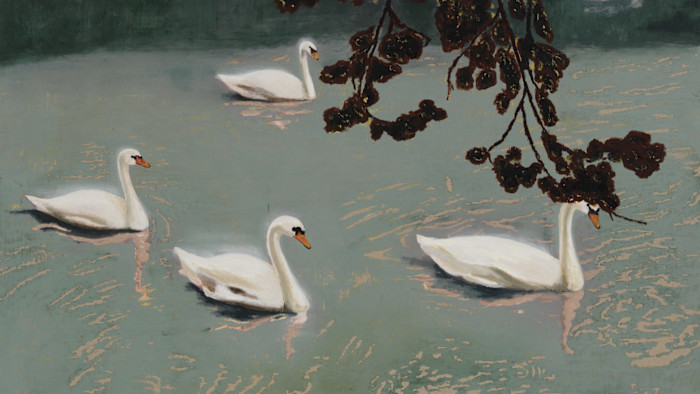
 Swan Pond, 2016, by Mamma Andersson © Per-Erik Adamsson/Courtesy of Galleri Magnus Karlsson
Recommended

“The swan is bound to the idea of love,” says the artist Mamma Andersson. “The romantic, infatuated kind, where two swans glide so closely together that their necks form a heart, and the love that has been lost, where an abandoned swan moves through the water alone.” For a long time, she avoided swans because “certain symbols are so saturated with cliché that one instinctively resists them”. Then, in 2016, alongside artist Tal R, she created an exhibition titled Svanesang (Swan Song), which featured the likes of Svanedamm (Swan Pond) with five birds gliding on water together. She returned to the subject with Swannery in 2019; she will be showing works at David Zwirner in Paris from 23 April. “A black swan still lives somewhere inside me,” she says. “Sooner or later it will find its way into a painting. They say a black swan can change everything.”