
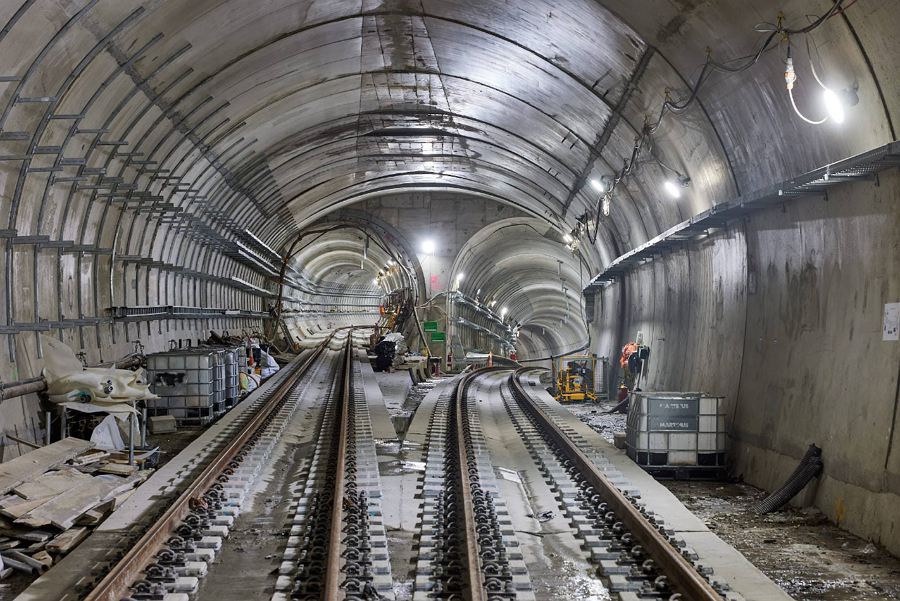
The City Rail Link (CRL) is routinely described as transformational. An overused term for infrastructure projects, but one that is surely appropriate in this case – as you’d hope, given the size of the investment. $5.5b ought to get us something truly new, not just another lane and more traffic.
Clearly, the CRL itself – the physical infrastructure – is revolutionary for our country, as our first piece of permanent high-capacity underground urban transit kit.
But significant as this is, to truly achieve a transformational outcome, we can’t just build the infrastructure – we also have to operate it in the best possible way.
So this post is not about the tunnels and stations of the CRL, but about the services that will be (or could be) using them. My question: are we planning services to ensure this great investment is as transformational as it should be?
Infrastructure is a means to an end
Let’s be clear what transformational means – it means this changes everything. Something “transformational” goes beyond mere improvement; it is shape-changing.
Transformational projects are discontinuous with the past. They are not just extensions of what exists already, but a whole new thing.
Until now, the clearest example of a transformational transport project in NZ is the Auckland Harbour Bridge. The bridge significantly shifted our city from its more compact isthmus-bound shape, into a much more spatially expansive, auto-dependent suburbs-dominant pattern.
This outcome was consistent with the times, the post-war sprawl era, it was the most dramatic part of a multi-directional low density car-focused horizontal spread in all directions out from the city, following the ripping up of the tram system.
The image below illustrates this brilliantly: the road-vehicle only bridge essentially invaded the rural but proximate Shore and colonised it with the private vehicle-oriented land development we’re so familiar with today.
The harbour bridge under construction, about the fish the Shore, Maui-like out of the sea, into late 20thC auto-dependent suburbia.
The CRL is set to achieve a similarly dramatic shape-change, an introversion of (and complement to) the auto-dependent spread of the previous age, redirecting growth in and up.
But to achieve this, it needs to be so useful that it radically improves non-car access across the city. And it will do this by being as metro-like as possible.
At a system level, this transformation is about a phase-change from commuter rail to a metro. At the outcomes level, it’s about making movement across the city – for all sorts of trips – as seamless as possible, outside of the traffic-congestion system, for many more trips at many more times.
Enabling new patterns and opportunities, and all that this promises for economic productivity and quality of life in our biggest city.
The key elements of a metro system
What, then, are the key characteristics of a more metro-like system? Compared to other kinds of city rail a metro exhibits much greater:
FrequencyLegibilityReliability
Deliver all three, across more of the day and night, and automatically you have higher capacity.
Of course there are other important elements – like safety, comfort, and cleanliness. Still, even dirty and dangerous-feeling metros get used as long as the basics apply (looking at you, NY Subway).
So it’s really the top three that are essential to achieving the leap in ridership that will justify the cost of converting an old mixed railway to a more metro-like experience.
Design a legible, simple to use and understand system, which routinely and reliably works, and runs at a regular turn-up-and-go frequency – and you’ll meet the key transformational goals of attracting lots of new and repeat riders.
Together, these three elements will transform the system into the best option for many journeys for a growing number of potential users. And over time the proof will be in the ridership outcome: (build AND) design and operate it well, and they will come.
The three-part kaupapa
Frequency really is the magic wand. Any actual journey time includes the time you spend waiting to board, so the time you spend waiting for a train can quickly cancel out other improvements.
For example, even if the trains themselves go faster, with a lower frequency service (fewer trains per hour), people’s journeys will be longer on average than with a higher frequency service.
The minimum for a “metro” system is a 10-minute service (i.e. a train arriving every ten minutes), which gives you an average wait time of five minutes. This is generally considered to be short enough to be considered a “rapid service”, fitting the bill for a metro.
And the real magic of higher frequency trains? It’s the equivalent of moving your station a stop or two closer to your destination – simulating an actual spatial change, effectively shrinking the city and putting everyone closer to where they want to be.
Legibility of the whole system is absolutely vital, especially for a new system. To attract new riders, it must be instantly comprehensible. Maps, signs, communications, etc all must be consistent and user-focused – for all kinds of users, young, old, newbies, old hands, long-time residents and visitors alike.
The use of easy-to-remember colours, numbers and letters to describe and identify routes and vehicles is a globally proven system. The line names AT have chosen do not pass the legibility test (E-W, O-W, S-C) – they are bafflingly fiddly and artless, and incoherent with the rest of the rapid transit system.
The whole top tier network, across modes should have a single route naming system. Sydney offers a great example of consistent coding across the various modes that make up their top-tier network.
Reliability is self-explanatory. And for repeat use, and word-of-mouth vibes, it is absolutely key. Do the simple, well-communicated thing, over and over, at the best possible frequency, and it will work.
Stick to this kaupapa and you will be delivering on the transformational promise of the beautiful infrastructure.
Transfers
Are not to be feared, but optimised. Auckland’s public transport network relies on transfers – especially on bus/train transfers, as at busy stations like Panmure and New Lynn.
The transfer model is a very efficient way to expand the reach of a sparse but growing rapid transit network. It speeds up people’s journeys, so long as the transfer is clear, easy and quick.
And the key to an effective transfer system is, once again: frequency. It’s no use having buses arriving every couple of minutes to trains (see also ferries) that are only on a 15min or worse schedule. Sure, the spreadsheet might say there is a “balance of seat capacity” across an hour between the two modes given the size of the trains. But you will lose riders if the higher-order mode, the train, is so infrequent that the transfer becomes a much greater pain point on the journey than it needs to be.
Simple system design is essential to the transformation
Now, I know our network is a very limited one (only double-tracked), and not fully grade-separated (it still has many level crossings), and it’s mixed-use (shared with freight and intercity trains), and it’s interlined (different lines have to share the same track).
All these factors significantly complicate system design. But they should not alter strategic intent. These are all known features, and have been clear for the full decade the CRL has been under way. In fact, these complexities further underline the importance of keeping system design as simple as possible.
The Western Line is key
The Western Line will be the most transformed by the CRL. It’s true that the CRL will give people all over the network far better direct access across the city centre – and the Southern line has now been extended with new stations to serve future communities.
But it’s the Western Line users whose travel will improve the most significantly, with new direct access to the city centre – the highest concentration of employment, education and entertainment in the country.
In fact, it’s hard to overstate how radical a transformation this will be, especially for a swathe of the city that’s home to an already sizeable and still growing population, but that has a relatively low level of local employment and no major tertiary institutions.
How radical, you ask? Twenty minutes faster! The equivalent of picking up these suburbs and moving them twenty minutes closer to the city, offering so many people the chance to opt out of traffic congestion.
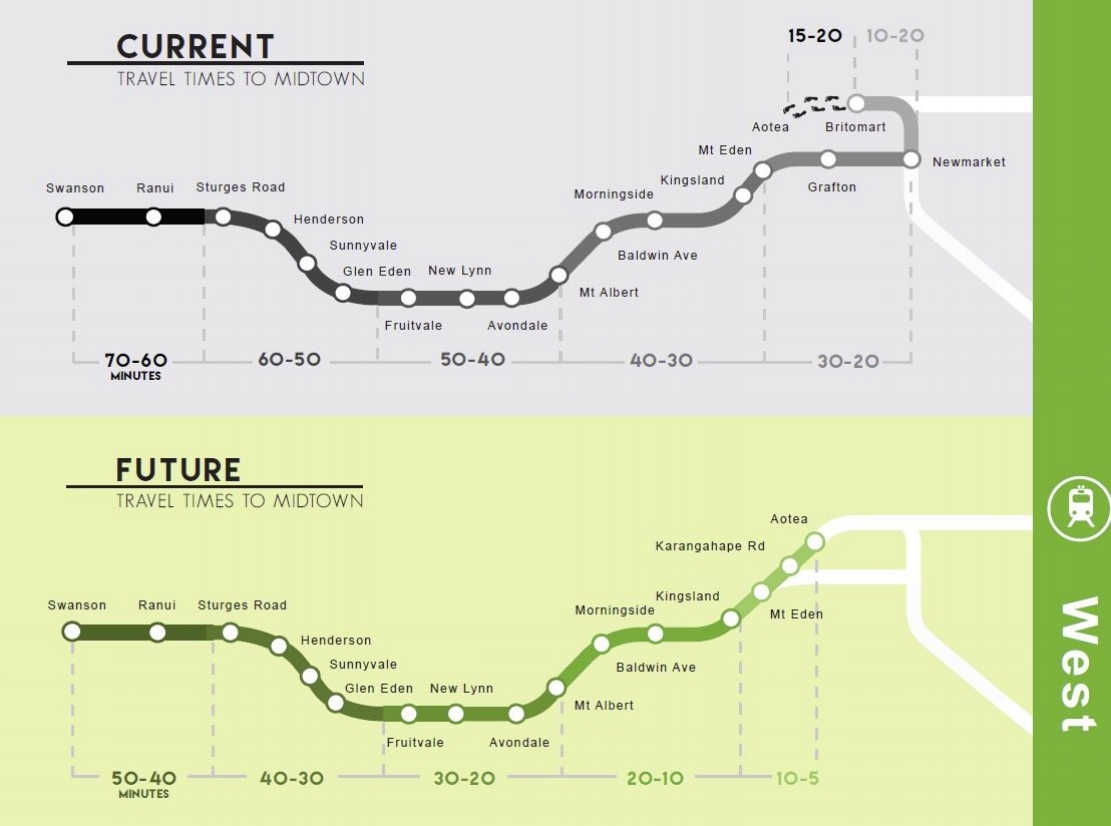
What this means is for the greatest success of the transformed network, the operating pattern should begin with a focus on delivering consistent higher frequency on the Western Line.
The new tunnels will open with a capacity to host 16 trains per hour [tph] per direction. By connecting two sides of the previous network, the CRL enables the reduction of the current three-line pattern down to two main lines. Fully half of these should be heading to and from the Western Line all day, to unlock this opportunity.
Eight trains an hour means a train every 7.5 minutes each way, on each line. Not just true turn-up-and-go, but a meaningful improvement on the current 6tph at peak and 4tph off peak. Where the two main lines overlap this means you’ll see a train every 3.45m in each direction. Now that’s a real Metro.
So, what would it take to deliver 8tph on the two main lines?
The two main constraints are competition for train slots from other rail services (passenger and freight), and slowing for road vehicles crossing the lines at level crossings at the outer reaches of the lines.
The Western Line hosts very few freight trains, currently a max of two per 24 hour period (which can and do run overnight), and no intercity services. So, as long as Auckland Transport doesn’t programme other services on the western line that are not heading to the CRL, maintaining a steady 8tph all day on this core task should be possible. Great.
The level crossings should be manageable at 8tph too. Of course, removing them would be better, and will enable even more services, but that will not be achieved in the near term.
The Eastern Line
By contrast, the Eastern Line is fully grade separated, with no level crossings, all the way to Manukau City. However, its two tracks also serve the busy and important Port of Auckland freight traffic to the inland depots, as well as a number of intercity passenger services.
Blocking out space for long slow freighters means maintaining all day 8tph on the eastern line portion is not possible, with freighters sharing the tracks in the off-peak periods.
Currently, AT is planning to pair the Western Line with the Eastern Line – running trains from one line directly through to the other.
This will limit Western Line frequency to Eastern Line maximums. In other words, there’ll be lower off-peak frequency on the Western Line to accommodate those freight train slots on the eastern.
Is this wise? When service on the Western Line is critical to the whole success of the CRL?
Especially when there is a clear alternative to this pairing?
The alternative: the Western Line can still terminate at Manukau City if it is sent via Parnell and Newmarket, rather than via the Eastern Line. As this direction reduces conflict with other services.
Moreover, this switch makes for a much clearer pattern overall:
South through the CRL to East terminating at ŌtāhuhuWest to Manukau City via the CRL and Parnell(leaving aside the Onehunga line, whose 2tph could either terminate at Britomart via Parnell, or Maungawhau NAL platforms).
See below how much clearer this plan is – the Red Line is no longer clouded in doubled-back confusion:
A more useful way to run the trains? Image credit: Jug Cerovic
The other great advantage of this pattern is that the trains on the Red Line heading east at Ōtāhuhu will have plenty of capacity for the busy stations there – including picking up all the transferring bus riders at Panmure, arriving via the expanding Eastern Busway. This is especially important if frequency is reduced to leave space for freight services.
Whereas, if the Red Line instead returns back south from Newmarket, by reversing back through the CRL, there will essentially be empty trains pouring through the CRL – even in the morning peak. That seems kind of crazy.
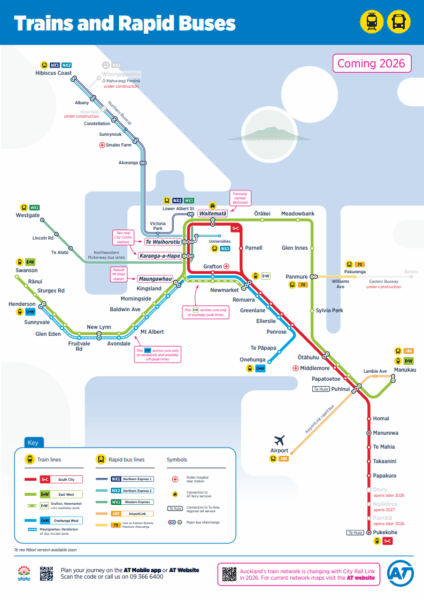
For comparison purposes, here is the currently available official map. It is not really clear how that Red Line operates:
 ConclusionsThe CRL changes everything – which means the Model™ will be even more inaccurate about potential future demand than usual. So, do not attempt to match capacities to modelling outputs. Instead, approach the design on Metro principles, as if the whole system were brand new. In particular, expect the Western Line to be completely different.Capacities on the lines are constrained, which means bespoke one-seat-ride services can only be provided at the expense of frequency on the core lines. Resist the temptation! A transfer in a properly frequent system is a fine alternative, and is even likely to be better as Matt shows here.This is a call to design the Day One pattern on an ambitious high-uptake plan. Start out with a system shaped for success. A Metro, on the principles outlined above. Riders will use the new system in all sorts of new ways, as long as the base pattern is clear and reliable. Keep our eye on the prize: new and repeat travellers, at scale, with strong growth over time.
With metro-isation as the core strategy, we can achieve a base two-line pattern with as close to 8tph as possible on both lines through the CRL, between Papakura, Swanson, and Manukau City. (Off-peak on the Eastern Line will likely be less frequent, to make space for Ports of Auckland freight traffic).
Plan for success: simplicity, clarity, and above all else, as-high-as possible frequency.
This will give us our best shot at achieving all the promise of this potentially transformative investment.
—
Note: this post is intended as a high-altitude strategy discussion. We will follow up with a more detailed analysis of the proposed running schedule, as more information comes to light.
Greater Auckland’s work is made possible by generous donations from our readers and fans. We’re now a registered charity, so your donations are tax-deductible. If you’d like to support our work you can join our circle of supporters here.
Share this