
Alkhouli, M. et al. Left atrial appendage occlusion: current advances and remaining challenges. JACC Adv. 1, 100136 (2022).
Holmes, D. R. et al. Left atrial appendage occlusion: opportunities and challenges. J. Am. Coll. Cardiol. 63, 291–298 (2014).
Smit, J. M. et al. Anatomical characteristics of the left atrium and left atrial appendage in relation to the risk of stroke in patients with versus without atrial fibrillation. Circ. Arrhythm. Electrophysiol. 14, e009777 (2021).
Lip, G. et al. Atrial fibrillation. Nat. Rev. Dis. Primers 2, 16016 (2016).
Marini, C. et al. Contribution of atrial fibrillation to incidence and outcome of ischemic stroke: results from a population-based study. Stroke 36, 1115–1119 (2005).
Sievert, H. et al. Percutaneous left atrial appendage transcatheter occlusion to prevent stroke in high-risk patients with atrial fibrillation: early clinical experience. Circulation 105, 1887–1889 (2002).
Whitlock, R. P. et al. Left atrial appendage occlusion during cardiac surgery to prevent stroke. N. Engl. J. Med. 384, 2081–2091 (2021).
Saw, J. Left atrial appendage occlusion. Nat. Rev. Cardiol. 21, 153–154 (2024).
Yu, C. M. et al. Mechanical antithrombotic intervention by LAA occlusion in atrial fibrillation. Nat. Rev. Cardiol. 10, 707–722 (2013).
Aryana, A. et al. Association between incomplete surgical ligation of left atrial appendage and stroke and systemic embolization. Heart Rhythm 12, 1431–1437 (2015).
Su, P. et al. Occluding the left atrial appendage: anatomical considerations. Heart 94, 1166–1170 (2008).
Kasper, K. et al. The Watchman FLX device. JACC Clin. Electrophysiol. 6, 1633–1642 (2020).
Sick, P. B. et al. Initial worldwide experience with the WATCHMAN left atrial appendage system for stroke prevention in atrial fibrillation. J. Am. Coll. Cardiol. 49, 1490–1495 (2007).
Kar, S. et al. Primary outcome evaluation of a next-generation left atrial appendage closure device: results from the PINNACLE FLX trial. Circulation 143, 1754–1762 (2021).
Paitazoglou, C. et al. The ALSTER-FLX Registry: 3-month outcomes after left atrial appendage occlusion using a next-generation device, a matched-pair analysis to EWOLUTION. Heart Rhythm 19, 917–926 (2022).
Price, M. J. et al. Comparative safety of transcatheter LAAO with the first-generation Watchman and next-generation Watchman FLX devices. JACC Cardiovasc. Interv. 15, 2115–2123 (2022).
Di Biase, L. et al. Does the left atrial appendage morphology correlate with the risk of stroke in patients with atrial fibrillation? Results from a multicenter study. J. Am. Coll. Cardiol. 60, 531–538 (2012).
Lee, J. M. et al. Impact of increased orifice size and decreased flow velocity of left atrial appendage on stroke in nonvalvular atrial fibrillation. Am. J. Cardiol. 113, 963–969 (2014).
Viles-Gonzalez, J. F. et al. The clinical impact of incomplete left atrial appendage closure with the Watchman device in patients with atrial fibrillation: a PROTECT AF (Percutaneous Closure of the Left Atrial Appendage Versus Warfarin Therapy for Prevention of Stroke in Patients With Atrial Fibrillation) substudy. J. Am. Coll. Cardiol. 59, 923–929 (2012).
Lugtu, I. C. et al. Percutaneous left atrial appendage closure using an occluder device: a single center experience. Acta Cardiol. Sin. 38, 352–361 (2022).
Dukkipati, S. R. et al. Device-related thrombus after left atrial appendage closure: incidence, predictors, and outcomes. Circulation 138, 874–885 (2018).
Sedaghat, A. et al. Device-related thrombus after left atrial appendage closure: data on thrombus characteristics, treatment strategies, and clinical outcomes from the EUROC-DRT-registry. Circ. Cardiovasc. Interv. 14, e010195 (2021).
Tanaka, T. et al. Challenges and advances in device-related thrombus in left atrial appendage occlusion. Future Cardiol. 20, 343–358 (2024).
Toumanides, S. et al. Transcatheter patch occlusion of the left atrial appendage using surgical adhesives in high-risk patients with atrial fibrillation. J. Am. Coll. Cardiol. 58, 2236–2240 (2011).
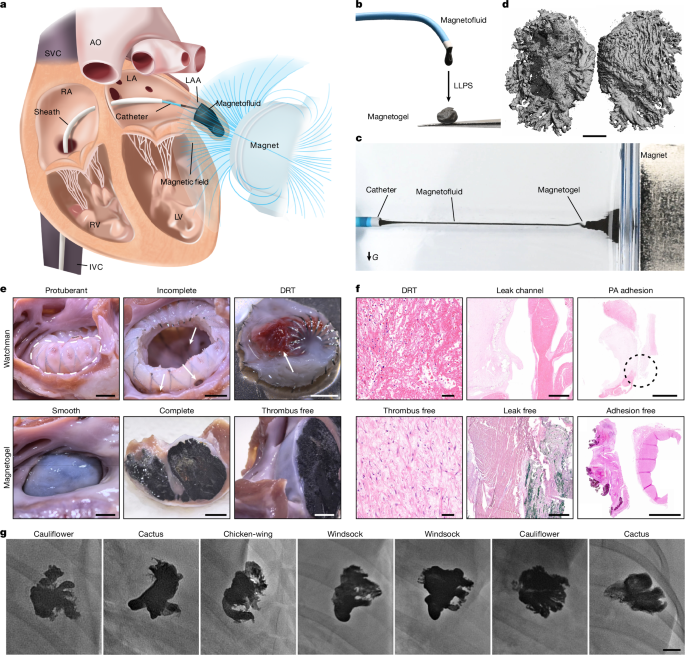
Robinson, S. S. et al. Patient-specific design of a soft occluder for the left atrial appendage. Nat. Biomed. Eng. 2, 8–16 (2018).
Wang, B. et al. Magnetically driven biohybrid blood hydrogel fibres for personalized intracranial tumour therapy under fluoroscopic tracking. Nat. Biomed. Eng. 9, 1471–1485 (2025).
Kuang, X. et al. Self-enhancing sono-inks enable deep-penetration acoustic volumetric printing. Science 382, 1148–1155 (2023).
de Lima J. et al. Phase diagrams of poly(ethylene-co-vinyl alcohol) and dimethylformamide solutions exhibiting both liquid-iquid and solid-liquid phase separation. J. Appl. Polym. Sci. 118, 1787–1795 (2010).
Zhang, Y. S. et al. Regenerative cell therapy with 3D bioprinting. Science 385, 604–606 (2024).
Lasagabaster, A. et al. FTIR study on the nature of water sorbed in polypropylene (PP)/ethylene alcohol vinyl (EVOH) films. Eur. Polym. J. 42, 3121–3132 (2006).
Wu, K. C. et al. A tough bioadhesive hydrogel supports sutureless sealing of the dural membrane in porcine and ex vivo human tissue. Sci. Transl. Med. 16, eadj0616 (2024).
Gupta, D. et al. The electrospinning behavior of poly(vinyl alcohol) in DMSO–water binary solvent mixtures. RSC Adv. 6, 102947–102955 (2016).
Alderman N. et al. Non-Newtonian Fluids: Guide to Classification and Characteristics (ESDU, 1997).
Kendrew, J. C. et al. A three-dimensional model of the myoglobin molecule obtained by X-ray analysis. Nature 181, 662–666 (1958).
Takeda, S. et al. Structure of the core domain of human cardiac troponin in the Ca2+-saturated form. Nature 424, 35–41 (2003).
Kashima, Y. et al. Single cell sequencing techniques from individual to multiomics analyses. Exp. Mol. Med. 52, 1419–1427 (2020).
Jana, S. Endocardialization of cardiovascular devices. Acta Biomater. 99, 53–71 (2019).
Zhuang, Y. et al. Challenges and strategies for in situ endocardialization and long-term lumen patency of vascular grafts. Bioact. Mater. 6, 1791–1809 (2020).
Kong, P. et al. Biodegradable cardiac occluder with surface modification by gelatin–peptide conjugate to promote endogenous tissue regeneration. Adv. Sci. 11, 2305967 (2024).
Li, Z. et al. A fully biodegradable polydioxanone occluder for ventricle septal defect closure. Bioact. Mater. 24, 252–262 (2023).
Hendrickson, T. et al. Thermally responsive hydrogel for atrial fibrillation related stroke prevention. Mater. Today Bio 14, 100240 (2022).
Yuan, H. et al. Clinical applicable carboxymethyl chitosan with gel-forming and stabilizing properties based on terminal sterilization methods of electron beam irradiation. ACS Omega 9, 18599–18607 (2024).
Hiruta, Y. Poly(N-isopropylacrylamide)-based temperature- and pH-responsive polymer materials for application in biomedical fields. Polym. J. 54, 1419–1430 (2022).
Strus, B. et al. PLGA-PEG-PLGA polymer: from synthesis to advanced pharmaceutical applications. Adv. Polym. Technol. 2025, 8899828 (2025).
Jiang, Y. et al. Liquid embolic agents for interventional embolization. ChemPhysMater 1, 39–50 (2022).
Jin, D. et al. Swarming self-adhesive microgels enabled aneurysm on-demand embolization in physiological blood flow. Sci. Adv. 9, eadf9278 (2023).
Liu, X. et al. Magnetic soft microfiberbots for robotic embolization. Sci. Robot. 9, eadh2479 (2024).
Peng, Q. et al. Thermal and magnetic dual-responsive catheter-assisted shape memory microrobots for multistage vascular embolization. Research 7, 0339 (2024).
Fan, X. et al. Light scattering and surface plasmons on small spherical particles. Light Sci. Appl. 3, e179 (2014).
Khan S. et al. in Handbook of Materials Characterization 317–344 (Springer, 2018).
Jonkman, J. et al. Tutorial: guidance for quantitative confocal microscopy. Nat. Protoc. 15, 1585–1611 (2020).
Guo, J. et al. Characterization of pore structures with mercury intrusion porosimetry after electrochemical modification: a case study of Jincheng anthracite. ACS Omega 7, 11148–11157 (2022).
Cohen J. Statistical Power Analysis for the Behavioral Sciences (Lawrence Erlbaum, 1988).