
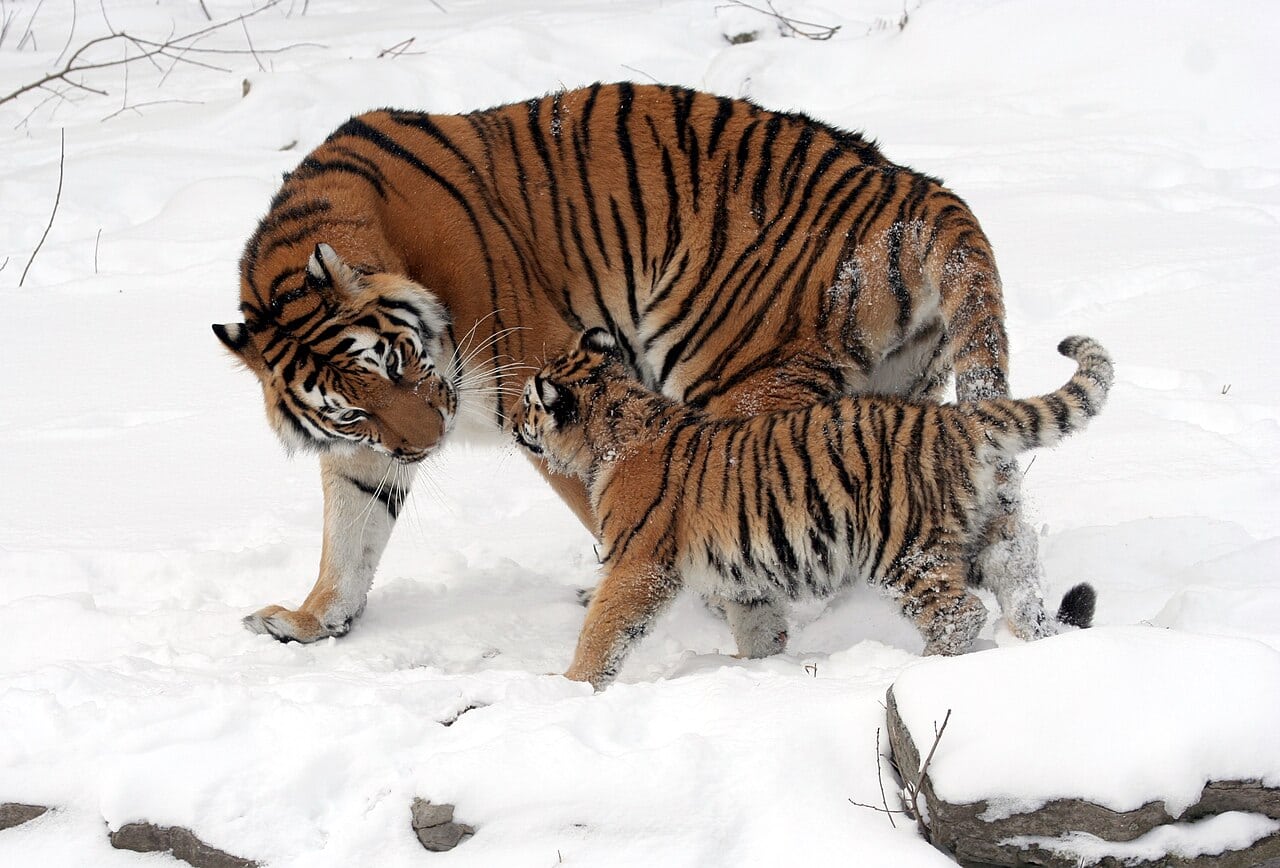
 Amur tigers (Panthera tigris altaica). Credit: Wikimedia Commons
Along the shores of Lake Balkhash in southeastern Kazakhstan, conservationists are rebuilding a forest for an animal that hasn’t walked there in decades: the tiger.
Teams have planted thousands of willow, poplar and narrow-leaf oleaster trees to rebuild habitat that once supported tigers and the animals they prey on.
If the plan proceeds as expected, several wild Amur tigers will be transported from Russia in the first half of 2026. The move is part of a broader effort to reintroduce tigers to Central Asia more than seventy years after they disappeared from the region.
Tigers once ranged widely across Asia. About a century ago, an estimated 100,000 tigers roamed the wild. Today, only roughly 5,500 survive.
Kazakhstan’s program aims to restore a small portion of that lost range.
Expecting Tigers
The last of the region’s Caspian tigers disappeared in the late 1940s. Hunting, shrinking forests and the disappearance of prey animals pushed them out of existence.
Now, Kazakhstan has begun rebuilding the ecosystem tigers once ruled.
In 2018, the government created the Ile-Balkhash State Nature Reserve, a protected area covering about 415,200 hectares. Officials have spent years restoring riverine forests, strengthening wildlife populations and monitoring the recovering landscape.
×
Thank you! One more thing…
Please check your inbox and confirm your subscription.
“As part of the project, the Ile-Balkhash State Nature Reserve was established in 2018, covering 415,200 hectares. Since then, infrastructure has been developed to restore riparian forests, protect the reserve’s territory, and conduct environmental monitoring,” said Daniyar Turgambayev of Kazakhstan’s Ministry of Ecology and Natural Resources, according to the Astana Times.
Rebuilding a tiger habitat means starting with dinner.
Between 2018 and 2023, conservationists released more than 200 Bukhara deer and 119 kulans, a Central Asian subspecies of Asiatic wild ass. Each animal carries a satellite tracker so scientists can follow how the ecosystem rebuilds itself.
Trees are returning, too. In the South Balkhash region, teams planted tens of thousands of seedlings in recent years, creating patches of new forest along the lakeshore.
“Already, wild ungulates have been seen foraging on the restored sites, indicating that the ecosystem is beginning to function,” a spokesperson for WWF Central Asia told Live Science in an email. “Each planted seedling is therefore a direct contribution to the future of the tiger in Kazakhstan.”
The effort forms part of a much larger greening campaign. Kazakhstan says it has planted about 1.4 billion trees since 2021 as part of a national reforestation campaign.
Engineering a Comeback
 Kazakhstan’s tiger reintroduction program welcomed its first Amur tigers in 2024, but these are captive individuals that the program hopes to breed. Credit: WWF Central Asia
The tigers destined for Kazakhstan will not be Caspian tigers—the original population is extinct.
But genetics offers a workaround.
A 2009 study found that Caspian tigers and today’s Amur tigers were once part of the same population before human activity split them apart in the 19th century. That makes the Amur tiger, which survives in Russia and parts of East Asia, a close ecological substitute.
Two of those cats have already arrived.
In 2024 a female named Bodhana and a male named Kuma were transported from a sanctuary in the Netherlands to the Ile-Balkhash reserve. They live in a large enclosure where researchers monitor them closely.
Their cubs, if they have any, could become the first wild-born tigers in Central Asia in decades.
Meanwhile, the real turning point may come from Russia.
According to Kazakhstan’s forestry and wildlife committee, three or four wild Amur tigers are expected to be relocated between January and June of 2026. If successful, they will become the first free-ranging tigers in the region in roughly seventy years.
Reintroducing top predators is never simple. Tigers need huge territories, plentiful prey and distance from people. When those boundaries blur, conflict can follow.
Officials are also preparing compensation programs for livestock losses and training specialists to manage encounters between humans and predators.
Conservationists have reason for cautious optimism. Similar efforts in Russia have shown that orphaned cubs raised by scientists can learn to hunt and survive in the wild.
Kazakhstan’s ambitions stretch further still. By 2035, planners hope Ile-Balkhash could support about 50 wild tigers.