
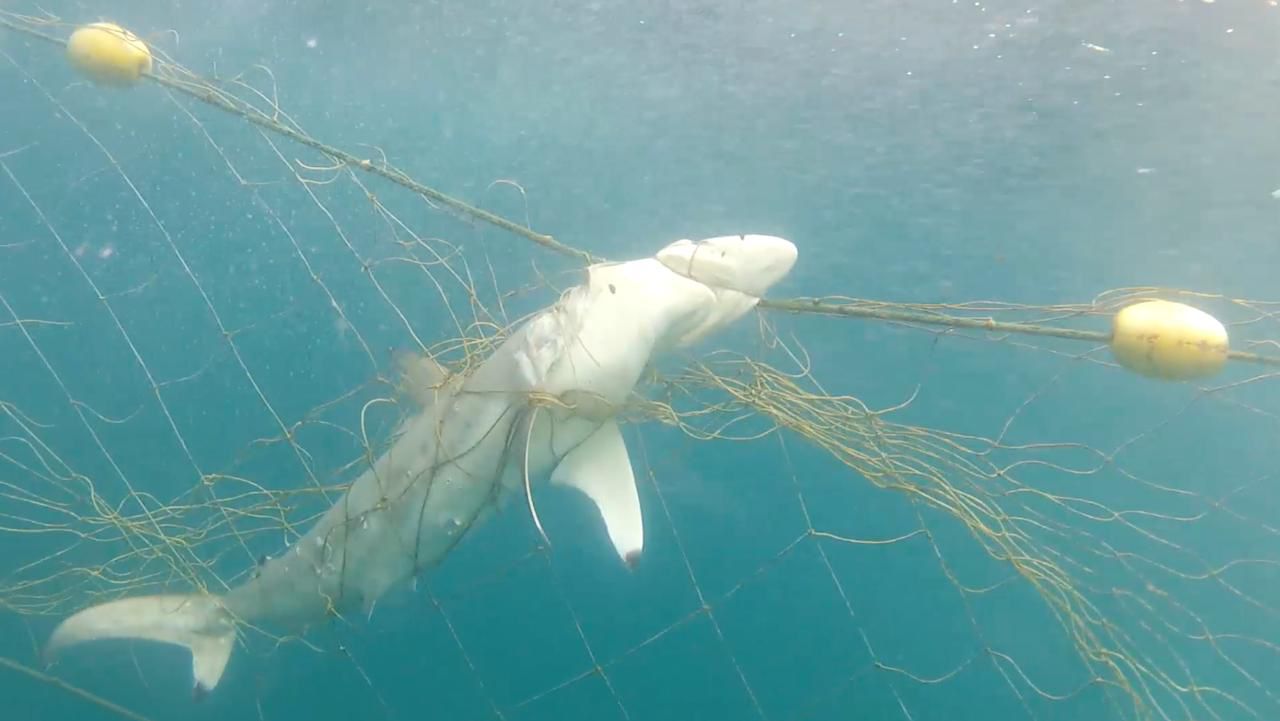
A proposal by municipal authorities in South Africa’s KwaZulu-Natal province to install shark nets at a public beach has triggered a public debate about the need to install gear that’s highly lethal to sharks and other marine life, and raised questions about its legality.The proposal, which authorities say will protect beachgoers from shark attacks, was made in anticipation of increased visitor numbers to Tinley Manor Beach once a new Club Med resort opens in the area later this year.Some scientists and environmentalists argue that shark nets and drum lines are outdated as they cull and kill nontarget species indiscriminately, including those protected under South African law.South Africa’s Department of Forestry, Fisheries and the Environment said it’s considering whether installing the net should trigger an environmental impact assessment. Some experts also question the legality of existing nets.
See All Key Ideas
On Feb. 13, a juvenile humpback dolphin was caught and killed in one of the many nets strung up off the coast of South Africa’s KwaZulu-Natal province to protect beachgoers from sharks. The incident, near the city of Richards Bay on the country’s eastern coast, was a blow for South Africa’s population of Indian ocean humpback dolphins, which has dropped to fewer than 500 in recent decades.
Shark nets, installed together with baited hooks called drum lines, aim to reduce the number of sharks that could come into contact with, and possibly harm, humans. Once entangled in these nets, which can run hundreds of meters wide, sharks have little chance of survival — nor do other species like humpback dolphins (Sousa plumbea). In the wake of the February incident, scientists working to conserve humpback dolphins issued a letter of opposition to a proposal to install another such net at a popular beach farther down the coast.
Tinley Manor is a one-and-a-half-hour drive from Richards Bay, and has emerged as a flashpoint in the debate about shark nets. Municipal authorities there are proposing installing a shark net at the public beach, in view of the new Club Med luxury resort being built right next to it. The KwaZulu-Natal Sharks Board (KZNSB), as the authority responsible for bather safety in the province, says it’s acting to safeguard beachgoers, whose numbers are expected to rise significantly with the opening of the resort later this year.
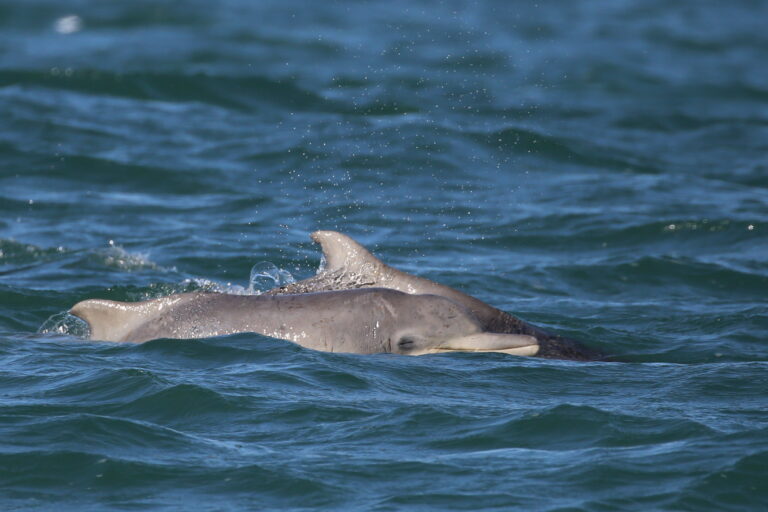 Indian Ocean humpback dolphins. Image courtesy of Bridget James.
Club Med, headquartered in Paris, is owned by Chinese conglomerate Fosun International Limited and acting in South Africa through a local developer, Collins Residential.
As a member of the Green Globe sustainable tourism certification scheme, the company has committed to minimize its impact on natural ecosystems and contribute “to the support of biodiversity conservation, including supporting natural protected areas and areas of high biodiversity value.”
But scientists at the SouSA Consortium, the conservation group working with humpback dolphins, say the company’s plans to install shark nets goes against this stated commitment.
Shark populations around the world have gone into steep decline since the 1970s, with more than a third of shark species currently threatened with extinction globally. In South Africa, the most recent assessment by the South African National Biodiversity Institute (SANBI) identified fisheries as the biggest threat to shark populations, with around 1,000 metric tons of sharks caught annually, mostly as bycatch.
However, SANBI also described the KZNSB’s shark control program as the main pressure on species such as the critically endangered great hammerhead (Sphyrna mokarran) and the endangered sandbar shark (Carcharhinus plumbeus).
The Indian Ocean humpback dolphin is listed as endangered on the IUCN Red List, with its population declining by 50% over the last 20 years. Living close to shore, it faces threats ranging from ports to shipping activity and coastal development.
Anticipating that the now public beach will draw significantly more visitors, the Tinley Manor Club Med developer Collins Residential approached the municipality to advise on how best to keep guests safe. The municipality then turned to the KZNSB, which recommended installing shark nets and drum lines — the only devices the board currently uses to mitigate shark risk.
At present, there are 14.8 km (9.2 miles) of net and 177 drum lines deployed at 37 beaches along the KwaZulu-Natal coastline. The net proposed at Tinley Manor would be 214 meters long by 6 deep (702 by 20 feet), held in place by two anchors; the six proposed drum lines would each have baited hooks attached to floats anchored to the seabed.
The nets target three species considered particularly aggressive: great white sharks (Carcharodon carcharias), bull sharks (Carcharhinus leucas) and tiger sharks (Galeocerdo cuvier). These species are sometimes considered the “Big Three,” as they’ve been involved in the most known unprovoked attacks involving humans. Both great whites and bull sharks are listed as vulnerable on the IUCN Red list, while the tiger shark is near threatened.
“Shark nets and drum lines are targeting megafauna, and 80% of this megafauna is listed in the IUCN Red List as vulnerable, endangered or critically endangered,” Sara Andreotti, a marine biologist at Stellenbosch University in Western Cape province, told Mongabay.
Neither device is selective, she added: “The kind of animals that are killed are whales and dolphins and sharks, and most of them just die as bycatch.”
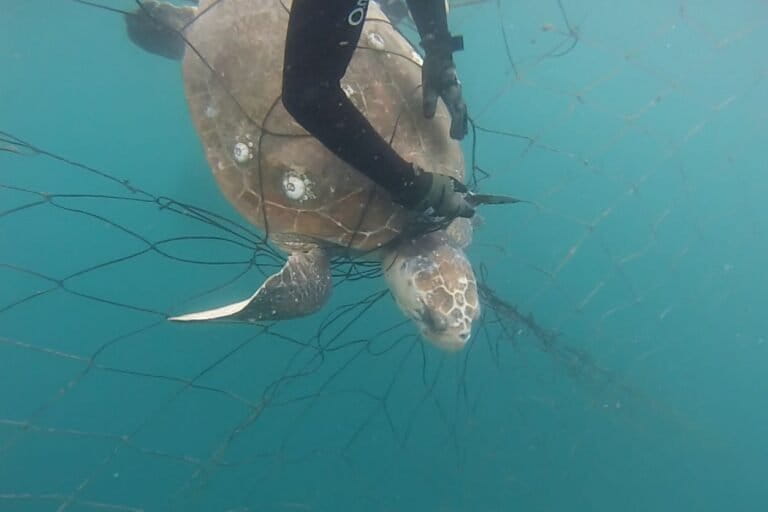 South Africa’s shark nets catch dozens of turtles and dolphins every year. Image from “Monsters” courtesy of Skyler Thomas.
Turtles, dolphins and nontarget sharks like sand tiger sharks (Carcharias taurus) and various species of hammerhead regularly get entangled in the gear and perish.
Data released by the KZNSB show that between 2018 and 2022, an average of 411 animals were killed every year by the gear deployed. Of these, 55 were target species, while the rest, 356, were nontarget species, including critically endangered animals such as scalloped hammerhead sharks (Sphyrna lewini).
The proposed installation site at Tinley Manor lies roughly 500 meters from uThukela Marine Protected Area, a key habitat for humpback dolphins, as well as threatened sharks and rays, including endemic diamond rays (Gymnura natalensis). The area also hosts leatherback turtles (Dermochelys coriacea).
During an online public participation meeting in November 2025, a KZNSB representative said the measures are necessary for Tinley Manor. Matt Dicken, the board’s head of research, told the meeting that the municipality and Club Med had “looked at numerous alternates, and they considered the only viable alternate right now for the specific environmental conditions and species of concern at Tinley Manor was the use of nets and drums.”
He added the deployment of nets and drum lines has reduced the incidence of fatal shark attacks by 100% over the last 73 years, and that compared to fisheries pressure, “the environmental impact of the nets is very, very minimal.”
Dicken didn’t respond to Mongabay’s subsequent requests for a direct comment.
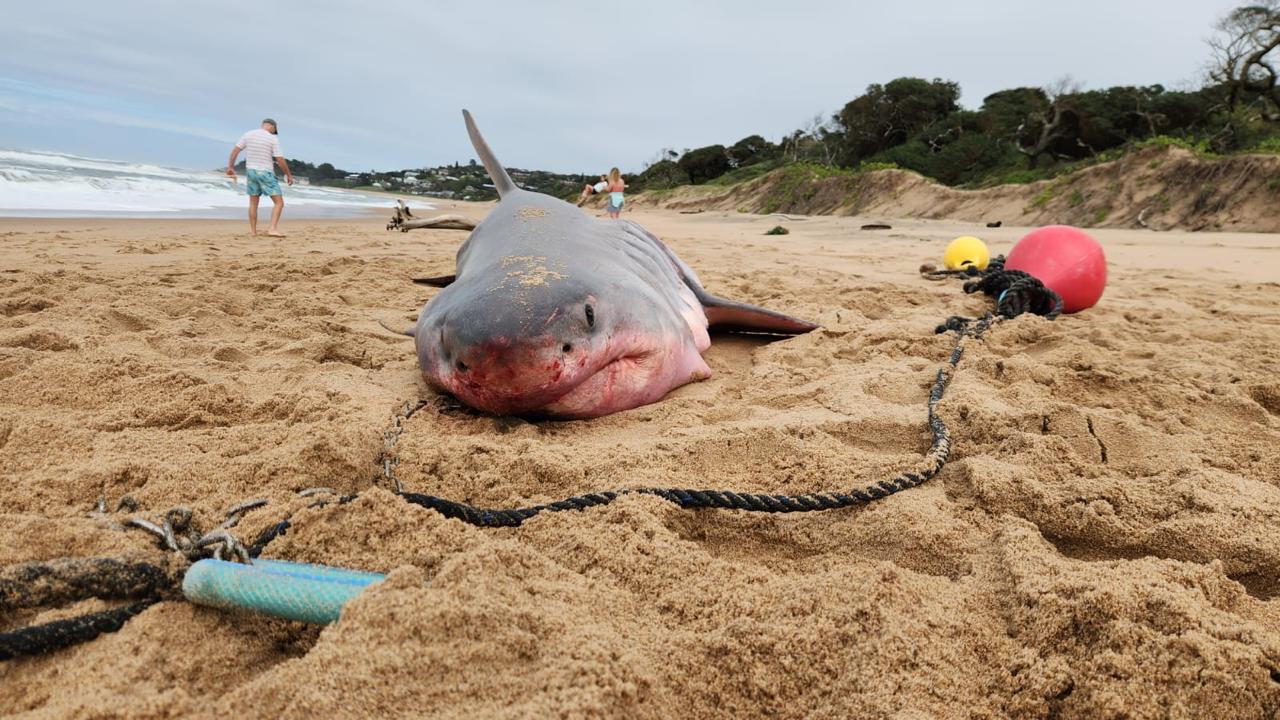 A great white shark washed up dead on the shore of Zinkwazi Beach in September 2024 after being caught in a KwaZulu-Natal Sharks Board drumline. Image courtesy of Josh Pons.
Other provinces in South Africa and places such as Australia and Réunion, an Indian Ocean island administered by France, increasingly use nonlethal approaches, including shark spotters, drones, exclusion barriers and smart drum lines that allow captured sharks to be released alive.
According to Dicken, however, none of these alternatives are viable in the South African context. He said surveillance-based approaches like shark spotters, cameras and drones depend on visual detection, and don’t pick up bull sharks as they often remain too deep under the water’s surface to be spotted. As for exclusion barriers, which physically block sharks without entangling them, Dicken said these are designed for calm conditions, which Tinley Manor doesn’t have. He also said sonar devices lack published evidence of effectiveness.
“There is no copy and paste of shark mitigation technology from one country to another,” he said.
However, some conservationists and scientists challenge these arguments, saying not enough effort is being made to trial or implement the alternative approaches. Grant Smith from the Shark Life Conservation Group, based in KwaZulu-Natal, told Mongabay that bull sharks hardly appear in the area these days and could be managed through temporary beach closures rather than permanently installed lethal gear.
He questioned whether the KZNSB has genuinely tested the alternatives it dismisses.
“Many of these alternatives appear to have been discounted without substantive trials or evaluation,” he said, adding that Club Med’s arrival represents a rare opportunity to pilot new approaches. “It’s imperative that eco-facing tourism resorts exhaust all nonlethal options before resorting to measures that harm protected species.”
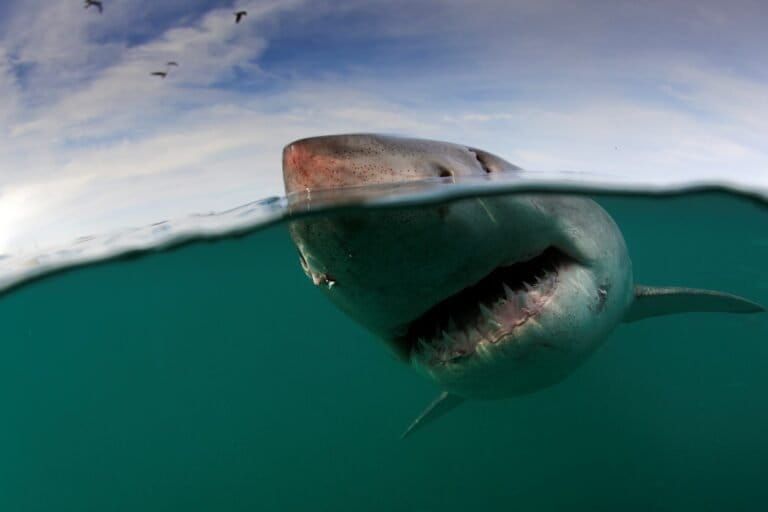 A great white shark. Image courtesy of Chris Fallows.
The controversy around Tinley Manor hasn’t just put shark nets and drum lines in the spotlight; it’s also brought scrutiny to the process by which they’re installed. Legal scholars question the adequacy of the public participation process, and some experts even question whether existing nets were installed in compliance with South Africa’s environmental laws.
”The public participation process for the Tinley Manor application fails to meet basic requirements of procedural fairness and environmental law,” said South African lawyer Kirsten Youens, who represents a group of surfers who use the beach regularly.
She added the problem extends well beyond Tinley Manor: “There is a far more serious issue: the KZNSB has never conducted proper environmental impact assessments for any of its shark net and drum line installations across the KwaZulu-Natal coast.”
Youens is challenging the legitimacy of all permits historically issued to the KZNSB by the South African Department of Forestry, Fisheries and the Environment (DFFE), which she said would have required comprehensive environmental impact assessments.
The DFFE has been receiving comments from affected and interested parties regarding the proposal to install nets and drum lines. It told Mongabay it’s now reviewing these internally, and will then decide whether an environmental impact assessment is required.
DFFE spokesperson Nomxolisi Mashiyi confirmed in an email to Mongabay that the “installation of bather safety gear may trigger a requirement for an environmental authorization as per the National Environmental Management Act, 1998: Environmental Impact Assessment (EIA) Regulations, 2014.” This legislation requires an EIA for any activity that may affect the environment, including the installation of items on or along the seabed.
Another DFFE spokesperson, Zolile Nqayi, said in an email that the country’s National Environmental Management: Biodiversity Act (NEMBA) “strictly prohibits the intentional killing of great white sharks” and requires the KZNSB to “minimize mortalities of live species detected to be caught in the bather protection gear.”
If the DFFE determines that an EIA is required, it’s unclear how the requirement will affect Club Med’s plans. The resort is scheduled to open in July.
Mongabay contacted Club Med for comment, but didn’t receive a response by the time this story was published.
Banner Image: Due to their nonselective nature, shark nets and drum lines frequently kill sharks that don’t pose a threat to humans. Image from “Monsters” courtesy of Skyler Thomas.
Feedback: Use this form to send a message to the author of this post. If you want to post a public comment, you can do that at the bottom of the page.
