
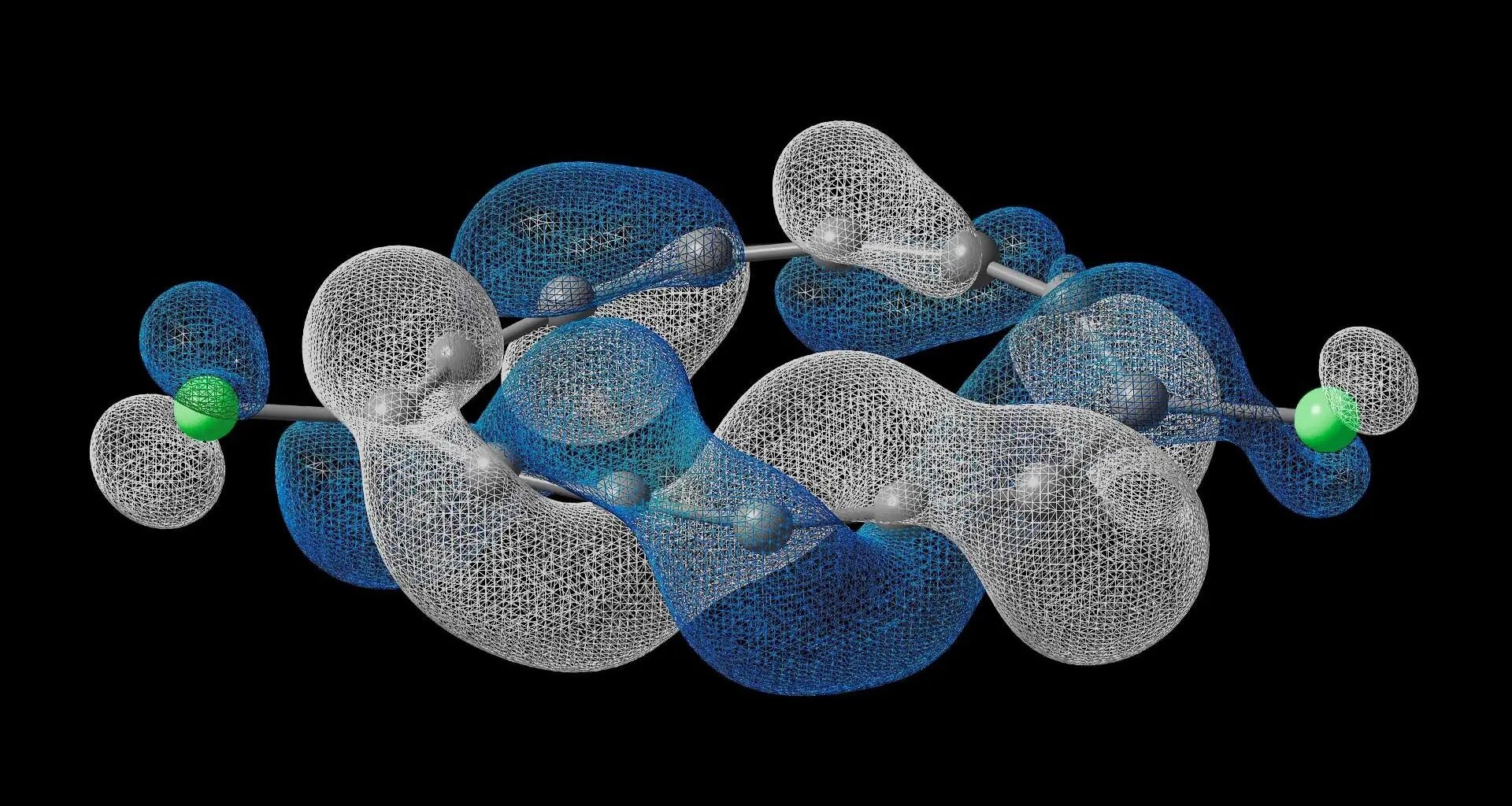
Imagine that electrons are not traveling in straight paths, but corkscrewing their way through a molecule.
And that is precisely what a collaborative team of international scientists from IBM, The University of Manchester, Oxford University, ETH Zurich, EPFL, and the University of Regensburg has accomplished: experimentally observing a half‑Möbius electronic topology, a form of quantum matter that had not even been conjectured before, within an individual molecule.
Published in Science, the work marks a milestone in both chemistry and quantum computing. The molecule is something never seen, made, or even predicted before. To understand this strange behavior, they turned to quantum computing, which can directly model the quantum rules that electrons follow.
Alessandro Curioni, IBM Fellow, Vice President, Europe and Africa, and Director of IBM Research Zurich, said, “First, we designed a molecule we thought could be created, then we built it, and then we validated it and its exotic properties with a quantum computer.”
Quantum entanglement and topology are inextricably linked
Decades ago, Richard Feynman had a dream: a computer built to simulate quantum physics and a demonstration where truly. This new study echoes his famous reminder that ‘there’s plenty of room at the bottom,’ opening the door for new ways to explore our world and the matter within it.
The molecule, C₁₃Cl₂, was painstakingly assembled atom‑by‑atom at IBM using a custom precursor from Oxford University. At nearly absolute zero temperatures, the researchers selectively ejected individual atoms from the surface using ultra-precise voltage pulses to sculpt an unprecedented three-dimensional structure.
When examined with scanning tunneling and atomic force microscopes, the molecule showed an electronic twist: electrons flip 90 degrees every time they go around, and it takes four full loops to return them to where they started.
This strange topology can be switched between clockwise, counterclockwise, and untwisted states, proof that electronic topology isn’t just something nature provides, but something scientists can now deliberately engineer.
But building the molecule was only half the challenge. Understanding it required quantum computing. Electrons’ interactions are deeply entangled, making them difficult to simulate on classical computers. On the other hand, quantum computers operate under the same rules as the electrons themselves.
A new quantum state of matter could power future technologies
Using IBM’s quantum hardware, the team uncovered the mechanism behind the molecule’s unusual behavior: a helical pseudo Jahn‑Teller effect.
Dr. Igor Rončević of Manchester University put it this way: “Topology can serve as a switchable degree of freedom, opening a new powerful route for controlling material properties.”
And Dr. Jascha Repp of Regensburg added: “It’s fascinating that a tiny molecule can have such a complex electronic structure, so twisted and strange that it almost twists your mind.”
Dr. Harry Anderson, paper co-author, Professor of Chemistry at Oxford University: “It is remarkable that the Lewis structure of C₁₃Cl₂ already indicates it is chiral, as confirmed by the experiment and quantum chemical calculations. It is also amazing that the enantiomers can be interconverted by applying voltage pulses from the probe tip.”
Journal Reference:
Igor Roncevic, Fabian Paschke, Yueze Gao et al. A molecule with half-Möbius topology. Science. DOI: 10.1126/science.aea3321