
The commonality between both teams was the all-round brilliance, balance and contributions of their respective back threes, all of whom could compete in the air, hunt for the ball, beat defenders, kick, counter ruck and look like they could have played anywhere in the backline.
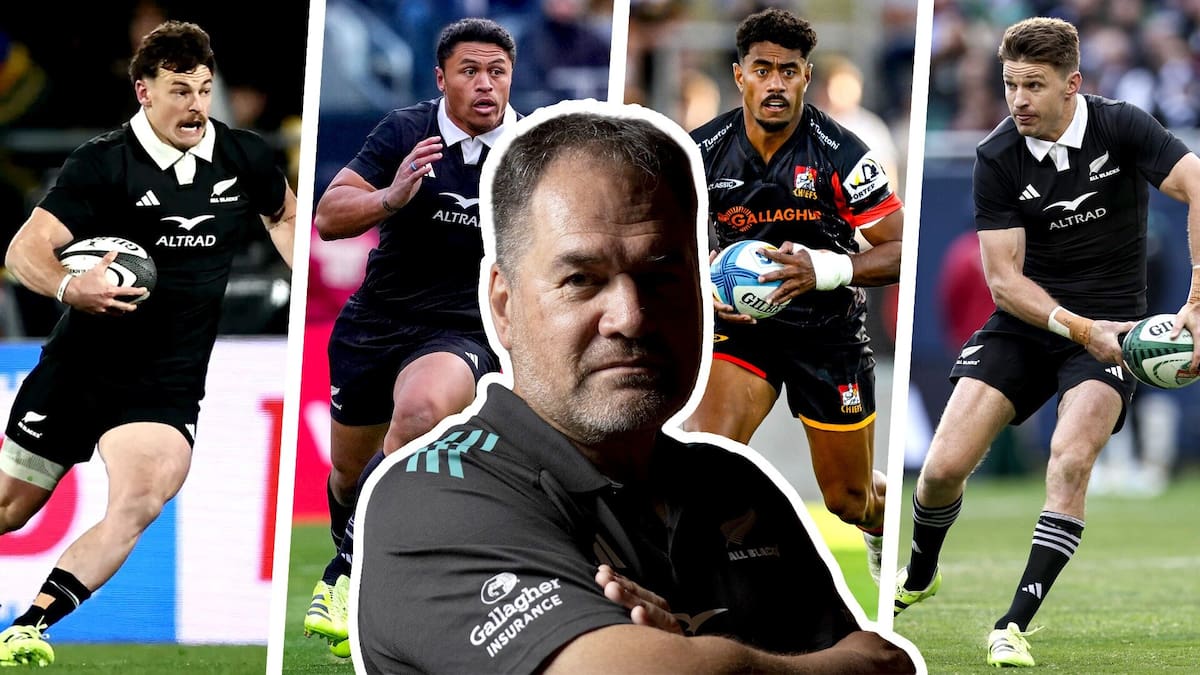
New All Blacks coach Dave Rennie will be watching the form of outside backs in Super Rugby Pacific. Photo / SmartFrame
The four wings on show – Kyle Steyn, Darcy Graham, Louis Bielle-Biarrey and Theo Attissogbe – demonstrated how far New Zealand has fallen behind not just in its skill development, but in its thinking about what sort of athletes it needs on its wings, and how to use its back three effectively.
In a sign of how out of touch the All Blacks were last year, they started their campaign with Sevu Reece and Rieko Ioane as the first-choice wings, even though neither was remotely equipped to win the aerial battle to which they would be exposed.
That felt like the All Blacks were not only working with Soviet-era technology but were also as shut off and as poor as the Politburo at reading the outside world.
The preference to pick Reece and Ioane – and to return to them through the year – was a horrible failure to accept that the primary battleground for the modern wing is in the air. Being able to compete for attacking contestable kicks as well as cleanly take defensive high balls are non-negotiables for anyone wanting to play on the wing for the All Blacks.
Sevu Reece (left) and Rieko Ioane were both selected on the wing last year. Photo / Photosport
The All Blacks scored one counter-attack try in the Rugby Championship, and that one stat tells the story of how New Zealand is no longer the king of the backfield.
Mindsets and selection templates need to change, and New Zealanders need to accept that the concept of the power wing is probably dead.
The days of being able to select an athlete such as Julian Savea or Waisake Naholo – 108kg-plus wings who can run over the top of defenders but who can’t get off the ground and compete in the air – are gone.
What New Zealand needs now are genuine allrounders – athletes with strength, speed and agility, but most importantly, players with the full suite of kick-run-pass attributes and the rugby awareness to know when to come off their wing and how to keep the ball alive.
All four wings in Edinburgh were able to win the ball in the air. Yet they also had all-round football skills – soft hands, fast feet, acceleration, strength in the collision and great rugby brains – that made them just as effective when operating on terra firma.
Looking around now, it’s not clear if New Zealand has anyone offering the All Blacks precisely what they need.
Caleb Clarke is supremely quick, agile, powerful and capable of retrieving attacking contestable kicks – but he’s not yet shown himself to be adept under defensive high balls or in possession of a kicking portfolio or an astute reader of the game.
Emoni Narawa can’t match Clarke’s running power, but he’s closer to being the modern prototype as he’s an aerial athlete with a relatively broad portfolio of football skills that have enabled him to play in the midfield (and he’d be just as at home playing fullback).
Leroy Carter has shown he can make impactful tackles, beat defenders and score from tight spots, but he hasn’t learned how to be as effective as the similarly diminutive Graham at winning the ball in the air and chasing kicks.
Caleb Tangitau is incredibly quick, but that one trick isn’t enough to thrive in the kick-chase world of test rugby and he needs to broaden his skill-set if he’s going to be an All Black.
It’s not just wings that need a rethink, as what Scotland and France showed is the importance of balance. Fullbacks Blair Kinghorn and Tomos Ramos, both of whom have played at first five-eighths, brought astute game management to the backfields, as well as strong aerial work, well-timed intrusions and cameos at first receiver.
When you see these two in action, it illustrates why Will Jordan is not best suited to playing fullback in the test arena, and why it may be that Beauden Barrett – once Richie Mo’unga returns as an option at No 10 – is the first choice at the back given his kicking game, organisation and play-making.
The All Blacks need to maximise their kick-catch players in the back three – keep doubling down on that facet and build a back three fit to win in aerial warfare and guerilla-style backfield ground assaults.
Rennie has a range of athletes to consider – but a long journey ahead to transform the potency, relevancy and contribution of the All Blacks back three and build the sort of triumvirate that puts New Zealand ahead of the curve.
Gregor Paul is one of New Zealand’s most respected rugby writers and columnists. He has won multiple awards for journalism and written several books about sport.