
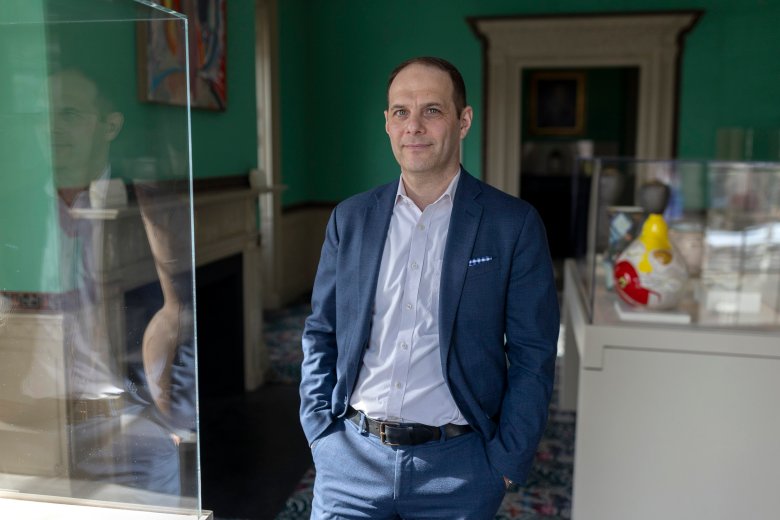
 Andrew Eshelbacher, the Portland Museum of Art’s new deputy director and head of art and exhibitions, on Thursday, March 5. (Brianna Soukup/Staff Photographer)
Andrew Eschelbacher sits at a large oval table in the McLellan House in the Portland Museum of Art (PMA) as a photographer circles the room snapping his picture. He’s a bit embarrassed by the attention. “Is my pocket square showing?” he frets as he worries aloud about whether the photographer’s angles will make him look, well, like a nerdy curator with his nose forever in a book. For the record, Eschelbacher is an affable, good-looking 46-year-old with penetrating blue-gray eyes that change aspect frequently, at times feeling inviting, at other times a bit otherworldly.
Eschelbacher is here to talk about his new position at the PMA: deputy director and head of art and exhibitions. According to the museum’s announcement, he “will provide strategic leadership, management, and vision for the museum’s collection and loaned works of art, overseeing care, development, interpretation, and programming across the PMA’s holdings. He will also help advance the PMA’s mission of Art for All through innovative and inclusive curatorial practices and philanthropic strategies aligned with the museum’s future.”
That’s a mouthful. But still, Eschelbacher insists, “It’s not about me. The art should be the focus. The curators should be the focus. Not the curators’ boss.” Despite the apparent modesty, however, it’s clear Eschelbacher is a polished and savvy speaker, aware of projecting the right image. He often turns to the museum’s communications representative, also in the room, asking if he’s getting himself into trouble.
AN INSTITUTION IN TRANSITION
Though Eschelbacher is not really new to the PMA, he keeps pointing out that it is only his fourth day on the job, a little early to talk about what he intends to do. He concedes that his influence might be felt “in small ways in the short term,” but insists, “My stamp will never be evident because it’s about the art.” He also comes at a time that is an inflection point for the institution, which is planning a substantial expansion and unification of the museum’s campus after an influx of acquisitions and bequests in the early 2020s.
Eschelbacher began as an assistant curator at the PMA in 2014 and became associate curator in 2017. He moved on to a fellowship at New York’s Metropolitan Museum the following year, then was appointed director of curatorial affairs at the American Federation of the Arts (2020-22). His last stint was director of collections and exhibitions at the Amon Carter Museum of American Art in Fort Worth, Texas. Now he returns to a very different institution.
“The collection has really evolved,” he observes. “There have been extraordinary acquisitions, whether through donations or actual acquisition. That demonstrates people’s faith in the way it will activate the collection and the community.”
He cites, among other things, a Rodin sculpture that “looks like it’s been there for 50 years,” the single-channel digital animation video by Chitra Ganesh that entered the collection last year, “the depth of the photo collection, which allows us to tell a longer story, which is so important,” and the Alex Katz collection.
“It’s not that there’s just strength, not just breadth,” he said, “but there’s strength in that breadth.”
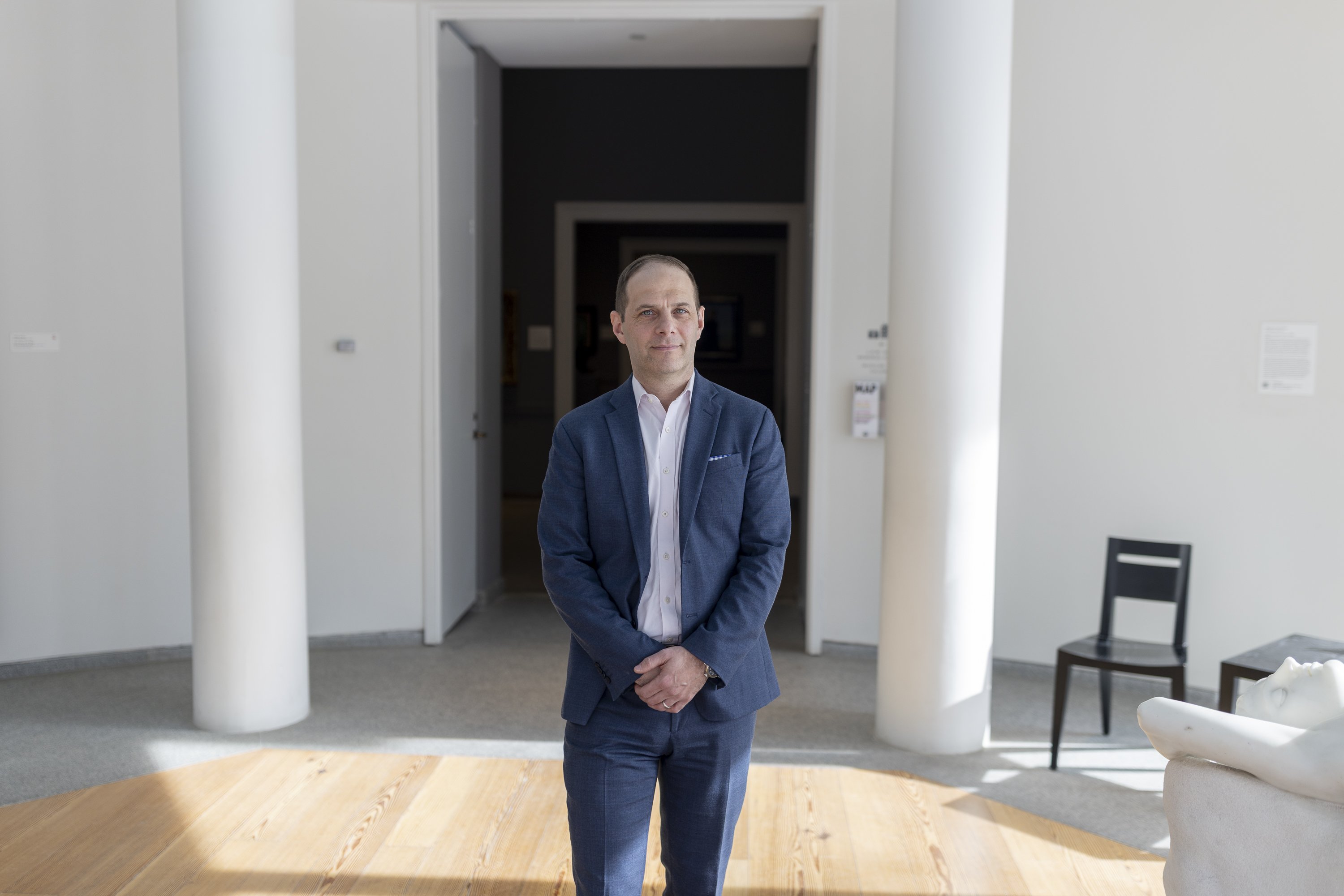 Andrew Eshelbacher at the museum on March 5. (Brianna Soukup/Staff Photographer)
MORE THAN ARTWORK
Eschelbacher is excited about the coming expansion. When asked about criticism that the proposed 60,000-square-foot Lever Architects design does little for increasing exhibition space, he said, “Museums function on the strength of two things: their collection and their community — and creating transformational experiences at the meeting of those two things. Museums are part of the life blood of cities. The more opportunities we have where people and art come together in meaningful ways, the more it activates ideas, connection, curiosity.”
There is copious research to back up Eschelbacher’s claim that the modern museum must be far more than just a repository of art and artifacts. Of the many findings in the Art Museum Director Survey 2025 conducted by ITHAKA S+R — which “provides strategic advice, conducts rigorous research and evaluations, and develops and incubates nonprofit tools and services” for colleges and learning institutions — is the fact that 96 percent of museum directors “rate providing educational programming” a high priority and 94 percent think the same of “serving as a trusted source of information.” Also high on the list was the need for museums “to provide physical space for social and community engagement” (88 percent) and “a place for the public to encounter art during a time of crisis” (84 percent). Finally, nine in 10 directors agreed that “community-centered programming will be a priority for their institutions.”
Movie screenings, art labs for young people to make art, educational programming, lecture series and so on have all become central elements for museums today. “Children who come in and experiment in an art lab are not oppositional to gallery space,” Eschelbacher said. “They go hand in hand. The community museums serve has also expanded exponentially in recent years as institutions have begun putting more emphasis on the art of marginalized cultures. The Museum Director Survey points to the murder of George Floyd as a pivotal point for this turn in focus.
Eschelbacher sees this as building upon what the PMA has already been doing with programs such as Art for All and exhibitions such as Jeremy Frey’s Indigenous basket retrospective and the current show about Black photographer Ming Smith, “Jazz Requiem — Notations in Blue.”
“We’ll continue developing projects and thinking about the collection in ways that bring new attention to historically underrepresented artists and histories,” he said. “It’s central to what we do and, given our longstanding commitment to Art for All, it is important to our community and to our field that we embrace a leadership role in this regard.”
However, he adds, “We will also look at stories we know and find something new about how to tell those stories. People will come to see ‘Winslow Homer: Painter, Etcher’ (opening July 3) out of their interest in Homer, but walk away with a whole new understanding of Homer.”
We are also in an age so suffused in technology, augmented and virtual reality that Eschelbacher says people are seeking authentic analog experiences of the sort museums can provide. Yet it has been ever thus, he notes.
“Think about the technological revolutions happening at the end of the 19th century, where people were concerned for their jobs and where they would live,” he said, citing Monet’s paintings of the French riverine commune of Vitheiul as an analogy for what we think of as a contemporary phenomenon. “Even Monet looked for the analog version of what he was painting by removing humans from the shore.”
FORGING A NEW IDENTITY
Eschelbacher said he will be looking closely at the museum’s European collection (his specialty is 18th and 19th century European art) with an eye to finding novel ways of telling stories that make that work relevant for today. He envisions something like the traveling exhibition he originated at the Amon Carter called “Farm to Table: Food and Identity in the Age of Impressionism.”
His selection of paintings unearthed discussions about French identity, gender and class norms, imperialism and colonialism — all through the lens of food. By looking through “something that brings classes together,” he said, “and asking questions like who is growing and making the food, who is bringing it to market, who enjoys it at a restaurant,” the exhibit also trained a critical eye on “social cohesion and ruptures in that cohesion.”
It is also important, Eschelbacher says, to forge a unique museum identity. “There is a way we engage with contemporary art that is different from the way the CMCA (Center for Maine Contemporary Art) does,” he says. “We are committed to working with Indigenous artists in the state, but it’s different from how the Abbe Museum does it. There’s enough for all of us without having to compete for visitors.”
For this Massachusetts native, returning to Maine was about coming closer to home with his wife, Suzy, and their 4-year-old son — who just had his first sled ride in the snow and was thrilled when Red’s Dairy Freeze opened for the season. But it was also about the vibrancy of Maine’s art community.
“What’s important is that there’s a strong art culture,” he said. “You can come to the PMA for what the PMA can do. You can go to the Farnsworth for what the Farnsworth can do. And we can come to Maine for what we can all do together.”
Jorge S. Arango has written about art, design and architecture for over 35 years. He lives in Portland and can be reached at [email protected].