
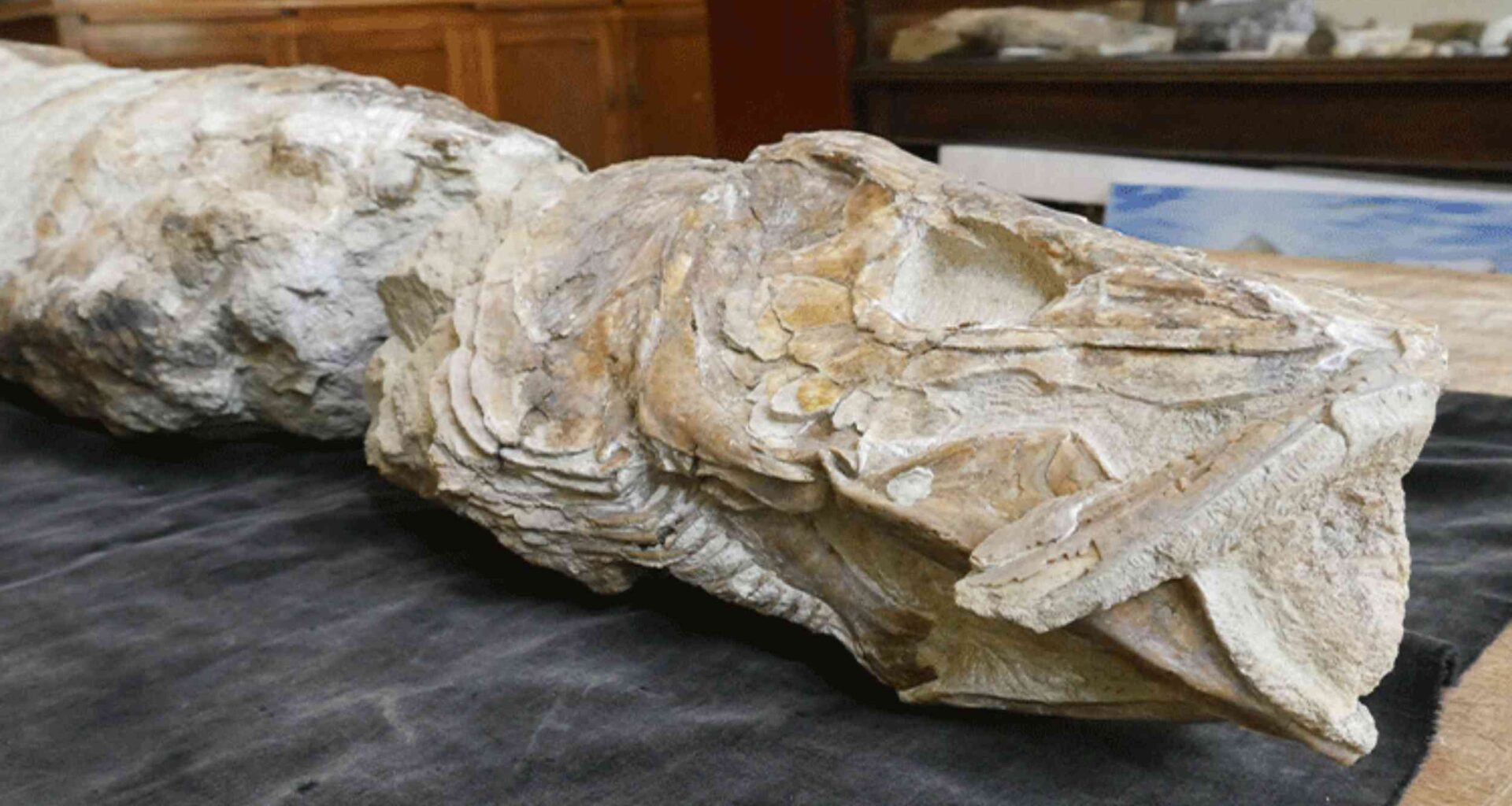
Scientists have identified a nearly four-foot predator preserved for 55 million years as a new tarpon relative, one of the most complete fossil members of this group ever recovered in the Southern Hemisphere.
Its identification restores a lost chapter of ocean life from the early Age of Mammals, revealing that powerful pursuit predators once hunted in seas far from where tarpons live today.
Tarpon fossil from New Zealand

High on a remote cliff above Waihere Bay on Pitt Island in New Zealand’s Chatham Islands, a large fossil fish lay sealed in rock for tens of millions of years.
Careful study of the specimen allowed Michael D. Gottfried of Michigan State University to document its anatomy and confirm it belonged to the tarpon lineage.
Distinctive features, including an elongated body, large overlapping scales, and an upward-facing mouth built for swallowing prey whole, mark it as a previously unknown species within that group.
Even with its identity established, understanding how and where the predator lived requires looking more closely at the details preserved in the fossil itself.
Built to chase
Long rigid scales, a powerful tail, and a large upturned mouth gave the fish the build of a predator that chased live prey.
Modern tarpons have the same upturned face and large scales, built for grabbing smaller fish in open water.
Compared with living tarpons, the fossil carried a lower head and a slimmer body overall. Together those differences told the team they were not staring at a living species in ancient rock.
Rare fossil preservation
Most fossil fish flatten under pressure, losing the body depth that helps scientists tell one fast swimmer from another.
Here, volcanic tuff, rock made from compacted ash, buried the animal so quickly that its form stayed almost lifelike.
That rare preservation kept the low head, long body, and unusual bones near the cheek and tail base in place. With that much detail still intact, the team had solid grounds to name a new species.
Where the study stalled
For years, one missing fact kept the fossil in limbo: no one could pin down the exact spot where it came from.
Richard Kohler had died, and the notes that could reconnect the specimen to the cliff were nowhere in the department.
By November 2023, a draft paper existed, but missing location data blocked the official record needed to finish it.
Without that documentation, even a spectacular fossil could stay scientifically incomplete, caught between discovery and formal recognition.
Notebooks reopen the case
Help arrived when one of Kohler’s children visited Otago in early 2025, hoping to find photographs of his father.
That visit led to field notebooks from the Pitt Island trip, and the pages supplied the missing locality details.
Lee said the notebooks finally supplied enough exact locality information to catalog the fossil properly. Once the fossil had a verified place in the record, the scientific story could move again.
Evidence of rich marine life
Large hunters do not live alone, and this fish hints at a food web rich enough to support active chasing.
A predator that swallowed smaller fish whole needed steady prey and enough room to chase.
Its presence therefore suggests a marine setting that was productive, layered, and more complex than a simple fossil list reveals.
That ecological glimpse helps explain why the find matters beyond a new name on a museum label.
Expanding the tarpon story
Far to the south, the fossil extends the tarpon story into waters where records of this broader fish group stay thin.
Researchers describe it as the most complete and informative southern-hemisphere fossil yet known from tarpon’s broader family line.
Because living tarpons now favor warm coastal waters, this southern record broadens the range their relatives once occupied.
That wider footprint helps researchers trace how old fish lineages spread and changed after the dinosaur extinction.
Work across decades
Science did not rescue this fossil in one burst of luck, but through years of collecting, preparation, and memory.
Kohler hauled it home in heavy blocks, Andrew Grebneff prepared it, and Ewan Fordyce helped start the paper.
“We could not have done this without them,” said Lee, summing up the notebooks’ role in bringing the study to completion.
That chain is unusually visible here, showing how fragile discoveries can be when field notes or collections go missing.
Naming the fossil species
Called Ikawaihere koehleri, the species name links the fossil to Waihere Bay and to Richard Kohler, the paleontologist who first recovered it.
Bones gave the study a predator, but notebooks gave it a place, a date, and the confidence needed for a name.
Names matter because later scientists can test only what collections, labels, and field notes fix in the record.
Fossil story across time
A fish that last swam 55 million years ago ended up telling two linked stories, one ancient and one distinctly human.
Its new name, reconstructed lifestyle, and verified home cliff all depended on evidence that outlasted the people who handled it first.
The study is published in the New Zealand Journal of Geology and Geophysics.
—–
Like what you read? Subscribe to our newsletter for engaging articles, exclusive content, and the latest updates.
Check us out on EarthSnap, a free app brought to you by Eric Ralls and Earth.com.
—–