
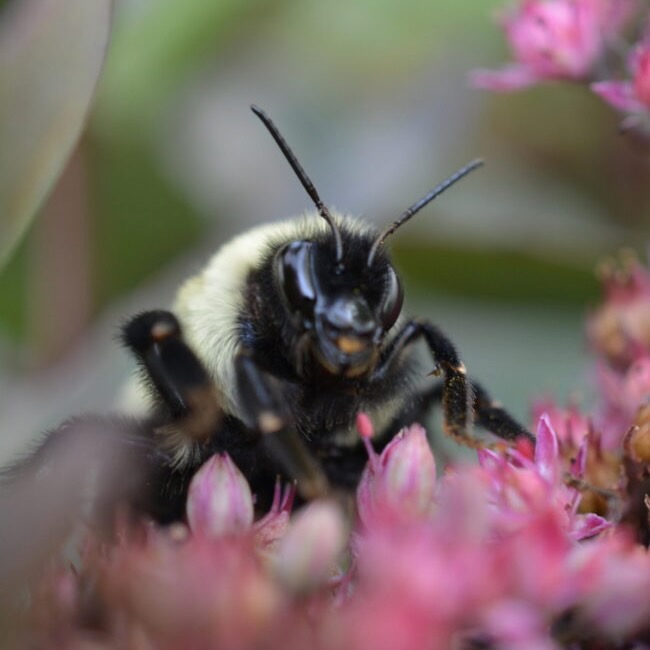
 Queen bumblebees hold the fate of whole colonies in their tiny bodies. Now, it seems they can survive for a week underwater, to defy floods and extreme conditions. Image via Lucas Borg-Darveau/ University of Ottawa. Used with permission.
Queen bumblebees can survive underwater
Bumblebee queens can survive underwater for more than a week, according to new research from the University of Ottawa. Scientists had long believed that melting snow and heavy rains drowned queens that hadn’t yet awakened from their winter sleep. But now, the new study shows dormant queens can remain alive even when spring floods submerge their underground winter chambers.
Why is it important? For the bees, the queen determines the future of entire colonies. In fact, each surviving queen becomes the founder of a new colony when spring arrives. So, if queens fail to survive winter or early spring flooding, those colonies never form.
For scientists, learning how bumblebee queens survive underwater provides valuable insight into the resilience of these essential pollinators. That’s important, these researchers said, as climate change brings more frequent floods and extreme weather. They said this knowledge could help protect bees that support ecosystems and agriculture worldwide.
In addition, they pointed out that the discovery highlights an encouraging reality: even tiny, seemingly fragile insects have remarkable ways to survive environmental challenges.
The researchers published their study in the peer-reviewed journal The Royal Society Publishing on March 11, 2026.
Life underground and sometimes underwater
Queen bumblebees spend each winter buried in the soil in what scientists call diapause. It’s a hibernation-like state that allows them to overwinter. During diapause, the bees’ bodies slow down dramatically to conserve energy until spring.
Later, when snow melts and seasonal rains soak the ground, water can flood the bees’ underground chambers. As a result, queens that remain dormant at that moment might become trapped underwater.
The research began with an intriguing observation. Charles-Antoine Darveau, professor of comparative physiology at the University of Ottawa, said:
This study started from a discussion with my co-author and postdoctoral researcher, Sabrina Rondeau, whose recent findings showed that these queens can survive submersion for over a week, which is extraordinary for a terrestrial insect. We wanted to understand how that’s even possible.
To investigate, the research team recreated winter conditions in the laboratory. First, the scientists placed queens in diapause for four to five months, then submerged them underwater for eight days. Throughout the experiment, the team monitored the bees’ metabolic rate – the speed at which their bodies use energy – and tracked several physiological changes. Honors student Skyelar L. Rojas also participated in the project.
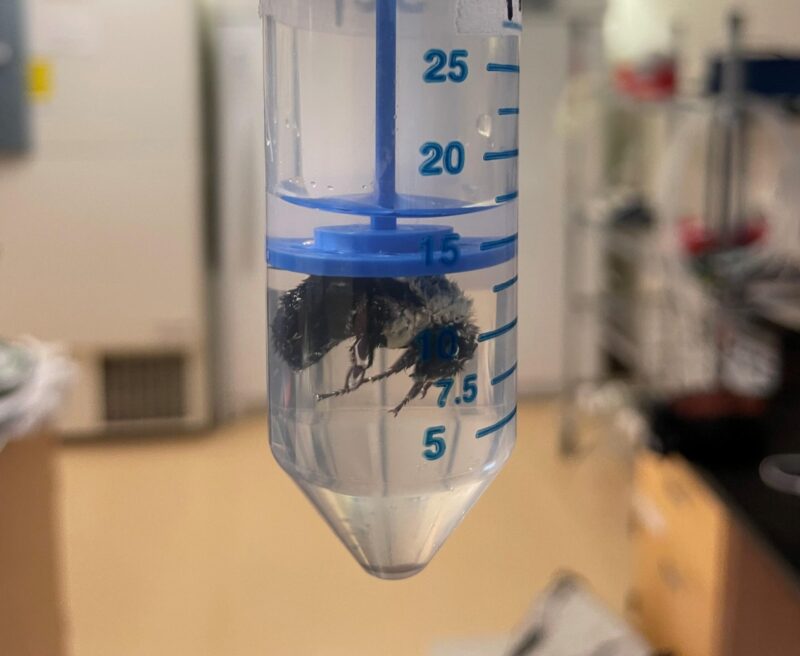 A bumblebee queen in a lab tube, simulating her water-filled winter underground chamber. Scientists monitored her physiology to understand how a terrestrial, flying insect can endure prolonged flooding and emerge ready to start new colonies in spring. Image via Professor Charles-Antoine Darveau/ University of Ottawa. Used with permission.
How queen bumblebees survive underwater
The results surprised the researchers. Even while submerged, the queens continued exchanging gases with the surrounding water, meaning they could still obtain small amounts of oxygen.
At the same time, their bodies maintained an exceptionally low metabolic rate. Darveau explained:
The first key is metabolic depression. Their metabolism is already extremely low during diapause. That low energy demand makes survival possible.
Put simply, the queens require so little energy during diapause that they can stay alive with minimal oxygen. But the scientists soon discovered that this explanation didn’t tell the whole story, however.
Energy without oxygen
The team also detected a strong buildup of lactic acid inside the bees’ bodies during submersion. This chemical appears when cells produce energy without oxygen, a process known as anaerobic metabolism.
Normally, animals use oxygen to convert nutrients into energy. When oxygen becomes scarce, some organisms temporarily switch to anaerobic metabolism. This alternative pathway still produces energy but also generates lactic acid as a by-product.
In the submerged queens, the accumulation of lactic acid showed that the bees had activated this backup system. Darveau explained:
They’re not relying on just one strategy. They combine underwater gas exchange with anaerobic metabolism. That flexibility is what allows them to survive these extreme conditions.
Together, very low energy demand, limited oxygen exchange and anaerobic metabolism allow the queens to endure several days underwater.
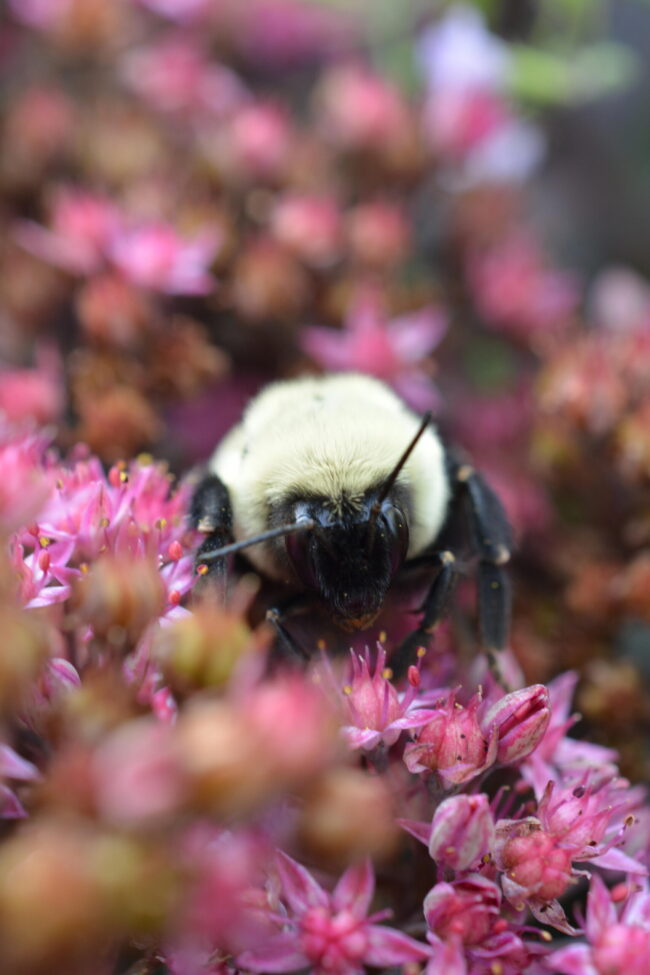 Even submerged for days, bumblebee queens endure by combining ultra-slow metabolism with a clever backup energy system. Image via Lucas Borg-Darveau/ University of Ottawa. Used with permission.
No harm done!
Surviving underwater comes at a cost, though. After eight days of submersion, the researchers removed the queens from the water and observed a dramatic response. Their metabolic rate increased sharply for two to three days. Darveau said:
That surge in metabolism coincides with clearing the accumulated lactate. It’s essentially a recovery phase. After about a week, their metabolism returns to normal diapause levels.
The queens remained in diapause throughout this process. The temporary increase in metabolism is an automatic physiological adjustment to balance the effects of anaerobic metabolism, not a sign that the bees have “woken up.” Then, once this recovery phase concludes, they resume the low-energy, hibernation-like state until spring, when they eventually awaken to start new colonies. Darveau commented:
This study shows how resilient these pollinators are. Understanding these mechanisms helps us predict how bumblebee populations might cope with increasingly frequent spring floods.
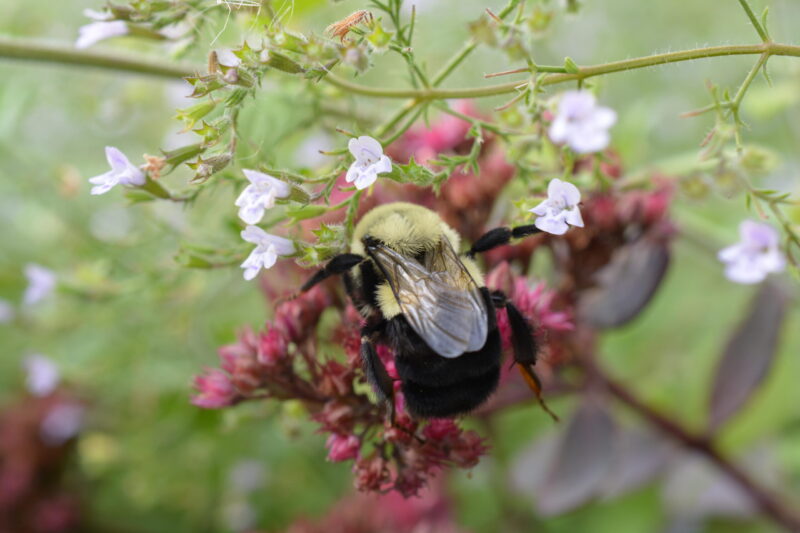 Queen bumblebees can be submerged for days and still rise to rule the hive once spring arrives, proving that these “queens” truly deserve the title. Image via Lucas Borg-Darveau/ University of Ottawa. Used with permission.
Bottom line: We knew queen bumblebees were mighty. Each queen that survives winter founds a new colony in spring. Now we know they can survive underwater for over a week!
Read more: Do bees die after they sting you?
Read more: Hummingbirds snooze when energy is low
Cristina Ortiz
View Articles
About the Author:
Cristina Ortiz – based in Granada, Spain – is EarthSky’s defender of animals with her “lifeform” videos at EarthSky YouTube. Discover the most fascinating facts about all the beings with whom we share Earth. Are you ready for the adventure? Cristina has been an EarthSky.org editor since 2021. She has a master’s degree in translation and interpreting, specializing in science and technology. “Since I was a kid,” she says, “I could feel that passion for science and communication.”