
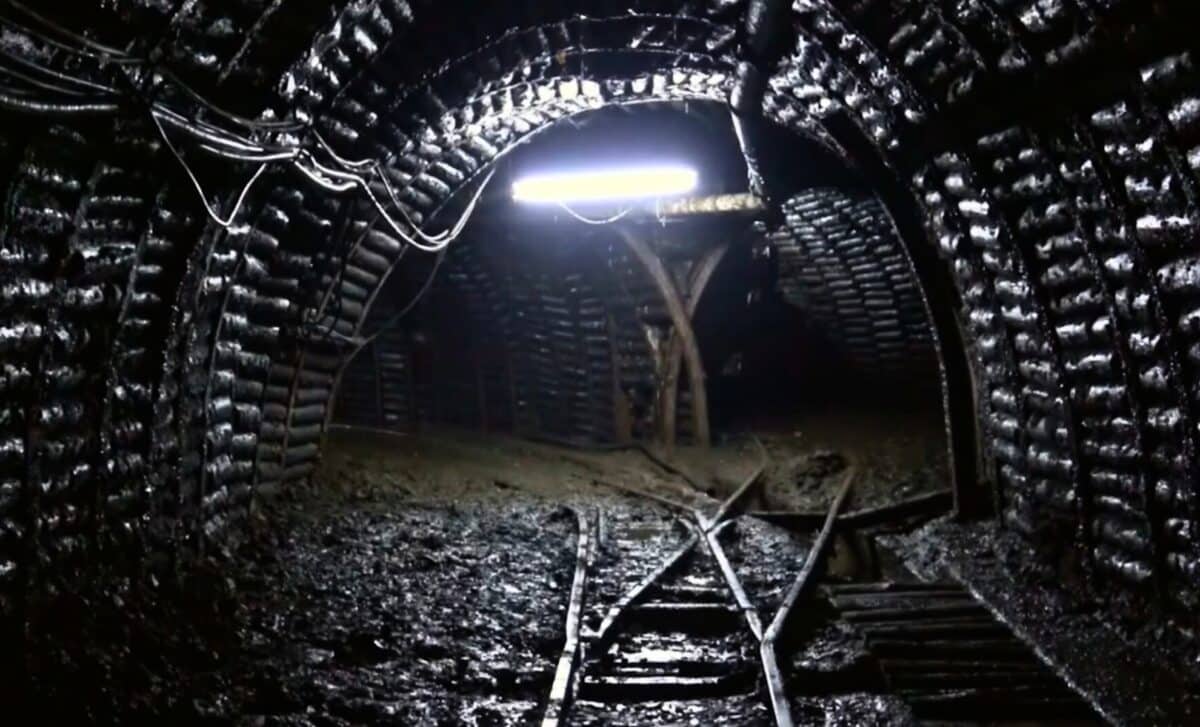
Beneath parts of the Appalachian Mountains, thousands of mine shafts still descend deep into the earth. Some of these vertical passages drop more than 1,000 feet, connecting long corridors carved through rock during decades of coal extraction. The tunnels once carried miners, machinery, and heavy loads of coal through reinforced routes engineered to withstand enormous geological pressure.
Today many of those passages remain intact but unused. Rusted headframes and sealed openings mark the locations of abandoned coal mines across states such as Pennsylvania and West Virginia, reminders of an industry that once powered large parts of the United States. Instead of operating as energy sources, many of these sites are now monitored as environmental risks because abandoned shafts can leak minerals into groundwater or create unstable ground above.
The scale of this underground network is enormous. Federal surveys have documented more than 500,000 abandoned coal mines scattered across the United States. Many lie near communities, transportation corridors, and industrial infrastructure that developed around mining activity over the last century.
Researchers at Oak Ridge National Laboratory began examining whether these deep shafts could serve a new purpose. Instead of sealing them permanently, engineers are studying whether abandoned coal mines could become part of the infrastructure needed to store electricity for the modern power grid.
The Hidden Depth Beneath Old Mining Sites
Coal mining created some of the deepest engineered shafts in North America. Many extend hundreds or even thousands of feet underground and maintain stable temperatures throughout the year. During their construction, engineers reinforced surrounding rock to ensure transport routes would remain open for decades of heavy industrial activity.
That design left behind a network of vertical shafts connected to wide horizontal tunnels branching through coal seams. According to researchers, this underground architecture creates conditions rarely replicated in modern construction projects.
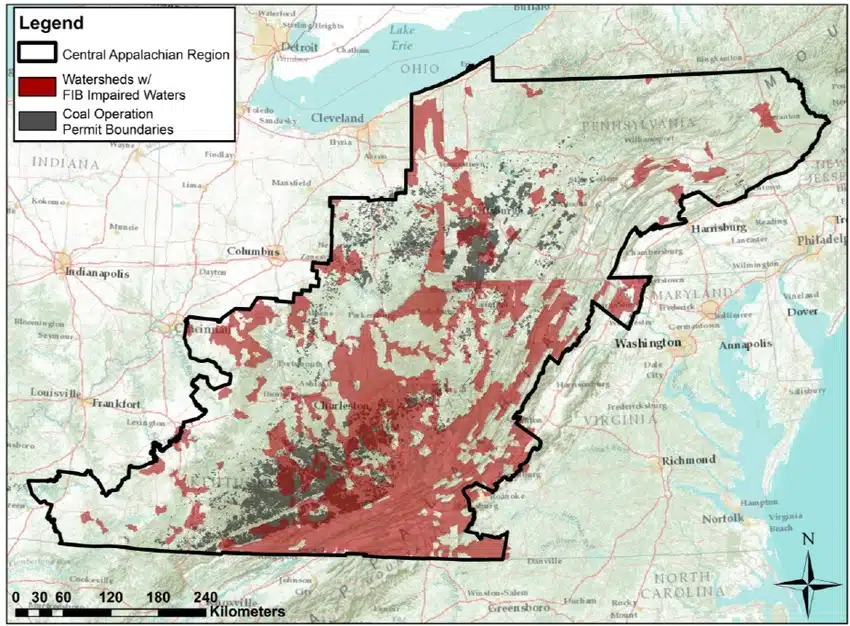 Central Appalachian Region Political Boundaries and Mining Extents. Credit: Cook, Nicholas & Sarver, Emily & Krometis, Leigh-Anne. (2015)
Scientists at Oak Ridge National Laboratory working with the U.S. Department of Energy have spent several years studying how this infrastructure might support energy storage technologies. Their research suggests the depth and stability of abandoned coal mines could make them suitable for storing large amounts of electricity.
The concept addresses a growing challenge for utilities. As the United States adds more renewable energy from solar and wind power, the electrical system needs ways to store surplus electricity when production is high and release it later when demand increases.
How Gravity Can Turn a Mine Shaft Into a Battery
One system under consideration relies on gravity rather than chemistry to store energy. The technology is being developed by Green Gravity, a company exploring ways to convert mine shafts into mechanical energy storage systems.
In this design, excess electricity from the electrical grid powers motors that lift extremely heavy weights toward the top of a mine shaft. When electricity demand rises, the weights are slowly lowered back down the shaft. Their descent spins a generator, producing electricity that flows back into the grid.
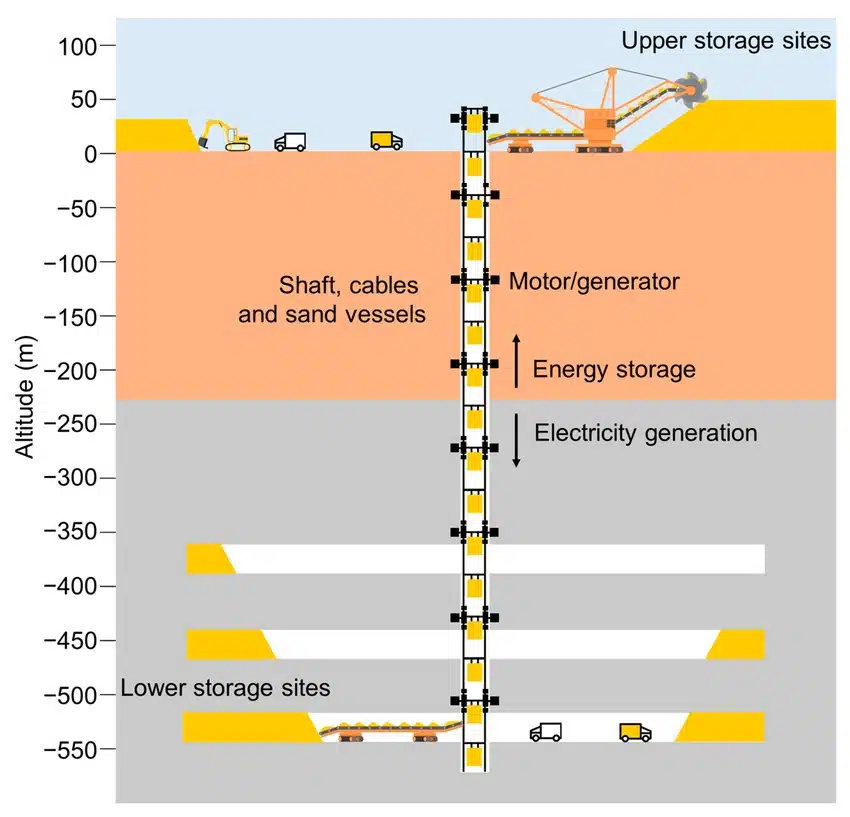 Underground Gravity Energy Storage system: A schematic of different system sections. Credit: JO – Energies
Mark Swinnerton, founder of Green Gravity, described the approach directly: “Our technology uses the proven principles of gravity and the existing infrastructure of mines to deliver a low-cost, long-life energy storage solution.”
The weights used in these systems are often constructed from recycled steel or dense concrete to maximize mass. Because the process depends on physical motion rather than chemical reactions, the equipment can operate for decades without the performance loss seen in many lithium-ion batteries.
Researchers say the depth of many abandoned coal mines provides enough gravitational potential to support large-scale storage systems using this approach.
Water and Air Storage Inside Underground Tunnels
Gravity weights are not the only option researchers are evaluating. Engineers are also examining the potential for pumped storage hydropower within old mine networks.
This method stores electricity by moving water between reservoirs located at different elevations. When electricity demand is low, pumps push water upward into a higher reservoir. When demand increases, the water flows back downward through turbines, generating power.
Inside a mining site, the deepest tunnels can function as the lower reservoir while the surface or upper shafts serve as the upper reservoir. This creates a closed-loop system that avoids the need to dam rivers or flood natural valleys.
Researchers are also exploring compressed air energy storage in the horizontal passages that branch away from the main shafts. Electricity powers compressors that push high-pressure air into underground chambers. When electricity is needed, the air is released through turbines that generate power.
The branching tunnels inside abandoned coal mines can provide large underground volumes suitable for storing pressurized air. The surrounding rock helps contain pressure and maintain system efficiency.
Mapping 500,000 Abandoned Coal Mines for Energy Storage
Determining which mines could support these technologies requires detailed analysis. A research team led by Olufemi Omitaomu at Oak Ridge National Laboratory has developed a mapping system to evaluate potential storage sites across the country.
The tool analyzes factors such as shaft depth, geological stability, and proximity to existing transmission lines. Mines that meet these criteria are flagged as potential candidates for future energy storage facilities.
Many of these sites already sit near electrical infrastructure built during the mining era. Heavy-duty power lines once supplied electricity to ventilation systems, water pumps, and underground equipment. Reusing this infrastructure could reduce the cost and time needed to connect storage systems to the grid.
Several of the identified sites are located in regions that experienced economic decline after the closure of coal operations. Converting abandoned coal mines into energy storage facilities could bring new technical work and infrastructure investment back to these communities.
The research now underway at Oak Ridge National Laboratory focuses on identifying which abandoned coal mines meet the structural and geological requirements for underground storage systems. The laboratory maintains a national database listing mine sites that satisfy the depth, stability, and infrastructure conditions needed for gravity-based and underground energy storage.