

The Saudi Arabian state-backed oil company has said it will restore just over 70 per cent of its shipments within days, as its chief executives warned that there could be “catastrophic consequences” for the world’s oil markets if the Iran war continues to disrupt shipping in the Strait of Hormuz.
Amin Nasser, chief executive of Saudi Aramco, said that it would divert about five million barrels a day of oil via its East-West pipeline within “a couple of days”.
Saudi Aramco typically exports about seven million barrels of oil a day via the Strait of Hormuz, with only a small portion shipped via the Yanbu port on the Red Sea.
“Tankers need to reposition to the west coast for loading, and this is what we are doing,” Nasser said.
Analysts had previously estimated that constraints in the storage tanks, along with shipping shortages at the port of Yanbu, could limit the amount of oil that can be realistically exported via the alternative route.
Nasser cautioned that the continuing disruption in the key waterway, through which about 20 per cent of all oil supplies pass, has upended the shipping and insurance sectors and is likely to hit aviation, agriculture, carmaking and other industries.
He said that global inventories of oil were at a five-year low, the crisis would lead to drawdowns at a faster rate, and it was critical for shipping in the strait to resume.
“There would be catastrophic consequences for the world’s oil markets, and the longer the disruption goes on, the more drastic the consequences for the global economy,” he said.
His comments, made on a quarterly earnings call, are the first public warning from the world’s largest oil company since the war in the Middle East broke out, prompted by the US-Israel attacks on Iran.
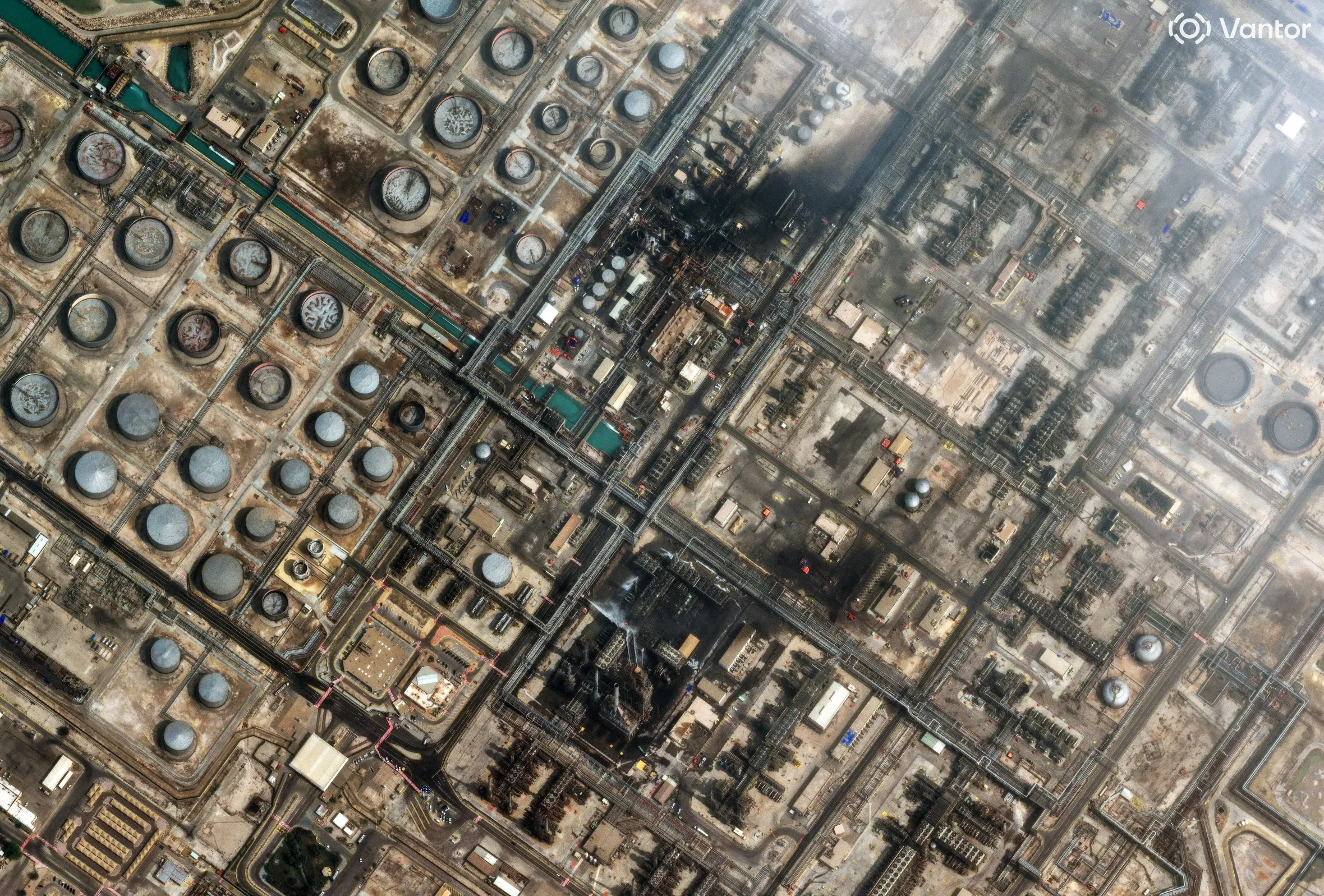 A satellite image shows damage at Saudi Aramco’s Ras Tanura refineryVANTOR/AFP/GETTY IMAGES
Nasser said Aramco’s Ras Tanura refinery was in the process of being restarted after a small fire from an attack last week.
The risk of attacks on tankers passing through the Strait of Hormuz has effectively closed the 104-mile route. Some of the region’s producers have only a few days before their storage tanks are full and they are forced to cut production more substantially.
Saudi Aramco is the world’s largest oil producer, turning out 12.9 million barrels of oil and liquefied gas last year.
The sharp rise in oil prices has eased after reaching a four-year high on Monday, on hopes that the conflict may be brought to a close. On Monday, President Trump told a journalist from CBS News over the phone that the war with Iran could soon be over. “I think the war is very complete, pretty much,” he said. Pete Hegseth, the US secretary for war, said Tuesday would be the “most intense” day of strikes inside Iran. Hegseth also said “we will not relent until the enemy is totally and decisively defeated … we do so on our timeline”.
However, Iran’s Islamic Revolutionary Guards Corps said on Tuesday that it would not allow “one litre of oil” to be shipped from the Middle East if American and Israeli attacks continued, prompting Trump to warn that the US would hit Iran harder if it blocked exports.
Brent crude is 12 per cent lower at $88 a barrel, after an extraordinary day on Monday that saw the benchmark surge to over $119 in early trading before falling back below $90. Despite the retreat, it is still up 44 per cent since the start of the year.
On Monday analysts at Rystad Energy warned that Saudi Arabia, one of the world’s largest oil producers and a key member of the Organisation of Petroleum Exporting Countries (Opec) cartel, had just three days before it runs out of storage for oil and other refined products.
The Gulf region produces about 20 million barrels of oil a day, which is exported primarily via the Strait of Hormuz.
“When the conflict ends, cranking up the supply chain won’t be swift,” said Simon Flowers, chairman and chief analyst at Wood Mackenzie, said.
“Product barrels in storage at refineries or in port might be moved on vessels quite quickly. But if wells are shut in for a prolonged period, restarting production to full output could take weeks or even longer,” he said.
Aramco reported a 12 per cent drop in annual profit to $93.4 billion, mostly due to lower crude prices last year. Total revenue for the year fell 7.2 per cent to $415.8 billion. However, it also announced a $3 billion share buyback, its first.
Aramco has long been a huge source of income for the Saudi state, providing more than half of government revenues. The kingdom directly holds nearly 81.5 per cent of the company, and its sovereign investor, the Public Investment Fund, holds another 16 per cent.
Its shares have risen 3.02 riyal, or 13 per cent, to 26.90 riyal (533p) since the start of the year.