
The original Stuff headline.
It was further inflamed when other media – including TVNZ and RNZ, whose syndicated story was also published by the NZ Herald – stated that punches were thrown, quoting the original article.
It spread like wildfire, with specialist rugby websites also reporting what had allegedly unfolded.
By now, an exasperated Crusaders communications and media manager Maddy Lloyd, a former TVNZ reporter, was on the equivalent of the modern-day blower – a WhatsApp group of rugby media contacts.
“For anyone who has the word ‘punch’ in your stories (most of who didn’t have a reporter here today, but that’s another issue in itself) can you please remove this,” she wrote.
“There [were] absolutely no punches thrown – I’ve viewed the training footage myself, and it was a bit of push and shove at most – most stories are grossly exaggerated by people who weren’t even here.”
Most newsrooms updated their headlines and stories in the following hours, removing any references to punches – RNZ appended a clarification to its story, stating that the earlier version was incorrect.
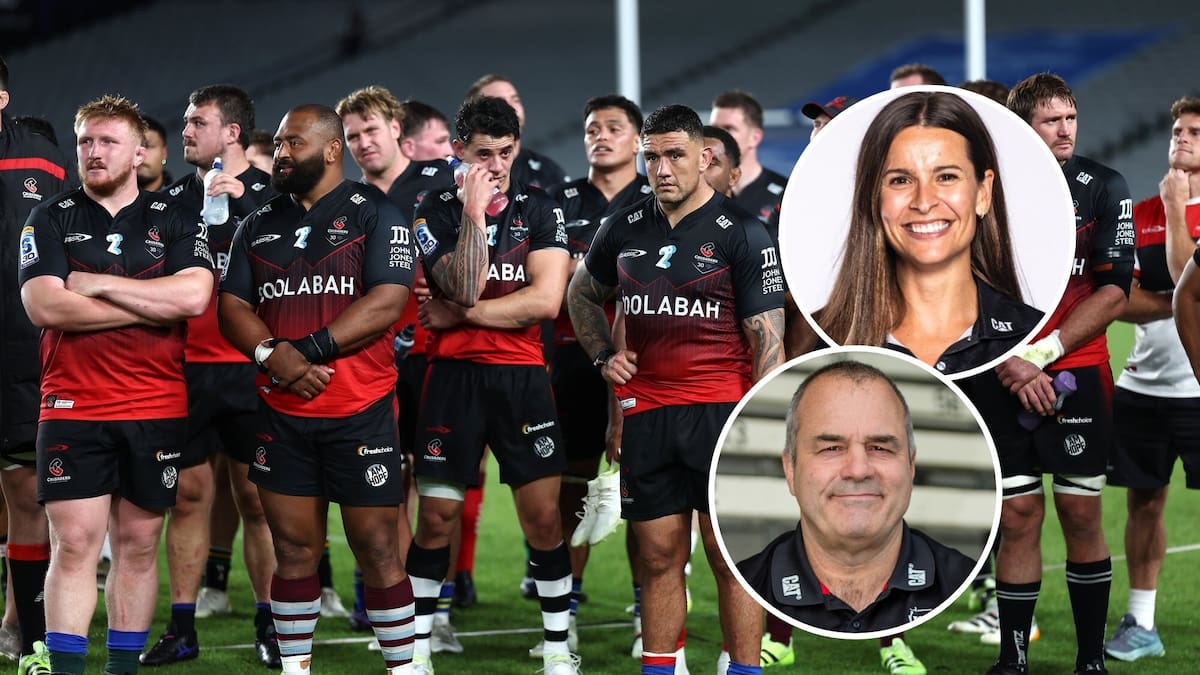
The Crusaders are New Zealand’s most successful Super Rugby franchise. Photo / Photosport
Stuff told Media Insider there was a “difference of opinion” between its journalist who was at the scene and the Crusaders, but ultimately it accepted their version of events, and updated its story.
Crusaders coach Rob Penney fronted up at a press conference and, later on, with D’Arcy Waldegrave on Newstalk ZB. He told reporters the incident was “lovely to see” and reflected his players’ passions following a reasonably ordinary start to the season (the Crusaders have won only one of four matches).
Like the incident itself, matters appeared to have been resolved reasonably quickly.
But the next day, the fallout ramped up. The Crusaders had moved from scuffling with each other and were now united in focusing on a new tackling bag – the media.
“Sorry,” wrote Lloyd, at the start of a new WhatsApp missive.
“This is not a message I want to be sending, but I have been given no choice.
“At the request of the players, from now on, I’m going to need you all to wait in the foyer until training has finished. This is far from ideal, and the last thing I want, but some of your actions yesterday give me no choice.
“It was disappointing to see inaccurate reporting and a story that’s been wildly blown out of proportion – trust is huge in this area, and unfortunately, it was broken yesterday.
“Some of you didn’t have reporters here yesterday, or you had reporters writing stories about it who weren’t even here. This is hard to wrap my head around and pretty poor form.
“From a player’s point of view, this is a real shame, especially for someone who is new to our environment. Trust has pretty much gone, which I have worked so hard to build up over the past year.
“This is gutting to say the least. We invite you into our space and trust you to adhere to the rules and trust you to respect our approved vision windows and this was blatantly ignored yesterday by some.
“I am your biggest advocate – I am constantly trying to give you the best access I can and plead your case to the team, and to have this thrown back in my face is really disappointing.
“From now on, when you arrive, please wait in the foyer until I say you can come out and film iron time. You are not permitted to stand and watch training before this time.”
She was sorry, she said, to the innocents who were not involved in the coverage and were now effectively collateral damage. “My hands are tied, and I need to respect the players’ wishes at this point as they are understandably feeling pretty burned.”
There’s a lot to unpack there.
Firstly, the reference to punches was an error, should not have been made, and was rightly corrected. But there was certainly a scuffle between two teammates – their captain had to reportedly help break it up – and that’s news. Any journalist worth their salt would report it.
Secondly, the Crusaders players’ response is silly – most professional sports teams are now embracing the warts-and-all coverage of their athletes and the behind-the-scenes drama. Drive to Survive, anyone? The players’ response highlights just how tough it can be for a rugby PR specialist – I have sympathy for those caught between grumpy players and coaches and grumpy media.
Thirdly, this incident further highlights that rugby players still have a way to go in recognising the exalted position the sport holds in New Zealand media. Media Insider has reported previously the difficulties between All Blacks and the media.
“This is universally accepted by all in sports journalism … everyone regards the All Blacks machine as the most difficult to deal with in all of sport,” Newstalk ZB’s Mike Hosking said in mid-2024. “They are a pain in the ass and there’s no reason to be. If you contrast them with motor racers who get up at all hours of the morning to come on this programme, the All Blacks will not.”
To give NZR some credit, it has been striving hard to overcome this perception more recently.
Nevertheless, most sports would love a reporter to turn up to their event at the weekend – having someone along to a weekday training would be a pipedream.
But as much as sports editors might like to send their reporters to the training of a team that currently sits eighth on the Super Rugby table, there might be other priorities in an era of newsroom cutbacks and stretched business models.
None of this excuses basic errors, of course. The media has a responsibility to get things right.
A chat with the Crusaders
I had an enjoyable chat yesterday with Lloyd and Crusaders chief executive Colin Mansbridge.
We discussed the need for professional sporting franchises to protect their IP and why rules are in place to balance the desire for teams to run through their secret moves, while also catering for the media’s desire for vision and interviews.
Crusaders CEO Colin Mansbridge. Photo / Photosport
“We do value the quality of the relationship that we have with media,” said Mansbridge.
“We do try to be as open and honest as we can possibly be. I encourage everybody here to not be scripted, not be overly prepared and to see media as very, very effective partners for us. We’re not looking to change that.”
He said Lloyd had worked hard to build trust between the players and media, and they both hoped that the relationship would eventually return to the point where it was before this week.
“I would say it’s almost a collective view of, let’s just be a little bit careful for the next wee while and watch each other’s backs,” said Mansbridge.
“My hope is that, as trust gets built on the other side and some of the people who have apologised for what’s happened… as they start to build some credibility back, we’ll go back. My personal preference is that all journalists would sit there through the whole training.
“That doesn’t happen in any professional code anywhere in the world. That would be nirvana, where we can trust each other enough.”
Meanwhile, Stuff gave its perspective on non-punch-gate.
“There was a difference of opinion between Crusaders management and our reporter at the scene on whether the altercation between players was connected punches or something less serious,” said Stuff Digital editor-in-chief Keith Lynch.
“After complaints from the Crusaders’ media manager, we amended our copy from ‘punches were traded’ to ‘heated scuffle’. This change should have been acknowledged in the story and, due to human error, it wasn’t.
“The image was first published only after seeking approval from the team management. This was later revoked and, due to the photos being taken outside the designated media vision window and as a courtesy to the players, we removed it.
“Following the event, coach Rob Penney seemed happy with the events as evidenced by his quotes: ‘It was a really lovely sight to see, actually. It is a reflection of how much it means… Very proud young men are going to come up against each other, and create a bit of sandpaper from time to time’.”
From consumer champion to business frontman
Herald NOW Business host Garth Bray. Photo / Michael Craig
He was the face, for many years, of TVNZ’s Fair Go – until the state broadcaster, faced with major cost-cutting challenges, culled the popular consumer show.
For the last almost two years, Garth Bray has reinvented himself as a senior business journalist for BusinessDesk, a role that has also included a daily business segment alongside Ryan Bridge on the NZ Herald’s morning news show.
And now Bray has his own show again.
Herald NOW Business with Garth Bray launches on Monday, a new half-hour show starting at 6.30am, before Bridge’s 7am-9am show.
“Business news is absolutely vital,” Bray told Media Insider.
“If you’re a leader, you need the best information to handle the risks and chase the gains. And what happens in business lands on everyone’s doorstep.
“It’s your mortgage, your job, the price of your groceries, the choices your family can make, people deserve to know. As for championing one or the other, I’ve never seen those as separate things.
“If businesses are doing well and doing right by people, everyone’s better off. It’s the same kaupapa, just a wider lens.
“We’re all more than just consumers. KiwiSaver means more of us have a stake in companies and assets. There are well north of 600,000 businesses in New Zealand and more every year. Even the pensions and ACC rely on wise investment.
“Maybe business could do with a champion but honestly, it’s the news I’m championing. Good, solid business journalism that helps people make sense of what’s going on.”
‘A good story is still a good story’: Farewell, Bernard
The Herald’s super city reporter, Bernard Orsman, is laying down his pen today after a 36-year stint at the paper – 28 of them covering Auckland. He took the time for a Media Insider exit interview.
Outgoing NZ Herald reporter Bernard Orsman. Photo / Michael Craig
1. Firstly, 28 years – that’s a phenomenal tour of duty covering Auckland issues. What’s kept you going all that time?
I grew up in Wellington, but Auckland has been home for most of my adult life. I’ve loved covering the political landscape and watching the city evolve from a squabbling babble of eight councils into the Super City. What really keeps the energy levels up is picking up community issues and helping to drive an outcome.
2. Are there still specific issues from 1998, perhaps within housing, transport or something else, that you’re still covering or are yet to be resolved?
Transport has been the city’s biggest challenge for decades, with housing not far behind, thanks to Aucklanders’ long‑standing infatuation with property. Public transport has improved markedly with the revival of rail, the Northern Busway, and better bus services. The City Rail Link will be a game‑changer when it opens later this year, and I’d love to see the Northwestern Busway become the next major project. Westies will love it. As for a new harbour crossing, I can’t see that happening in my lifetime.
3. How has journalism, and the way you have covered the council round, changed in that time?
When I started at the Herald, we were using manual typewriters. Today, those mid‑20th‑century Imperial 60s sit in museums, and AI is the latest tool on the desk. The technology may have changed, but a good story is still a good story, whether it’s council or crime, even if it’s dressed a little differently these days.
4. What do you love about Auckland?
Auckland is unique with its maunga, sprawling suburbs, rural regions to the north and south, all framed by the wild west coast ocean beaches and beautiful Hauraki Gulf. What’s not to love? I love how the city has embraced diversity, and a shoutout for my favourite cafe/deli – Ripe, in Grey Lynn.
5. What’s holding the city back from achieving its full potential?
Money. Neither Auckland Council and/or the Government have the financial resources to fix the city’s broken infrastructure and build the public transport, roads, schools, hospitals, and other needs for Auckland to reach its full potential.
6. I see the mayor, deputy mayor and councillors all paid tribute to you this week – how have relations been with them in the Wayne Brown era?
About as good as I could have hoped. A bit of healthy tension and the occasional unprompted text from the mayor, which I usually leave sitting there unanswered.
7. As you reflect on your career, what stands out – a favourite story, or memory?
One of the most satisfying stories was the 2005 battle by fashion leaders to save the red pebble pavers in Vulcan Lane. Council officials ran what was essentially a sham consultation that, surprise, surprise, recommended ripping them up and replacing them with the same bland grey pavers spread across the CBD. The council dug in, pitching its case from a stand at the bottom of the lane, but eventually public pressure led to a backdown. The drainage was fixed, and the red pavers stayed.
8. Any memorable run-ins or stoushes?
John Banks calling me “a streak of weasel’s piss” on his talkback programme, Banksie on Sunday, when I worked in the Press Gallery.
9. Who’s been the best mayor? And the worst?
There hasn’t been a best or worst mayor. Banks went from being a bull in a china shop in his first term, and “transmogrifried” (his word) into a softer self in his second term. Christine Fletcher built Britomart (the biggest achievement of any mayor), Dick Hubbard never came to grips with politics, but developed the blueprint for Wynyard Quarter and the Tank Farm. Len Brown has stayed out of the limelight since his 2013 headlines, but he can take real pride in getting the City Rail Link over the line, thanks partly to the strong bond he built with then‑Prime Minister John Key. Phil Goff’s managerial style was boring to cover, but he cunningly overturned the board and management at Ports of Auckland after its poor safety record.
That brings me to Wayne Brown – a likeable but grumpy old man who never minces his words. Just ask Auckland Transport, which has felt the full force of his vocabulary.
10. What are you going to do with yourself after today?
Enjoy a cup of tea.
‘We’re coming home’: Kiwi agency expands to Wellington
Federation leaders include Aaron White (left), managing partner, Wellington; Sharon Henderson, chief executive; Brad Collett, chief creative officer; Olly Walker Boden, managing director.
Big, happy news for the Wellington advertising market.
Independent creative agency Federation is expanding to the capital, with the appointment of respected agency leader Aaron White as Wellington managing partner.
White, previously managing partner of Stanley Street Wellington, joins Federation as it expands across Wellington, Auckland and Melbourne – with further Wellington appointments to be announced, says the agency.
“This is a definitive moment for our 100% New Zealand-owned agency, and a big milestone for me personally,” said Federation founder and chief executive Sharon Henderson.
“While our agency started with its base in Auckland, few know that Wellington is where Federation’s story really began.
“Back in 2008, when international networks dominated the market, it was Wellington-based Meridian Energy who gave us our first big break, entrusting Federation with their critical power-saving campaigns during one of the worst droughts on record.”
She said the move would help “boost Wellington’s return to growth”.
“In 2026, we’re proud to count The Co-operative Bank, Massey University and Maritime New Zealand amongst our Wellington clients.
“Opening our agency with a respected leader on the ground in Wellington and someone of Aaron White’s calibre as agency lead, well, it feels a bit like we’re coming home to where it all started.”
White said: “Change has to start somewhere. And in Aotearoa New Zealand, it often starts in Wellington. While we are the political heart of the country, we are so much more. Wellington is the cultural crossroads, the social barometer and a testing ground for the most influential ideas that change behaviour for the long term.
“The decisions shaped here, in both public sector and commercial organisations, don’t stop at the city limits. They reach into the regions, industries and communities nationwide.”
Henderson said the Wellington market had “fragmented”, with multinational and Australian-owned agencies.
“Federation, on the other hand, remains fiercely independent and is proudly 100% New Zealand-owned. We don’t offshore profits or dilute our strategy for overseas shareholders.”
Federation chief creative officer Brad Collett said: “I’ve worked with Aaron previously and on multiple government and public sector clients. Together we’ve delivered some truly impactful campaigns for Department of Corrections Ara Poutamu and Ministry of Education.
“Aaron is not just a brilliant strategist and business leader; he’s a genuinely great guy – someone you definitely want in your corner.”
White said 2026 was “Federation’s time”.
“It’s a homecoming for me too. I worked alongside Sharon at Clemenger-owned Proximity and with Brad at Stanley Street. I share their passion for ideas that create genuine commercial results, improving outcomes for New Zealanders, and creating critical behaviour change that transforms Aotearoa.”
Editor-at-Large Shayne Currie is one of New Zealand’s most experienced senior journalists and media leaders. He has held executive and senior editorial roles at NZME including Managing Editor, NZ Herald Editor and Herald on Sunday Editor and has a small shareholding in NZME.