
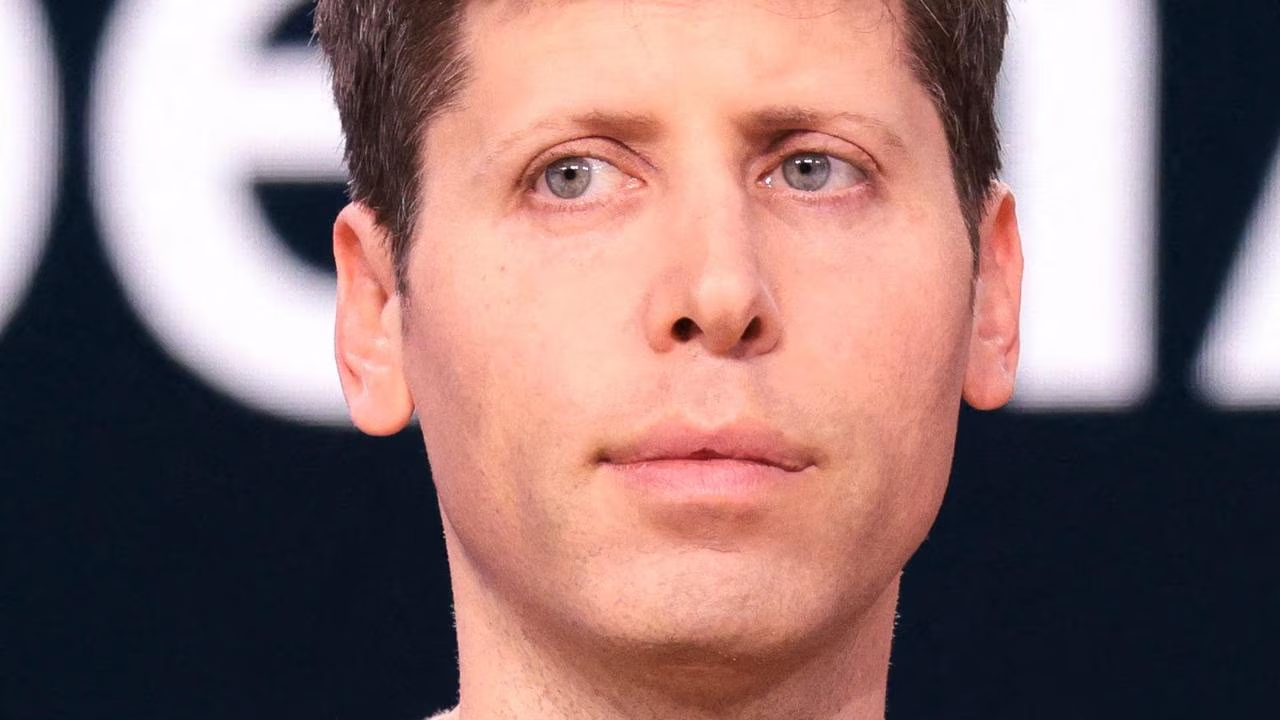

OpenAI CEO Sam Altman has sparked debate after suggesting artificial intelligence could soon be sold like electricity or water – with users paying for “intelligence” on a meter.
The ChatGPT creator made the bold prediction during an appearance at the BlackRock US Infrastructure summit in Washington this week, where he detailed his forecast on the evolution of AI as demand continues to rise.
“We see a future where intelligence is a utility, like electricity or water, and people will buy it from us on a meter,” said Altman.
“Fundamentally, our business and I think the business of every other model provider is going to look like selling tokens.
“They may come from bigger or smaller models, it makes them more or less expensive. They may use more or less reasoning, which also makes them more or less expensive.
“They may be running all the time in the background trying to help you out. They may run only when you need them if you want to pay less. They may work super hard and spend hundreds of millions of dollars on a single problem and that’s really valuable.”
Viewers were left divided over the prediction, with some calling it the “bleakest” statement they had ever heard.
“I don’t need AI to live, dude. I’ve literally never seen a more delusional tech founder in my life,” wrote one X user.
MORE: 6 essential workplace skills in the age of AI
“This is one of the bleakest things I’ve ever heard. Categorically anti-humanity,” said another.
“They stole all this data from us, the people, our life’s work, creativity, art, etc. by devouring the internet and blowing through all copyright laws. Now they want to ‘sell it back to us’ in the form of a utility?,” questioned a third.
“Honestly this sounds like the beginning of a black mirror episode … “Intelligence as a utility” is just fancy talk for “we’re gonna charge you to think,” wrote a fourth.
What would this look like?
For those of us who are still trying to work out the ins and outs of AI, a token is essentially a small chunk of text that AI reads or writes.
If we were to imagine AI as a vending machine; every time you ask it to do something, it uses a small amount of ‘fuel’ to understand your request and respond accordingly. That fuel is called a token.
If AI was to become an everyday utility, it might work like you paying for one million tokens at the beginning of each month, which would be your ‘budget’ for how much you can use the intelligence.
At the end of the month, you would get a bill for your usage, similarly to gigabytes on a phone plan.
CEO says AI being blamed for too much
“Data centres are getting blamed for electricity price hikes. Almost every company that does lay-offs is blaming AI, whether or not it really is about AI,” said Altman.
Altman went on to claim that companies were engaging in “AI washing”, and attempting to blame lay-offs on new technologies.
The CEO believes humans will “create new jobs” to coincide with the tech revolution, but conceded that the “next few years are going to be a painful adjustment.”
Rising concern over energy use
The rapid expansion of AI infrastructure is also raising major concerns about its environmental impact.
To fuel what Mr Altman calls the “next renaissance”, OpenAI is pursuing massive infrastructure builds, including gigawatt data centre campuses.
“We want to flood the world with intelligence, we want people to just use it for everything,” he said.
Data centres already consume a significant share of global electricity, and that demand is expected to rise sharply as AI systems become more widespread.
These facilities are essentially large buildings that operate around the clock to process, store and manage digital information.
Inside, they house vast networks of equipment including servers, routers, firewalls and storage systems.
Sizes vary widely, from relatively small sites of around 500 square metres to massive sites spanning up to 100,000 square metres.
Australia has already emerged as a major hub for data centres, with over 250 centres operating across the country, and more under construction.
The proposed Mamre Road Data Centre in Sydney’s west has a planned capacity of one gigawatt, roughly the same electricity consumption as a small city.
Mr Altman has previously acknowledged the energy challenges posed by AI’s growth, saying the industry will need large-scale supplies of nuclear, wind and solar power to sustain its demand.