
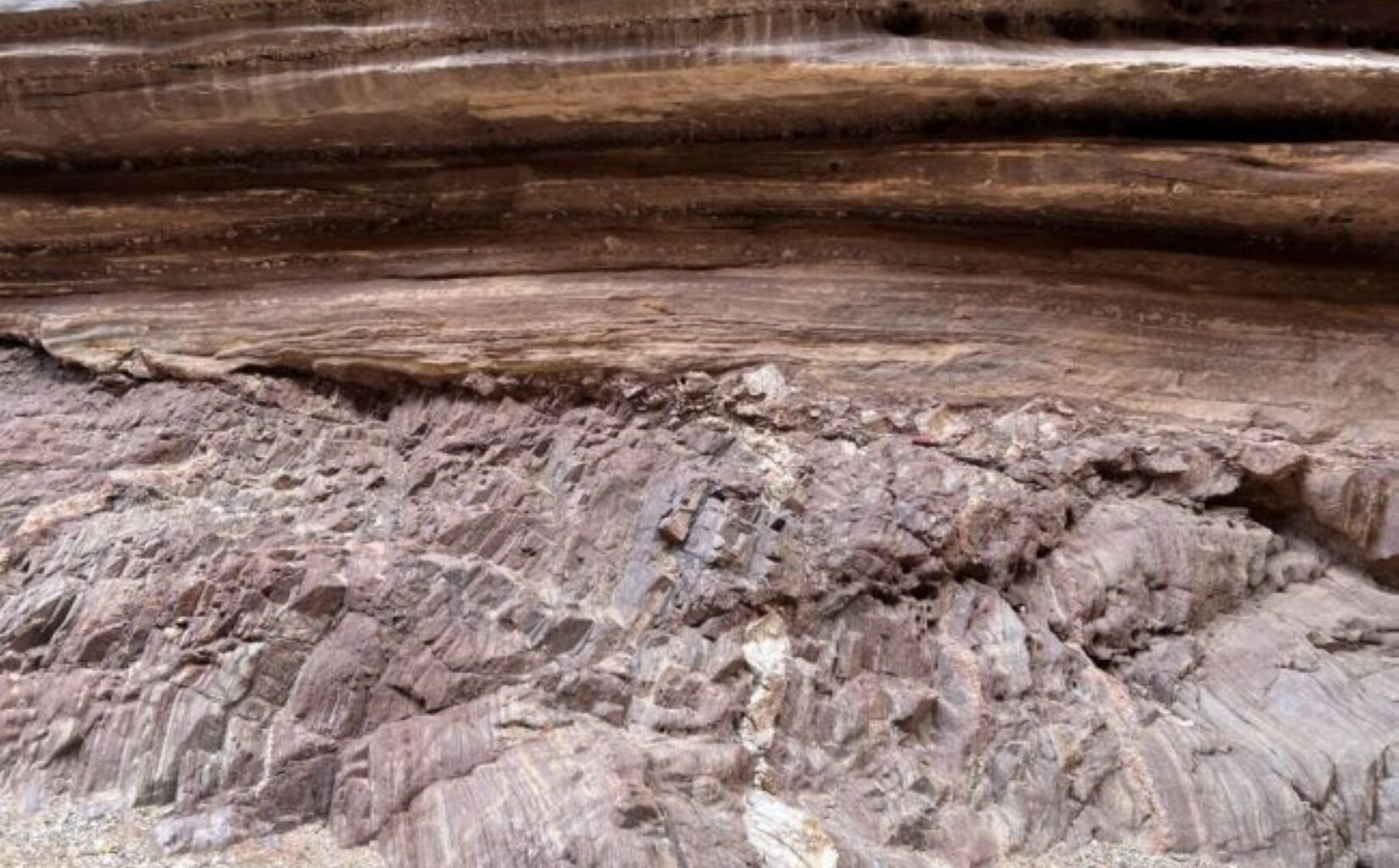
Picture Earth’s history as a giant book. Now imagine opening it and finding that more than a billion years of pages are missing. That mystery is called the Great Unconformity. Across much of the world, Cambrian rocks sit directly on top of far older basement rocks, leaving a huge gap in the record. The missing chapter reflects both the erosion of ancient layers and long periods when little or no new sediment was deposited.
It marks a crucial time when Earth’s continents were exposed and eroded, and when all the major groups of animals first appeared. However, its origin remains the subject of vigorous debate.
Sedimentary rocks from the Cambrian Period rest directly atop much older crystalline basement rocks, leaving scientists to wonder: what erased this colossal chapter?
For years, scientists have debated two main ideas. The Snowball Earth theory says giant glaciers about 700 million years ago scraped away thick layers of crust. The tectonic uplift theory argues that shifting supercontinents slowly lifted and eroded the land over very long periods of time.
Now, new research published in Proceedings of the National Academy of Sciences tips the scales toward tectonic forces associated with early supercontinent formation as the primary culprit.
A team of geologists turned to the North China Craton, one of Earth’s oldest and most stable continental blocks. They gathered rock samples from five sites, including in the craton interior and along its edges. In the heart of the craton, Cambrian rocks sit directly on much older layers. This skips over more than a billion years of history, as if time itself had disappeared. However, near the edges, the missing years lessen, and the story of Earth’s past seems more complete.
By analyzing minerals such as zircon, monazite, and mica, which act as natural thermometers, they reconstructed the cooling and uplift history of the basement rocks beneath the Great Unconformity.
Coauthor Nicholas Christie-Blick, a geologist at Lamont-Doherty Earth Observatory, said, “If glaciation had been the dominant driver, you’d expect to see a clear pulse of erosion at the time of the Cryogenian ice ages. We don’t see that pattern in the North China data.”
Their findings revealed that between 2.1 and 1.6 billion years ago, rocks cooled rapidly, rising about 12 kilometers toward the surface. By 520 million years ago, another 9 to 13 kilometers of uplift had occurred.
Crucially, about 60 percent of the erosion occurred before 1.6 billion years ago, and nearly 75% occurred before 1.35 billion years ago. Using thermochronology dating methods, the scientists could trace how the land was stripped down long before later ice ages.
Research finds billion-year superocean cycles in Earth’s history
The data show no major cooling event during the Cryogenian ice ages. While some cooling then is possible, the evidence suggests glaciers had only a limited effect deep inside the craton.
One sample of zircon crystals from the interior shows cooling between about 620 and 544 million years ago, meaning the rocks were already close to the surface by then. The youngest ages overlap with signs of a late Precambrian ice age in North China, hinting that glaciers may have played a small role.
But the biggest cooling happened much earlier. When scientists compared thermal history records from other ancient continental cores, Laurentia in North America, Baltica in Europe, and Amazonia in South America, they saw the same pattern: most of the uplift and erosion occurred before 1.6 billion years ago.
It suggests that long-lasting plate tectonic activity, driven by the cycles of supercontinents, exposed and eroded the crust beneath the Great Unconformity, rather than the global ice ages of ‘Snowball Earth.’
In fact, the authors estimate that more than half of the total early uplift and erosion, about 13 kilometers, linked to over 400 degrees of cooling, took place in that earlier period.
The strongest signs of erosion, found in both the thermochronologic record and geochemical signs of continental weathering, appear at the same time that Earth’s first true supercontinent, Columbia, was forming. This occurred before the Cambrian explosion and the start of modern plate tectonics.
The researchers admit their estimates depend on standard assumptions about how temperature changes with depth, and they didn’t directly measure some of the earliest mineral ages. Even so, the North China results match patterns seen in other ancient continental cores. Together, the evidence points to tectonic forces, not glaciers, as the main reason so much rock was stripped away during the Great Unconformity.
Journal Reference:
Rong-Ruo Zhan, Liang Duan, Massimiliani Zattin, and Xingliang Zhang et al. Tectonism rather than “snowball Earth” glaciation is responsible for the Great Unconformity. PNAS. DOI: 10.1073/pnas.2523891123