
When it comes to the Universe and everything in it, only one thing is absolutely certain: everything that’s now living will someday die. This doesn’t just extend to living beings, but to all sources that use some sort of fuel and emit energy: eventually, as demanded by the laws of thermodynamics, all of that energy-liberating activity will cease. Stars will go dark, stellar remnants will fade away, and even black holes will evaporate. In the far future, our Universe will become something that’s virtually unrecognizable to us today, as our bright, star-and-galaxy-rich cosmos will transform into a sparse, dark landscape from which precious few signals could ever be detected.
But there’s a whole lot that’s going to happen before we reach that funerary late-stage state. Given what we know today, can we say anything important about the path to that end state, and how dark the Universe, as well as our galaxy, will become over time? That’s what our regular reader James D wants to know, writing in to ask:
“I was wondering if it’s possible to estimate using star formation rates, and given that ~95% of all stars which will form have already done so, approximately how dark the universe/our galaxy will become over time?”
It’s remarkable that this is a question we know how to answer today, because just a few decades ago, our best answers would have looked awfully different. Here’s what we think is in store for our long-term future, with a special nod to all the luminous events still to come.
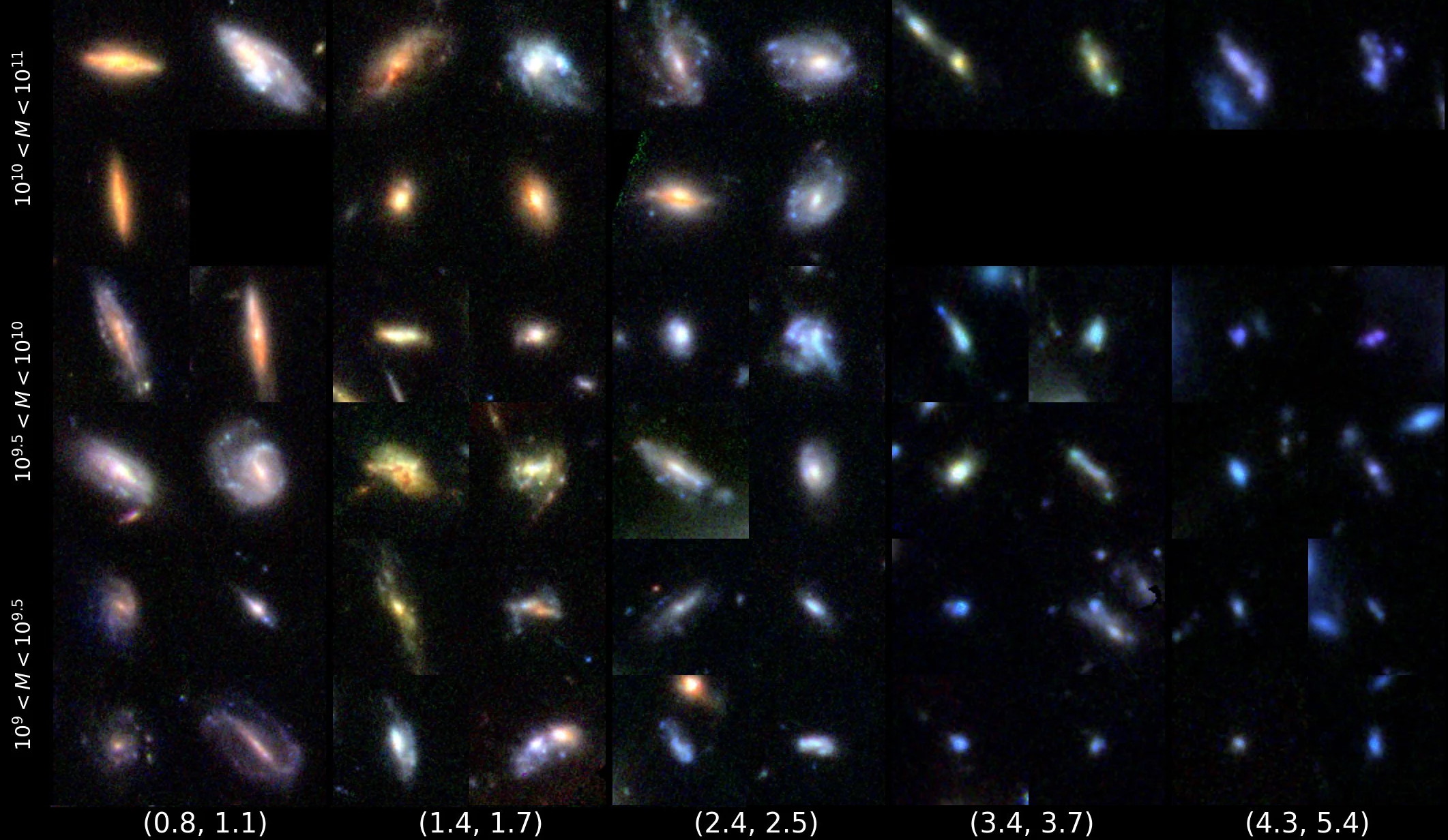
This selection of 55 galaxies from the JWST’s GLASS Early Release Science program spans a variety of ranges in redshift and mass. This helps teach us what shapes galaxies take on over a range of masses and stages in cosmic time/evolution, revealing a number of very massive, very early, yet very evolved-looking galaxies. However, it’s only at relatively late cosmic times, from about ~550 million years onward, that practically every galaxy starts possessing large amounts of dust; prior to that, the dust fraction is variable, with some galaxies having plenty of dust already but others, particularly among the faintest galaxies, displaying little evidence for dust.
Credit: C. Jacobs, K. Glazebrook et al., arXiv:2208.06516, 2022
When we look out at galaxies across the vast cosmic distances, we’re also surveying them across cosmic time. This makes sense: the Universe has been around for 13.8 billion years since the start of the hot Big Bang, galaxies have existed for nearly all of that time, and when we look at distant galaxies, we’re seeing them as they were when the light that’s arriving now was first emitted. Therefore, when we measure these galaxies, and in particular when we use our measurements to infer their star-formation rates, we’re getting glimpses of what those star-formation rates were at the time that light was emitted.
By averaging large numbers of galactic star-formation rates together, we can get an average for what the star-formation rate is at that particular epoch in cosmic history. Although there are still large uncertainties at the earliest of cosmic times — say, within the first 0.5-1.0 billion years of cosmic history — the overall star-formation rate at later times is well-known, and also far more important for the global history of cosmic star-formation. Whereas we’re finding lots of surprises in the very early Universe as far as the types, brightness, and abundance of objects we’re seeing in the first few hundred million years of our history, the truth is that 99% of all stars that exist now were formed after the first billion years had already elapsed.
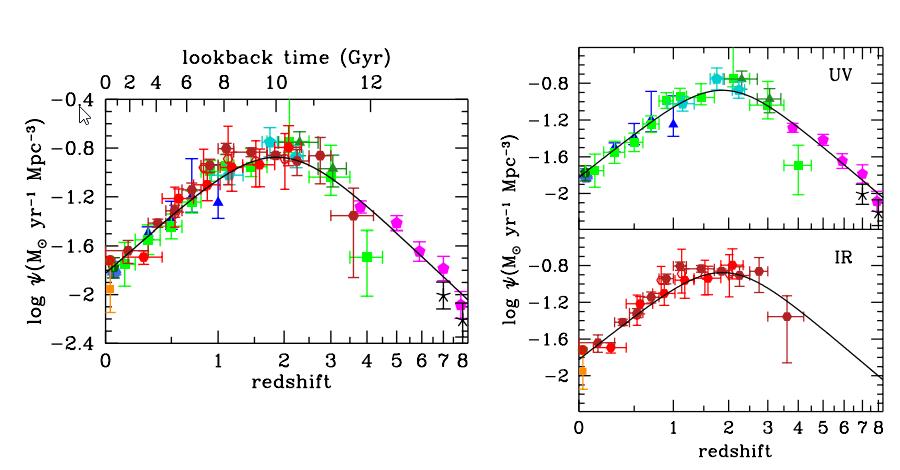
The star-formation rate in the Universe is a function of redshift, which is itself a function of cosmic time. The overall rate, (left) is derived from both ultraviolet and infrared observations, and is remarkably consistent across time and space. Note that star formation, today, is only a few percent of what it was at its peak (between 3-5%), and that the majority of stars were formed in the first ~5 billion years of our cosmic history. Only about ~15% of all stars, at maximum, have formed over the past 4.6 billion years. Direct measures of star-formation are important, but the method of Fermi-LAT for measuring the total number of photons produced by stars is superior.
Credit: P. Madau & M. Dickinson, 2014, ARAA
Specifically, we find that star-formation rates:
rose and rose over the first 2-3 billion years since the start of the hot Big Bang,
reached a peak about 3-4 billion years after the Big Bang began,
remained at a very high rate until the Universe was about 6-7 billion years old,
and then began to fall, slowly at first, and then more quickly.
By the time we arrive at our Universe today, 13.8 billion years after the earliest stages of the hot Big Bang, we find that star-formation is merely a trickle of what it was at its peak. In fact, today’s star-formation rate is only roughly 3%, by most modern estimates, of what it was some 10-11 billion years ago.
If we extrapolate that trend into the future, what it tells us is that the vast majority of stars that ever will form in the Universe have already formed. It tells us that — from a cosmic perspective — the star-formation rate that has dropped and dropped over time can be expected to continue to drop, and that compared to all the stars that exist today, only about 10% more of them, tops, will ever form. Overall, therefore, you might simply expect that the shorter-lived blue, massive stars will die, leaving a Universe that looks more like the interior of an old globular cluster: filled with low-mass but long-lived stars that shine, while their brighter, more massive brothers and sisters wink out of existence one at a time.
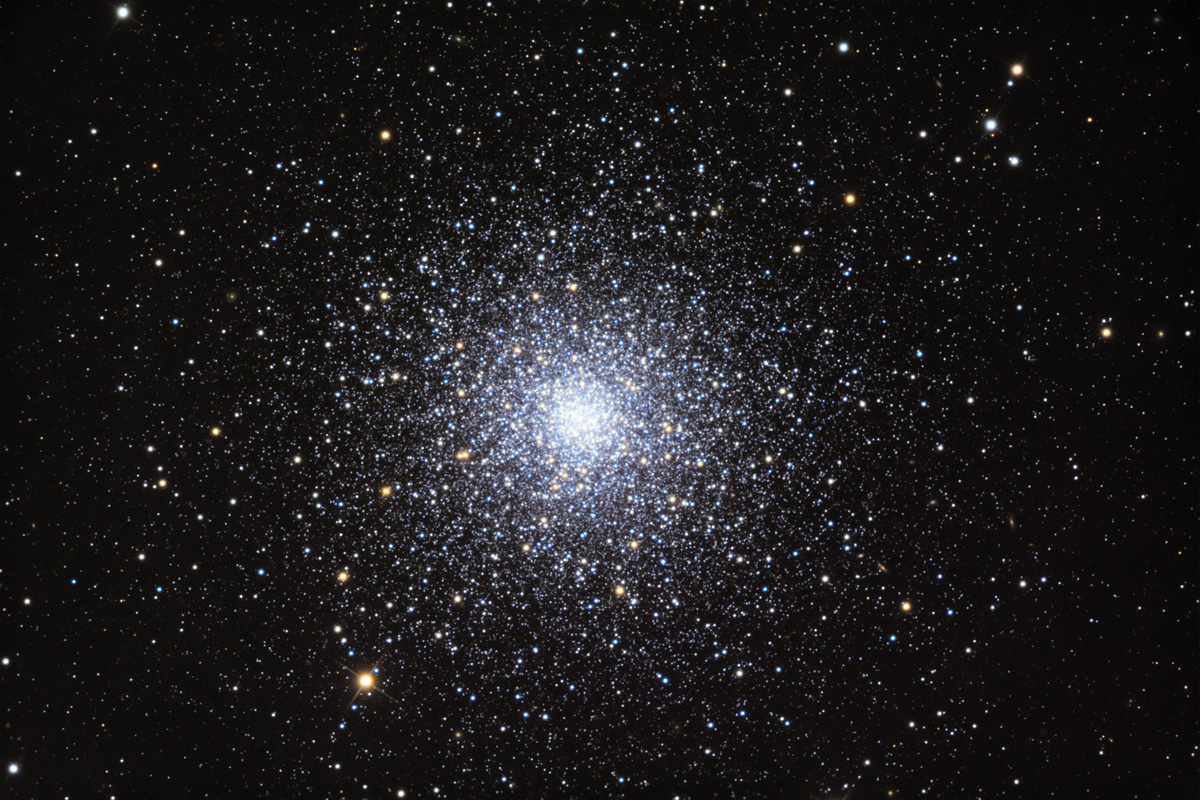
Messier 3, a globular cluster located 33,900 light-years away, as seen through a 24″ telescope. The stars within this globular cluster are approximately 11.4 billion years old, and it can be seen with the naked eye under ideal viewing conditions. Although there are a few blue stars within it, they are very likely the result of a recent merger between two lower-mass stars. Overall, the stars found within this, and most, globular clusters are primarily old and yellow/red/orange in color, as they formed quite long ago.
Credit: Adam Block/Mount Lemmon SkyCenter/University of Arizona
The reasons for expecting this are several, and they all go hand-in-hand.
First, we live in a dark energy-dominated Universe, and dark energy isn’t going away anytime soon. This means that every structure today that isn’t already gravitationally bound together will never become so. Sure, our Solar System can remain bound, as will the Milky Way and the Local Group. But beyond that, other galaxy groups and galaxy clusters — the M81 group, the Leo group, the Virgo Cluster, the Coma Cluster, etc. — are all unbound to us, will never merge with us, and will mutually accelerate away from ourselves and one another as time goes on.
Second, dark energy also rarifies the intergalactic medium, which means that already-bound structures will accrete less and less material onto them as time goes on, causing the influx of new star-forming material (e.g., gas, dust, and molecular clouds) to taper off and cease.
And third, as stars continue to be born, live, and die, the combined effects of winds and radiation will drive potentially future star-forming material out of the already existing galaxies. The more stars a galaxy forms, the stronger its matter-expelling effects become, leaving less and less material available for future star-formation episodes.
If all we cared about was the global star-formation future, we would indeed see our earlier expectation — that the more massive pre-existing stars die and leave the less massive, longer-lived ones as the only ones remaining — come to be the overwhelming reality on average.
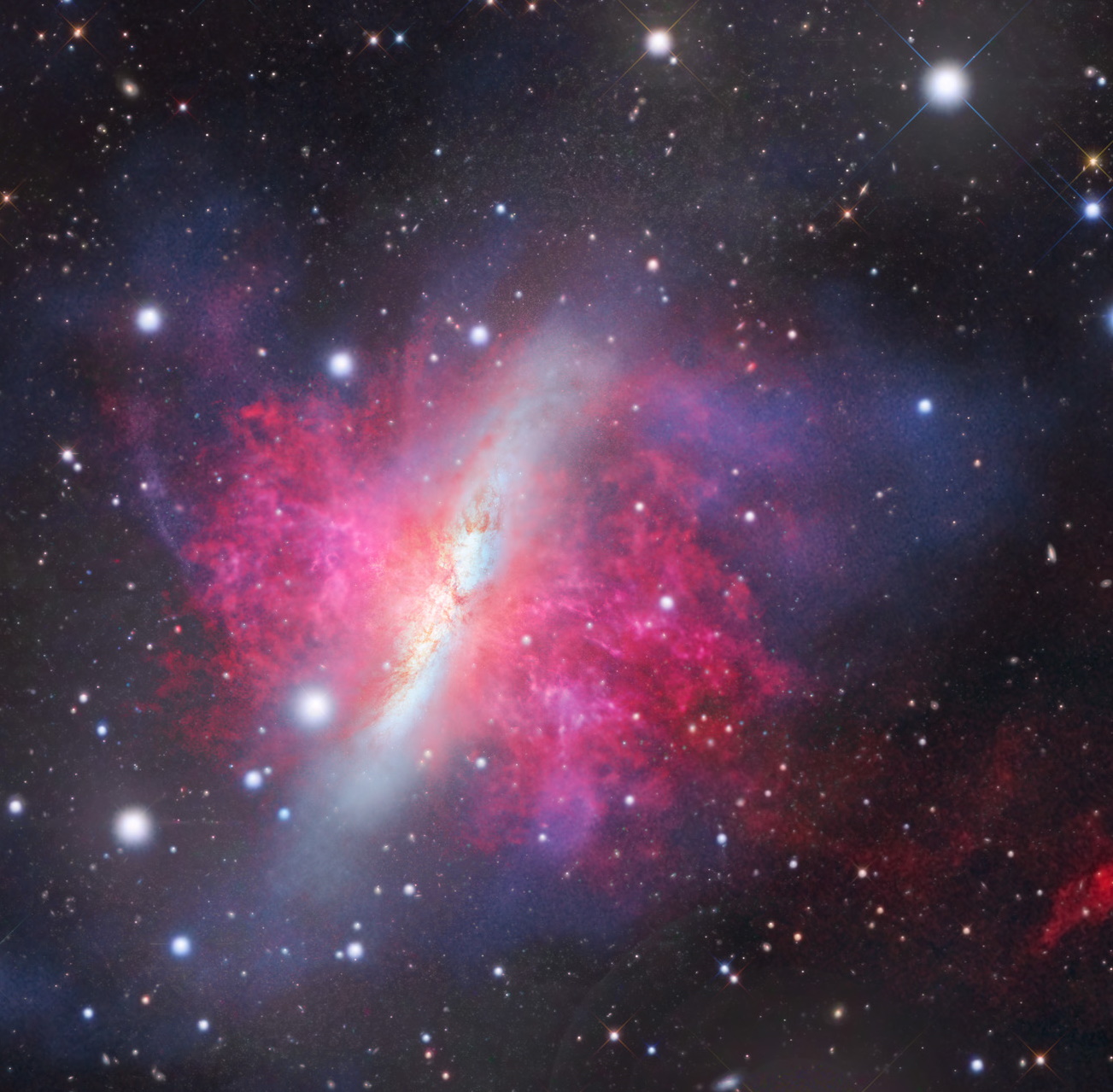
This close-up view of Messier 82, the Cigar Galaxy, shows not only stars and gas, but also the superheated galactic winds and the distended shape induced by its interactions with its larger, more massive neighbor: M81. (M81 is located off-screen, to the upper right.) When star-formation actively occurs across an entire galaxy, it becomes what’s known as a starburst galaxy, characterized by violent, gas-expelling winds. If the galaxy is too low in mass, this enriched material will all get ejected, preventing the formation of later-generation stars with the potential for rocky planets.
Credit: R. Gendler, R. Croman, R. Colombari; Acknowledgement: R. Jay GaBany; VLA Data: E. de Block (ASTRON)
However, this is only what happens on a large-scale average, and that is not necessarily a good reflection of what we’re going to see. The reason for that is simple: what we see is incredibly biased by how close we are to it, and how bright it intrinsically is. For example, if you consider the stars in our own night sky that are visible to the naked eye, you’d find that:
every single one of them is a star located within the Milky Way galaxy,
nearly all of them are either extremely close to us or are extremely intrinsically luminous,
the farthest one is still less than 20,000 light-years away,
and even the aggregate light from a whole galaxy’s worth of stars means that only four external galaxies can be glimpsed, maximum, no matter where you are on Earth.
Similarly, if you extrapolate far into the future, what we can see and observe will continue to be dominated by the brightest and most nearby objects, and dark energy isn’t really capable of taking those away from us. The overwhelming majority of material that’s present within the Local Group today will continue to remain inside the Local Group for as far as we can extrapolate into the future. Unlike galaxy Messier 82, shown above, whose extreme galactic winds are driving large amounts of mass out of the galaxy entirely, our Local Group is massive enough that the material within it, even if it gets blown or expelled out of an individual galaxy (like the Milky Way), is unlikely to escape our Local Group’s gravity.
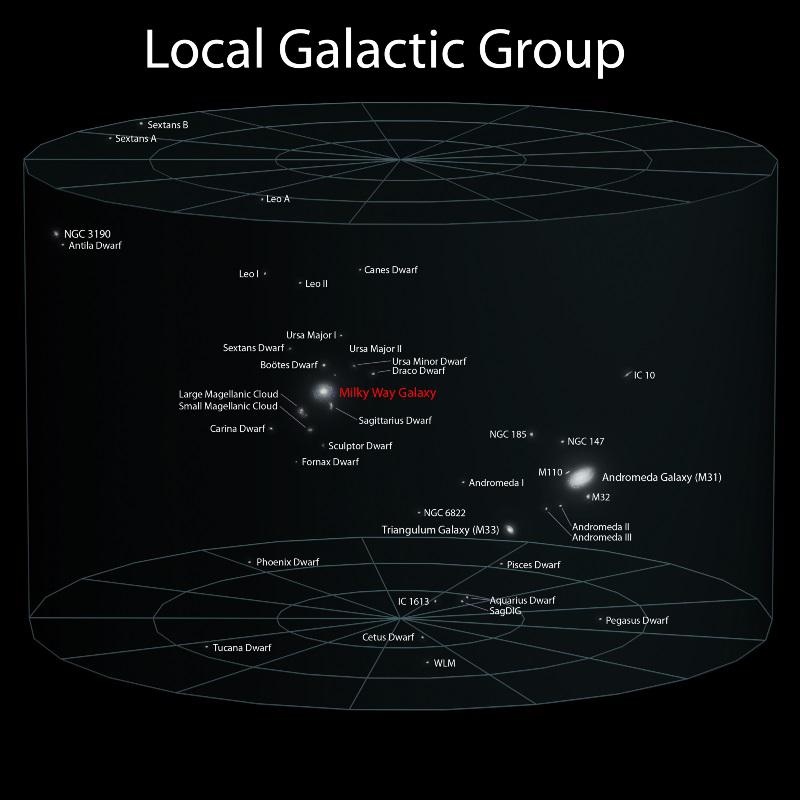
Our Local Group of galaxies is dominated by Andromeda and the Milky Way, but there’s no denying that Andromeda is the biggest, the Milky Way is #2, Triangulum is #3, and the LMC is #4. At just 165,000 light-years away, the LMC is by far the closest among the top 10+ galaxies to our own, and as such it takes up the largest angular span in the sky of all galaxies outside the Milky Way. There are over 100 galaxies within the Local Group, but Andromeda and the Milky Way contain most of the stars, as well as most of the mass.
Credit: Andrew Z. Colvin/Wikimedia Commons
Within the two largest galaxies in the Local Group — the Milky Way and Andromeda — there are still enormous reservoirs of gas: material that can be used to form future generations of stars. In fact, both our own galaxy and our big sister galaxy are currently undergoing a period of ongoing star-formation: where there isn’t a major episode that causes new stars to form, but where material within the galactic disk, and specifically where material within the density waves that create a galaxy’s spiral arms, gets dense enough to collapse and fragment, leading to the birth of new stars and new star clusters.
We see this all across the Milky Way, concentrated in the galactic plane, in well-known nebulae like the Eagle Nebula, the Orion Nebula, the Omega Nebula, the Lagoon Nebula, the Trifid Nebula, and many more. Similarly, there are star-forming regions, albeit more distant ones, in Andromeda: evidence for ongoing star-formation.
However, if we look at the smaller but still gas-rich galaxies of the Local Group, particularly the ones found relatively nearby (within a couple of hundred-thousand light-years) to the Milky Way galaxy, we find that star-formation is anything but quiet and steady.
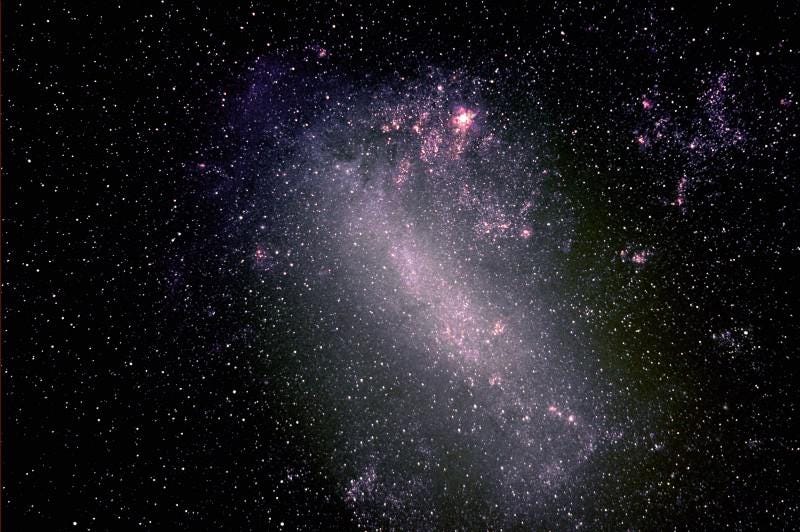
The Large Magellanic Cloud is home to the closest supernova of the last century, having occurred in 1987. The pink regions here are not artificial, but are signals of ionized hydrogen and active star formation, likely triggered by gravitational interactions and tidal forces primarily due to the Milky Way’s influence. The pink regions specifically arise when electrons fall back onto ionized hydrogen nuclei, and transition from the n=3 to the n=2 energy level, producing photons of precisely 656.3 nm.
Credit: Jesús Peláez Aguado
Instead, a galaxy like the Large Magellanic Cloud, as shown above, is exhibiting what’s known as a starburst: where a large portion of the galaxy, or even the entire galaxy itself, becomes a star-forming region. This is normally caused by a gravitational interaction: either a strong gravitational tug from a nearby, massive neighbor, or from a merger with a comparably-sized, massive galaxy. Because the Milky Way is so much larger and more massive than the satellite galaxies we have, its gravity is significant enough to trigger these rapidly star-forming events. As time goes on, large galaxies like the Milky Way will gobble up their smaller satellite neighbors, adding new stars to their population, including newly-formed but short-lived bright, blue stars.
To trigger a starburst in the Milky Way, however, will require something even more significant: a merger or close-pass interaction with a galaxy that’s comparable in mass to our own. Within the Local Group, there is only one candidate: Andromeda itself. Perhaps fortunately for us, the Milky Way and Andromeda are in rapid motion toward one another, and look like they’re going to make a close pass by one another some 4-to-5 billion years from now. Owing to the mutual gravitational influence of one galaxy on another, this should trigger severe star-formation episodes in both galaxies, leading to a massive influx of new stars built out of the internal gas within them.
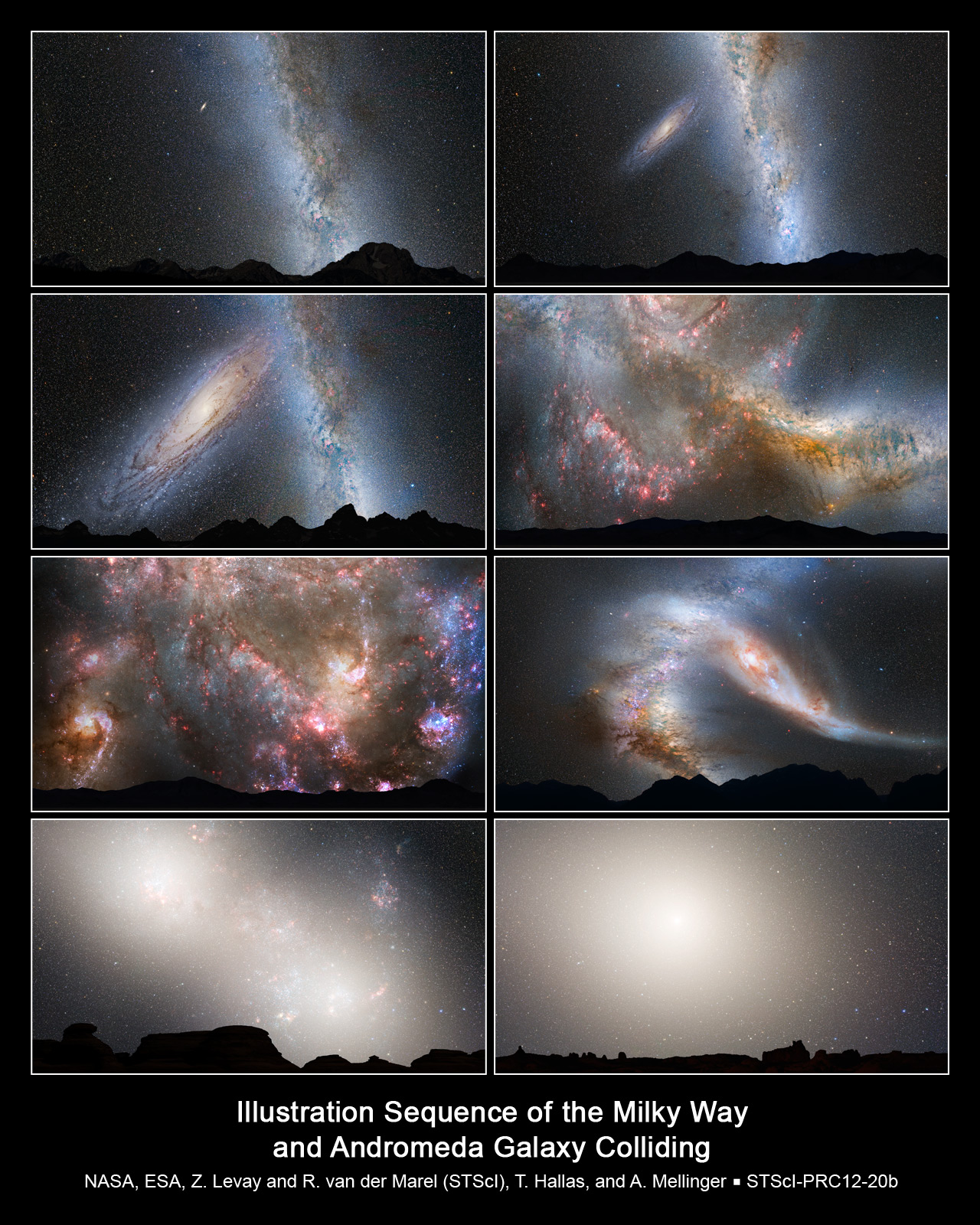
A series of stills showing a visualization of the Milky Way-Andromeda merger and how the sky will appear different from Earth as it happens. This merger has long been expected to begin roughly 4 billion years in the future, with a huge burst of star formation leading to a depleted, gas-poor, more evolved galaxy ~7 billion years from now. However, new research challenges the likelihood and timescale of this event, throwing this classic picture into doubt.
Credit: NASA; ESA; Z. Levay and R. van der Marel, STScI; T. Hallas, and A. Mellinger
We used to think, as illustrated above, that the relative motions of the Milky Way and Andromeda would lead to a merger of these two galaxies in the aftermath of this interaction. However, more recent research has shown that there’s only a small probability of a merger occurring during that close pass, and that it’s far more likely that a merger won’t occur until 8-20 billion years from now: far into the cosmic future. This discovery, which took into account the gravitational effects of many other galaxies within the Local Group for the first time, suggests that the future of stars in our galaxy won’t be as simple as we once thought.
Instead of a merger, we’ll most likely get a close pass of an interaction, triggering a massive wave of star-formation that could potentially be galaxy-wide, with a chance of transforming both members into starburst galaxies for a time. Then, after that close pass, the new, massive stars that formed will die, returning a large amount of gas back to the interstellar medium, where future episodes of slow, quiet star-formation can take place. Because the Local Group is gravitationally bound, these galaxies will then make subsequent close passes in the billions of years to come, triggering the biggest new episode of star-formation when they eventually do merge, whether that’s 8 billion years from now, 15 billion years from now, or 20 billion years from now or more.
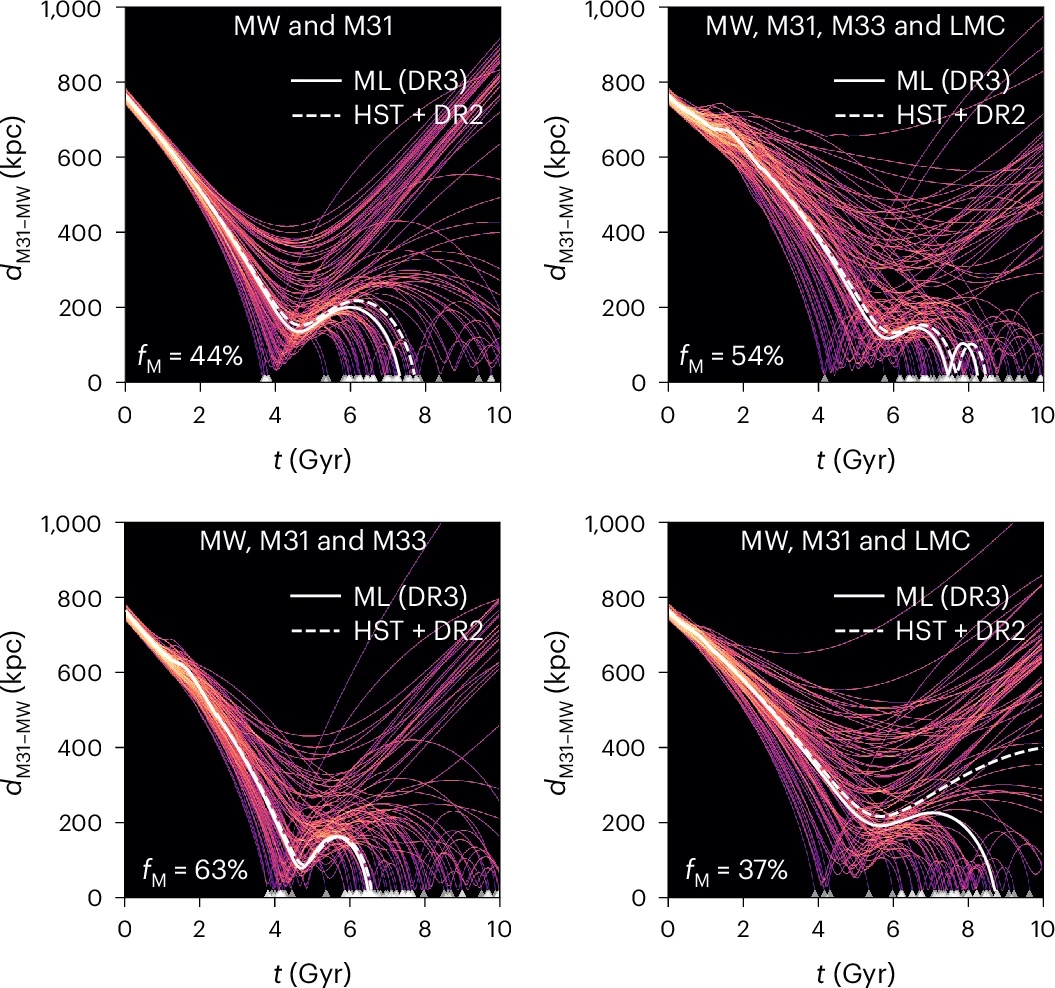
This four-panel illustration shows the results of 100 simulations each for a model of the Milky Way-Andromeda system, along with the likelihood and timescale of a merger occurring. The top-left shows only the Milky Way and Andromeda, the lower-left also includes Triangulum (M33), the bottom-right excludes Triangulum but includes the LMC, and the top-right includes all four.
Credit: T. Sawala et al., Nature Astronomy, 2025
With all of that in mind, we can finally make predictions for the kind of stars and stellar populations we’ll be able to see over time from our perspective within the Milky Way.
Initially, the star-formation rate will remain small and continue to decline ever so slightly, while isolated episodes of star-formation continue within our galactic plane. When satellite galaxies fall into the Milky Way, they can trigger small increases in that rate, which will be followed by lulls in the aftermath of those increases.
Then, about four billion years from now, a close pass between the Milky Way and Andromeda will light up our sky, locally, in a way that no human (and none of our mammalian ancestors) has ever seen. There will be a burst of new star-formation nearby, as enormous amounts of gas within our Milky Way gets triggered to collapse and fragment, forming new stars in an episode that will likely signify our galaxy’s biggest star-forming episode in the past several billion years.
And then, after a few more of our satellite galaxies get cannibalized, some undetermined number of billions of years beyond that, the Milky Way and Andromeda will finally merge, giving rise to a new, even more massive galaxy: Milkdromeda. The odds, statistically, are that the aftermath of this violence will lead to a galaxy that is still gas-rich and has a galactic disk, although there’s a small (about 5%) chance that we’ll use up and/or expel all of the remaining gas and transform into a giant elliptical galaxy.
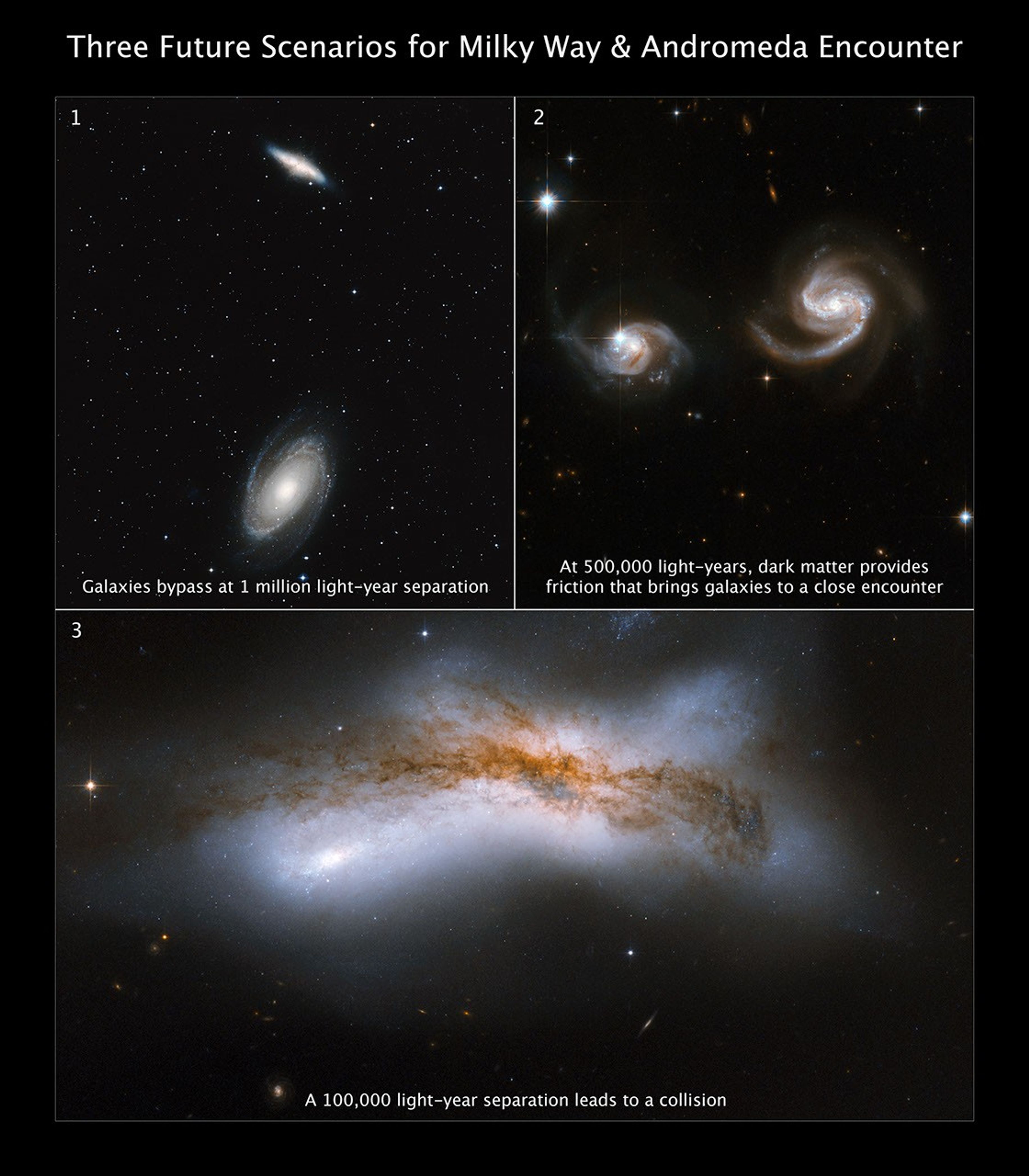
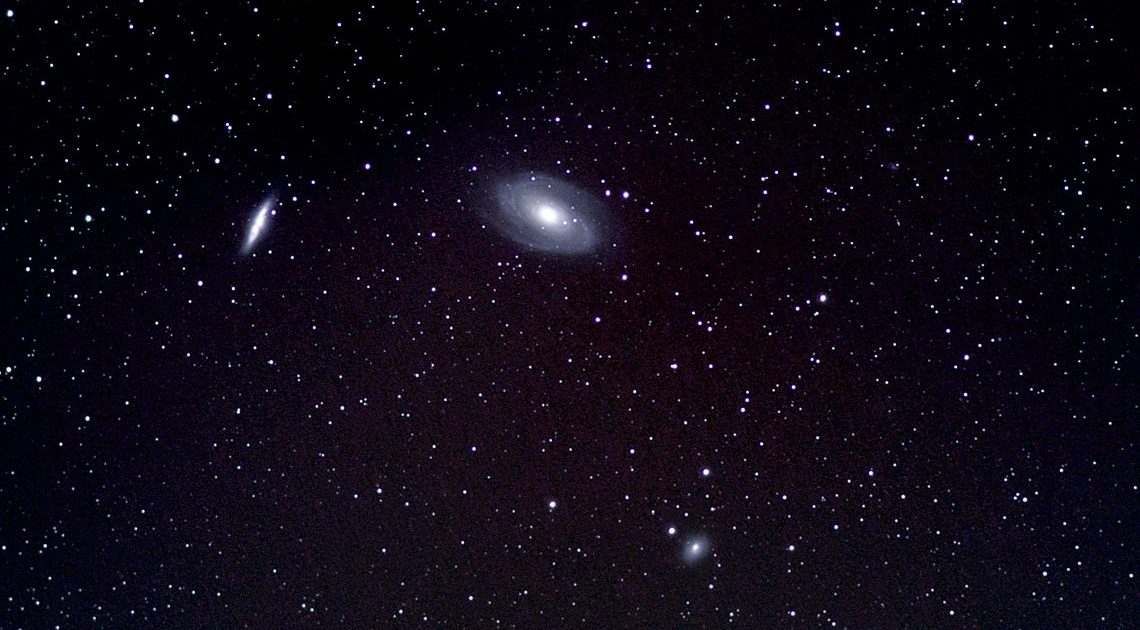
This selection of images of external galaxies illustrates three encounter scenarios between our Milky Way and the neighboring Andromeda galaxy. In the top left panel, a wide-field DSS image showing galaxies M81 and M82 serves as an example of the Milky Way and Andromeda passing each other at large distances. The top right panel shows NGC 6786, a pair of interacting galaxies displaying the telltale signs of tidal disturbances after a close encounter. The bottom panel shows NGC 520, a cosmic train wreck as two galaxies are actively merging together. The last is likely the ultimate fate of the Milky Way-Andromeda system, but the question as to when this will occur is greatly uncertain.
Credit: NASA, ESA, STScI, Till Sawala (University of Helsinki), DSS, J. DePasquale (STScI)
Those two major star-forming episodes in our future, locally, have the potential to form tens of billions of new stars, and potentially even up to 100 billion new stars: somewhere around 10-20% of the cumulative number of stars that the Milky Way and Andromeda have ever formed up until now. During this time, however, we’ll still see the effects of dark energy, as galaxies and galaxy groups and clusters recede from us and from one another. The Universe will get less dense, and the overall star-formation rate within the galaxies we can still see will continue to drop. Locally, star-formation episodes will continue and experience at least two major spikes that we can predict, but globally, the overall star-formation rate will drop and drop, as mergers and accretion become rarer and less significant with the passage of cosmic time.
Once our final major merger has occurred, however, star-formation will truly slow to a trickle, declining from our relatively modest rate today of less than one solar mass worth of new stars per year to less than one solar mass per century after approximately another 40 billion years, and less than one solar mass per millennium after yet another 200 billion years have elapsed. After around a trillion years, total, have elapsed since the hot Big Bang, there won’t really be any galaxies left to view other than Milkdromeda, and the star-formation rate may be effectively zero, save for the rare merger of brown dwarfs that then cross the mass threshold to become stars.
The only stars that will remain after that will be the lowest-mass red dwarf stars. It will take more than 100 trillion years for all of them to burn out, and perhaps a quadrillion years for their stellar corpses to fade away entirely, leaving us with a Universe that, at last, is dark pretty much everywhere. Of course, all of this is heavily dependent on dark energy not evolving, and also on the specific merger timetables for the various galaxies within our Local Group. That’s the far future, as of 2026, of star-formation and of what stars will persist, to the best of humanity’s current knowledge.
Send in your Ask Ethan questions to startwithabang at gmail dot com!