
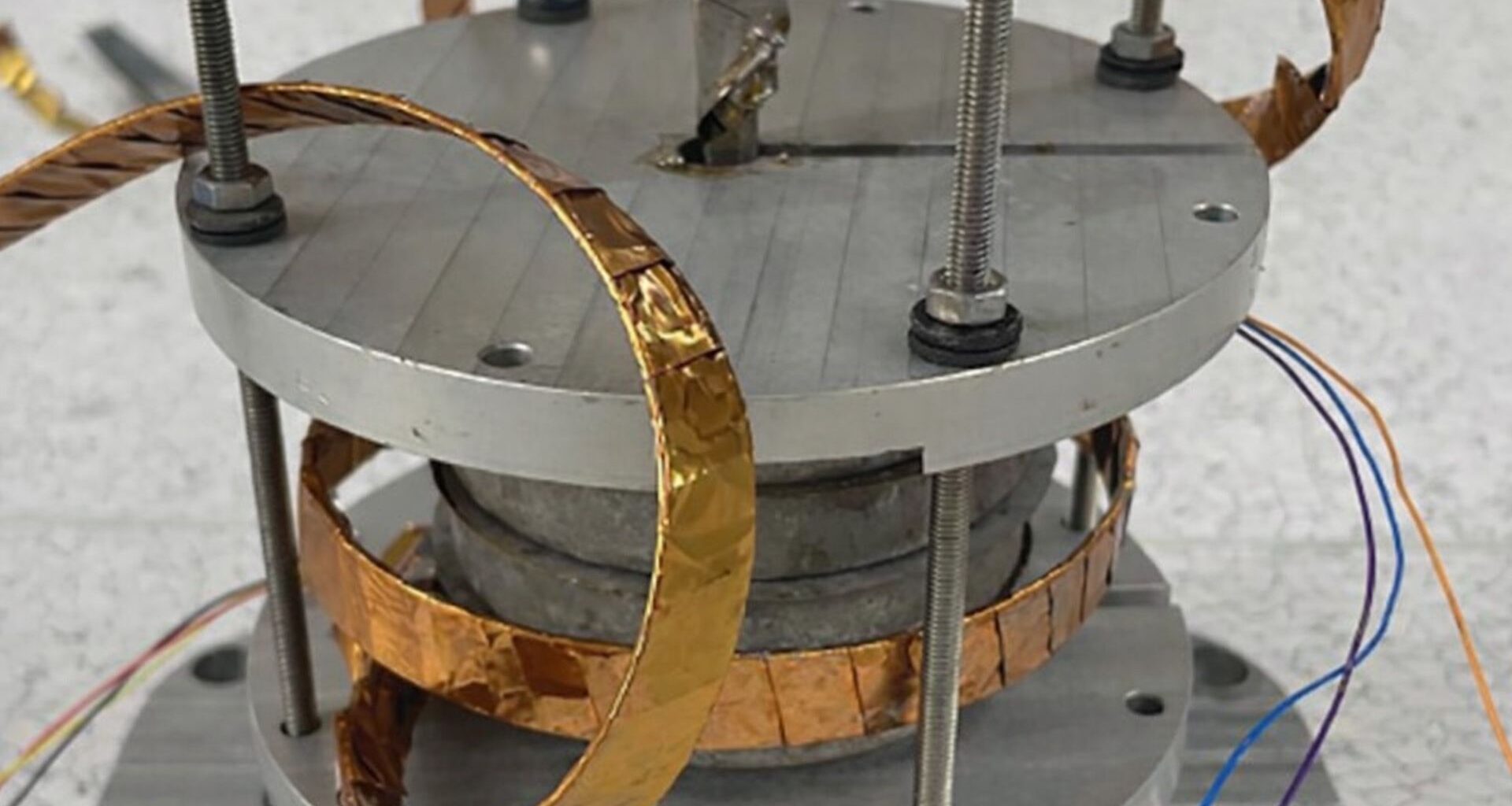
Researchers at ETH Zürich have built the most powerful miniature superconducting magnets ever demonstrated, potentially opening the door to affordable, lab-scale high-field science.
Generating magnetic fields above 40 tesla has traditionally required room-sized machines that guzzle megawatts of electricity. A team of researchers at ETH Zürich has just changed that equation — fitting a magnet capable of hitting 42 tesla into a device small enough to hold in one hand, running on less than a single watt of power.
The results, published in Science Advances, describe two compact all-high-temperature superconducting (HTS) magnets built from rare-earth barium copper oxide, or REBCO, tape. One reached 38 tesla using two pancake-shaped coils. The other, with four coils stacked together, hit 42.3 tesla — a field strength that previously required massive, power-hungry infrastructure found only at a handful of national laboratories worldwide.
Putting numbers in perspective
To put those numbers in context: a standard hospital MRI machine operates at 1.5 to 3 tesla. The previous benchmark for an all-HTS magnet stood at 26 tesla. The world-record steady-state magnet, a 45.5-tesla behemoth at the U.S. National High Magnetic Field Laboratory, consumes more than 20 megawatts of power and requires an enormous infrastructure footprint.
In contrast, the ETH Zürich magnets use thousands of times less power and have coil volumes over 1,000 times smaller, while coming close to that record.
The engineering trick
The main challenge was winding REBCO tape around a very small bore — just 3.1 millimeters in diameter, roughly the width of a pencil. Standard winding methods need at least 14 millimeters to prevent cracking the superconducting layer. The team created a special method that moves the connection point between coils to the outside of the bore, keeping the tape intact despite the tight bend.
The magnets also use a no-insulation winding method combined with soldering across the whole coil. This technique increases both current density and mechanical strength. The result is current densities up to 2,257 amps per square millimeter, much higher than most large superconducting systems.
Beyond the impressive numbers, the team showed something even more important—they performed nuclear magnetic resonance (NMR) experiments inside the 3.1-millimeter bore. NMR spectroscopy, a powerful method for studying molecular structures, works better with stronger magnetic fields that boost sensitivity and resolution. Right now, using fields above 28 tesla means applying for time at a national lab.
A palm-sized magnet capable of operating in that range — at a fraction of the cost and power — could make high-field NMR far more accessible to university labs and research hospitals that currently can’t justify the expense.
The researchers also note potential applications in quantum materials research and next-generation micro-NMR, where radiofrequency coil dimensions below 1 millimeter have already been demonstrated.
What comes next
The team admits that field homogeneity, or how even the magnetic field is across the bore, is still a challenge. They plan to improve this and aim to push direct NMR measurements beyond 40 tesla in future work. A patent application for the technology is already in progress.
For now, the demonstration stands as proof that extreme magnetic field science doesn’t have to stay locked inside a national laboratory. Sometimes, it fits in your hand.