
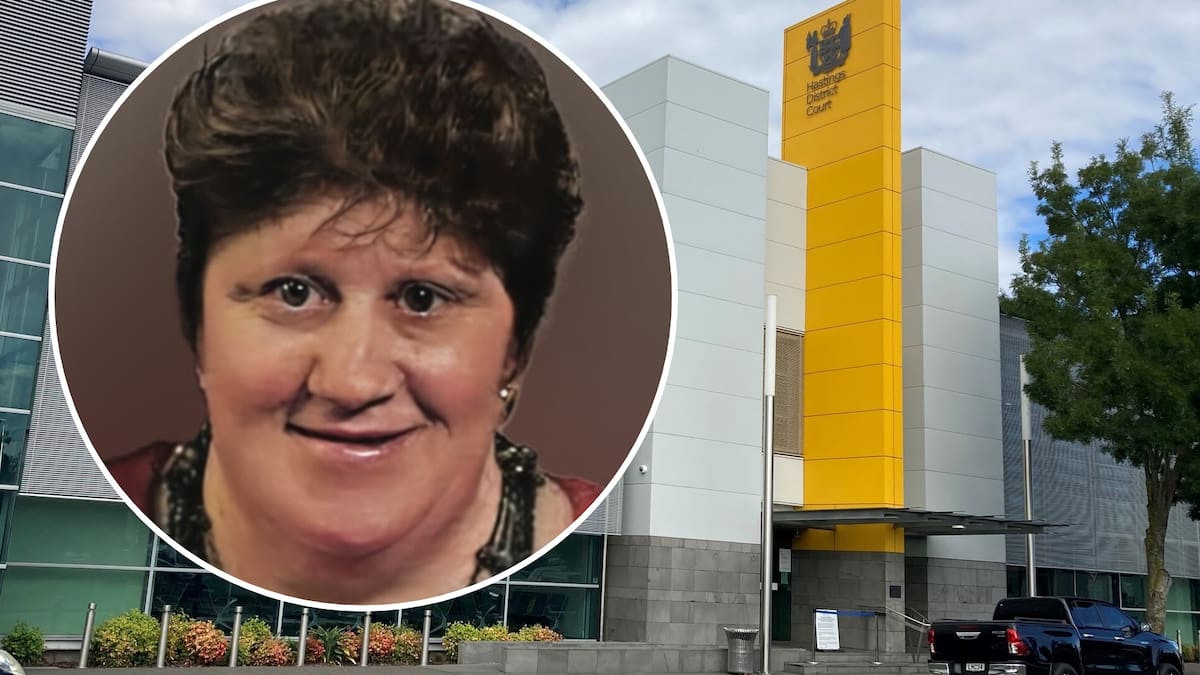
Jacobs had a number of conditions, including Turner syndrome, a chromosome deficiency, along with the intellectual disability that sometimes accompanies it.
Although able to ride her bike to the shops, she was dependent on her carers, had limited speech and little ability to advocate for herself.
She received treatment for asthma, suffered from hypertension and had an enlarged thyroid, or goitre.
She had also been nagged by a persistent, habitual cough for more than 20 years. The only times she would not cough were when she was eating or sleeping.
Jacobs had been in residential care since 1994, apart from when she lived with her younger sister Stephanie Salisbury’s family during the Covid pandemic.
However, she would go to Salisbury’s home every second weekend and attended wider family occasions.
“She was very much loved and a big part of our family,” Salisbury said.
In the weeks before her death, Salisbury felt her sister’s health was deteriorating and it got to the point where Jacobs could not move without coughing. She struggled to breathe while eating.
Debra Shirley Jacobs died suddenly in 2023. Photo / Supplied
At Salisbury’s request, staff at Idea Services, which ran the home where Jacobs lived, tried twice to change her doctor to get a second opinion about her health.
They were unsuccessful, as the medical practices were full and not taking on new clients.
After her sister died, Salisbury said she was “very distressed” to receive her sister’s phone and find on it messages that Jacobs had been trying to send to family members and her doctor in the days and weeks before she died, seeking help.
The messages were not sent because Jacobs did not have any credit on her device.
“It was heartbreaking to read those messages and know that Debra was trying to contact us for help and she would have been wondering why we did not come,” Salisbury said in evidence to the coroner.
Salisbury also found three short videos on her phone: one possibly recorded accidentally in which Jacobs is coughing; one in which she is heard to say “Oh, God, my throat” and coughs while talking to her cat; and a third in which she is out of breath and wheezing while sitting in one spot.
The videos were played to the inquest and two doctors who provided care to Jacobs were asked about a particular type of cough that was captured on the soundtrack.
An inquest hearing into the death of Debra Jacobs was held at the Hastings courthouse.
The cough was identified at the hearing as stridor – a noisy wheeze that can indicate the airway is obstructed, putting the patient in danger.
Jacobs’ long-term GP, Richard Eastcott, now retired, was asked what he would have done had he heard her stridor in real life.
“If I had heard that, I would have sent Debra to hospital,” he said.
Another doctor, Rachael Harris, who at that time worked in Eastcott’s practice and who saw Jacobs in the fortnight before she died, was also asked about the stridor on the video.
She said that if she had heard stridor in a consultation, she would have “called for assistance, or called 111”.
Harris saw Jacobs when she was taken to the medical practice on September 4, 2023, 10 days before she died.
In that consultation, no wheeze was heard when Jacobs’ chest was examined.
A summary of the consultation provided to the inquest by Eastcott said Harris gained the impression of “a post-viral cough and post-nasal drip, [and] early lower respiratory tract infection”. A nasal spray and antibiotics were prescribed.
No post-mortem exam conducted
After Jacobs died, no post-mortem examination was conducted and Eastcott signed off her death certificate.
Salisbury, as Jacobs’ next of kin, raised questions about this with the coroner.
“None of us could understand why there wasn’t an autopsy and I had no answers for people or myself,” she said.
Coroner Ian Telford held an inquest into Debra Jacobs’ death. Photo / Supplied
“Dr Eastcott had told me there was no explanation for why Debra died and he did not understand how or why it happened, so how could he be sure what really killed Debra?”
Eastcott told the inquest that after Jacobs died, he was contacted by Napier police, who asked if he was able to sign a death certificate.
He declined to do so, because he was not the doctor who had seen Jacobs last, because her death was sudden and unexpected, and because he had not seen her for three months.
The police then referred the death to the coroner, and the following day, Eastcott was contacted by one of the coroner’s clinical advisers.
The clinical adviser told him Jacobs was “unlikely to reach the threshold” at which a post-mortem examination would be carried out.
Eastcott and the adviser discussed what they considered the most likely cause of death – a chest infection against her background of Turner syndrome and asthma.
“From my review of the clinical records a lower respiratory tract infection seemed to be the most likely cause of death,” Eastcott said.
“I was advised that I could sign a medical certificate of causes of death for Debra on this basis, and if her family agreed to a death certificate being completed, with a cause of death being made on the strength of probability,” Eastcott said.
He said he would have preferred it if an autopsy had been performed but he was guided by the advice he had received on the phone from the clinical adviser.
“[It was] a most unusual phone call,” Eastcott told the coroner.
“It has never happened in the 40 years I have been qualified. It sticks in my mind.”
Sister not listed as next of kin
Eastcott needed the agreement of the family to sign the death certificate, but Salisbury was not listed in his records as being Jacobs’ next of kin.
When Eastcott’s practice was restructured into a new legal entity some years ago, patients were required to fill in new registration forms, and Salisbury’s name was omitted.
Eastcott therefore got consent to sign the medical certificate from another sibling whose phone number he had, because he was also a patient.
Because no autopsy was carried out, Jacobs’ exact cause of death remains unknown.
Independent opinion called in
Coroner Telford asked another doctor, Johan Peters, to look at the case and provide a report.
Peters’ report warns that his opinion is “speculative”, but he draws attention to Jacobs’ goitre, or enlarged thyroid, possibly causing an upper airway obstruction.
Dr Johan Peters provided a report to the coroner. Photo / Gisborne Herald
“I consider this the most likely cause of death, on the basis of a known goitre, not further assessed or treated for years, with persisting and steadily increasing cough, causing disturbance at night, not addressed by treatment for asthma,” Peters said.
“The probable presence of stridor as heard in the video evidence is highly suggestive.”
Peters said that lying down or sleeping would cause a relaxation of the upper airway, completely obstructing air passages critically narrowed by an enlarged goitre.
“Death then is rapid due to hypoxia [lack of oxygen], explaining the lack of signs of distress when found.”
Jacobs’ body shape, common with people with Turner syndrome, heavy-set with a wide neck, would have made monitoring the progress of the goitre difficult, the hearing was told.
Coroner Telford’s inquest findings will be published at a later date.
Ric Stevens spent many years working for the former New Zealand Press Association news agency, including as a political reporter at Parliament, before holding senior positions at various daily newspapers. He joined NZME’s Open Justice team in 2022 and is based in Hawke’s Bay.