
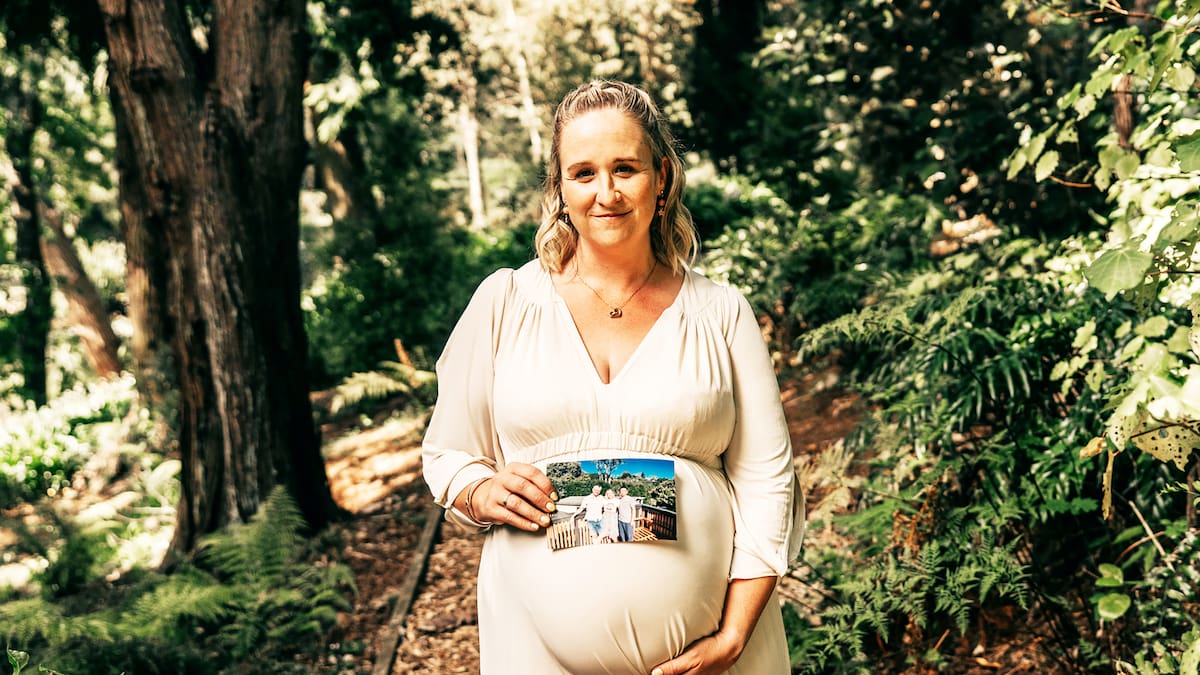
“It started with a thought that wouldn’t leave me – I kept thinking I had one more baby in me,” she tells.
Although Nick and Long felt complete with their two children, they knew friends who might benefit from Emma’s generosity.
While Auckland couple Peter and Patrick were in the adoption pool, they longed for a biological connection. After messaging, Emma and the men realised they were aligned on expectations, values and hopes. But first, Emma had to check with her own children, Korban, 18, Maddison, 16, and Lacie, 14, that they were happy for her to go ahead.
Emma explains, “They needed to be on board given this would be a half-genetic sibling. Their responses were wonderfully unique. My son, who has autism, just said, ‘I don’t care – it’s your body.’ My eldest daughter wanted to use the pregnancy as an essay for midwifery at uni. And my youngest couldn’t wait to see me pregnant.”
From left: Maddison, Lacie, Emma and Korban. Photo / Meg Holmes Photography
Surrogacy in New Zealand has its quirks. It must be altruistic – it’s illegal for money to change hands beyond pregnancy-related expenses – and at birth, the surrogate is legally the baby’s mother, even if the child is genetically unrelated.
Just one month after initial conversations with Peter and Patrick, Emma came to Auckland to meet them for the first time.
She recalls, “I quickly realised I was ovulating and thought, ‘Why not try?’ It was like a movie scene. They handed me a medical cup, I went into a room and syringed it up. I gagged a little – I’m not squeamish with body fluids, but it was awkward!”
Repeating the process twice the next day, after three attempts and less than a teaspoon of “product” later, Emma was pregnant.
She says the first test was unnervingly positive.
“I’ve never seen such dark lines and so early,” she recalls.
Meanwhile, her very early nausea hinted that this wasn’t Emma’s usual pregnancy experience and at her first scan, she saw not one but two sacs.
Emma with Peter, Patrick and the twins. Photo / Meg Holmes Photography
Emma recalls, “I looked at my mum and she looked at me. I waited for the sonographer to check the heartbeats and then said to Peter and Patrick, ‘Oh, shit. Are you ready for twins?!’”
For them, the news they’d be parents to not one but two babies came just two months after first meeting Emma.
“We would have been happy with one baby,” Peter says. “Two made us even happier because it meant our family would be complete in one go.”
Traditional surrogacy – where the surrogate is also the genetic mother – is rare in New Zealand. Conceiving twins naturally makes it even more unique.
While Emma, whose father was a fraternal twin, knew her body might release two eggs, even she was shocked.
Her pregnancy was unlike any of her previous experiences. She started 70kg lighter after undergoing gastric sleeve surgery in 2020, a loss she maintained with high-intensity interval training (HIIT).
Emma remains the twins’ legal mother. Photo / Meg Holmes Photography
But twins were harder on her body – by 22 weeks, her obstetrician advised she stop HIIT classes. At 25 weeks, she went on early parental leave. Seven weeks before giving birth, Emma stopped driving, and her mother stepped in to help with cooking, cleaning, driving and emotional support.
“I’m one of those people who’s sick from the start until birth,” she laughs. “I also didn’t completely relax once during the pregnancy. Carrying someone else’s babies is a big responsibility – if I miscarried, it wouldn’t just be me grieving.”
When the twins made their entrance in December – in a birth so textbook and speedy, the midwives didn’t even have time to phone the obstetrician – Emma’s daughter Maddison caught Lina. Nine minutes later, Henry followed as Peter and Patrick stood alongside her, watching as their babies entered the world.
Emma insisted on delayed cord clamping and initial skin-to-skin contact, before the twins rested on their parents’ chests an hour later.
“My body had done nine months of work – I needed that moment,” she explains.
Yet she never doubted she would give up the babies.
Emma tells, “People say there’s a risk the surrogate will want the baby, but surrogates actually fear the parents might not take the baby!”
The twins made their entrance in December. Photo / Meg Holmes Photography
Peter and Patrick stayed close by, alternating nights in a double hospital room. After being discharged, Emma returned home to her kids but visited daily to breastfeed and deliver expressed milk.
“I plan to pump until 14 weeks,” she says. “It goes on a chiller truck and is shipped to the family in Auckland.”
The twins’ arrival has transformed Peter and Patrick.
“Life is richer now,” Peter says. “Our hands are full, but we feel complete. We feel like we won the lottery every day.”
Meanwhile, Emma is embracing her maternity leave as a chance to rest and reflect. She bought herself a small “push present”, upgraded her Thermomix and planted the placentas beneath roses in her garden, alongside those of her previous surrogate babies. She knows this will be her last surrogacy.
“If it had been one baby, maybe I’d have offered a sibling,” she reflects. “But twins were brutal. I don’t have another one in me. I’ll forever be grateful my body allowed me to do this. Not everyone gets that opportunity.”
Legally, the journey isn’t over. In New Zealand, surrogate parents have no legal rights until adoption is finalised. Until then, Emma remains the twins’ legal mother. Oranga Tamariki will conduct home visits, financial checks and references before the adoption order is granted. When it is, Peter and Patrick will officially become the twins’ parents.
For Emma, Peter and Patrick, legalities are secondary to the joy the twins’ arrival has brought.
Peter enthuses, “We are very grateful for Emma and her family. She truly is an angel. We will never forget what she has done for us.”
To learn more about how families and surrogates can match, go to lovemakes.family