
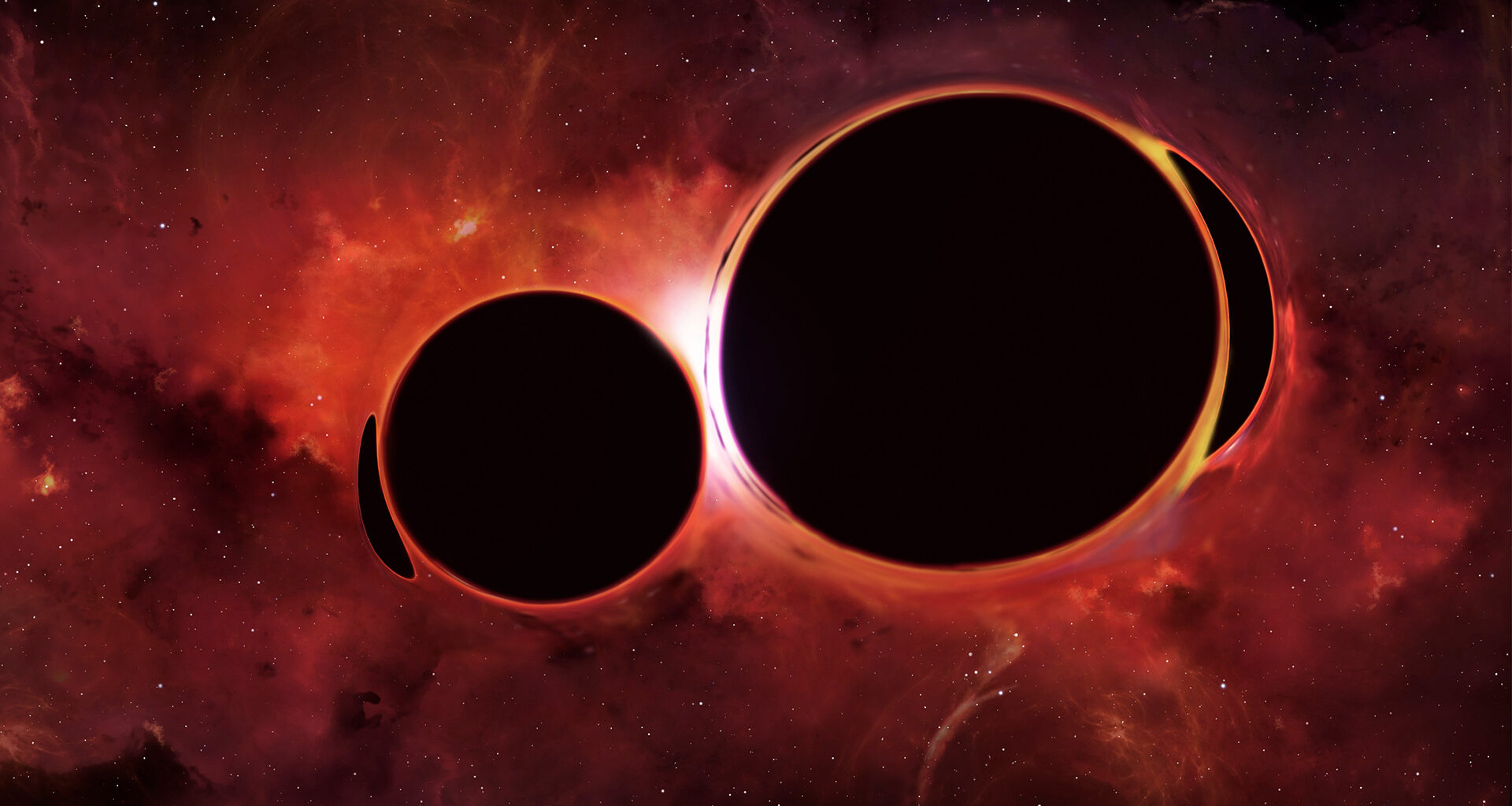
In November 2024, gravitational-wave detectors recorded the violent merger of two black holes billions of light-years away. Normally, such events are invisible to telescopes, producing only faint ripples in spacetime. However, this time something unusual happened.
According to a new study, just seconds after the signal arrived on Earth, space telescopes detected a burst of gamma rays (GRB) from the same region of the sky.
The coincidence, linked to an event known as S241125n, hints that under rare conditions, even black hole collisions may briefly light up the cosmos. If the connection is real, it would challenge the long-held view that black hole mergers occur in near-vacuum environments where little material is available to produce radiation.
“Binary black hole (BBH) mergers are generally not expected to produce GRBs,” the study authors note.
Detecting light from such an event would therefore require an unusual cosmic setting. Although the association has not yet been confirmed, the team’s analysis suggests the chance of the two signals aligning randomly is low, making the event scientifically intriguing.
Gravitational waves and gamma-ray burst
The event first appeared in data from the LIGO–Virgo–KAGRA network of gravitational-wave observatories. These instruments detected spacetime ripples produced when two black holes spiraled together and merged.
The signal indicated that the event occurred extremely far away—about 4.2 billion light-years from Earth, corresponding to a cosmic redshift of around 0.73. The masses of the objects involved also caught scientists’ attention.
Together, the two black holes weighed more than 100 times the mass of the Sun, placing the event among the most massive stellar-mass black hole mergers detected so far. Most previously observed mergers involve systems with only a few tens of solar masses.
Shortly after the gravitational waves reached Earth, something unexpected appeared in space-telescope data. Roughly 11 seconds after the merger signal, NASA’s Swift satellite detected a short gamma-ray burst, an intense but brief flash of high-energy radiation, coming from the same area of the sky.
Not long afterward, China’s Einstein Probe satellite identified a potential X-ray afterglow from the same region. This raised an interesting question—
Could the black hole collision have produced the burst?
Gamma-ray bursts lasting less than about two seconds are typically linked to neutron star mergers, not black hole pairs. However, the properties of the detected burst were also somewhat unusual.
The radiation observed at the start of the event had a softer photon spectrum than is normally seen in short gamma-ray bursts, meaning the emitted photons carried slightly lower energies.
At the same time, the afterglow radiation appeared harder than usual, suggesting the physical process behind the burst might differ from typical GRBs.
“This GRB-like event exhibits a specific spectral index in both the prompt and afterglow phases, and thus serves as an interesting test model of a binary black hole merger event in an active galactic nucleus disk,” the study authors note.
To test whether the gravitational-wave signal and the gamma-ray burst were related, the researchers carried out a joint statistical analysis of the data. Their calculations suggest that the chance of such a coincidence occurring randomly corresponds to roughly one false event in about 30 years of observations.
The team deliberately used conservative assumptions, meaning the real probability could be even lower. Even so, they stress that more evidence will be needed before the association can be confirmed.
A possible explanation inside an active galactic nucleus
To explain how a black hole merger might generate light, the researchers propose that the event occurred in a particularly energetic environment—the disk of gas and dust surrounding a supermassive black hole in an active galactic nucleus (AGN).
“We propose a theoretical model in which a binary black hole merger occurs within an active galactic nucleus (AGN) disk,” the study authors said.
In the centers of active galaxies, huge amounts of matter swirl around a central supermassive black hole, forming a dense rotating disk. These disks can contain smaller black holes that orbit within the gas. Over time, some of them may form binary pairs and eventually merge.
If the two black holes involved in S241125n collided inside such a disk, the situation would be very different from a merger occurring in empty space. After the merger, the newly formed black hole would likely experience a recoil kick caused by uneven emission of gravitational waves. This kick could send the black hole racing through the surrounding gas.
As it moves through this dense material, the black hole could begin swallowing gas at an extremely rapid rate—possibly far exceeding the normal Eddington accretion limit. Such intense inflow of matter can create powerful relativistic jets, narrow streams of particles and radiation launched from near the black hole’s poles at nearly the speed of light.
In the team’s scenario, the jet initially remains buried inside the thick AGN disk. As it pushes outward, it drives strong shock waves through the surrounding gas and traps large amounts of energy within the disk.
Eventually, when the jet finally breaks through the surface of the disk, the stored energy can suddenly escape. This sudden release of radiation, also called a shock breakout, could produce a gamma-ray burst.
Since the radiation interacts with dense material before escaping, the resulting spectrum would appear softer and more thermalized, which matches the unusual properties observed in the Swift data.
What the discovery could mean—and what comes next
If future observations confirm that the gravitational waves and gamma-ray burst came from the same event, it would expand the possibilities of multi-messenger astronomy—a field that studies cosmic phenomena by combining different types of signals.
Until now, binary black hole mergers have been detectable only through gravitational waves. Seeing light from such events would provide valuable clues about the environments where these collisions take place.
The finding could also help scientists understand how extremely massive stellar-mass black holes form. If mergers occur inside active galactic disks, repeated collisions in such environments might gradually build larger and larger black holes.
For now, however, the evidence remains suggestive rather than definitive. “Our model is predictive, and we highlight the importance of further constraining the orbital eccentricity of the merger and conducting deep-field observations of the host galaxy to test our explanation,” the study authors added.
The study is published in The Astrophysical Journal.