
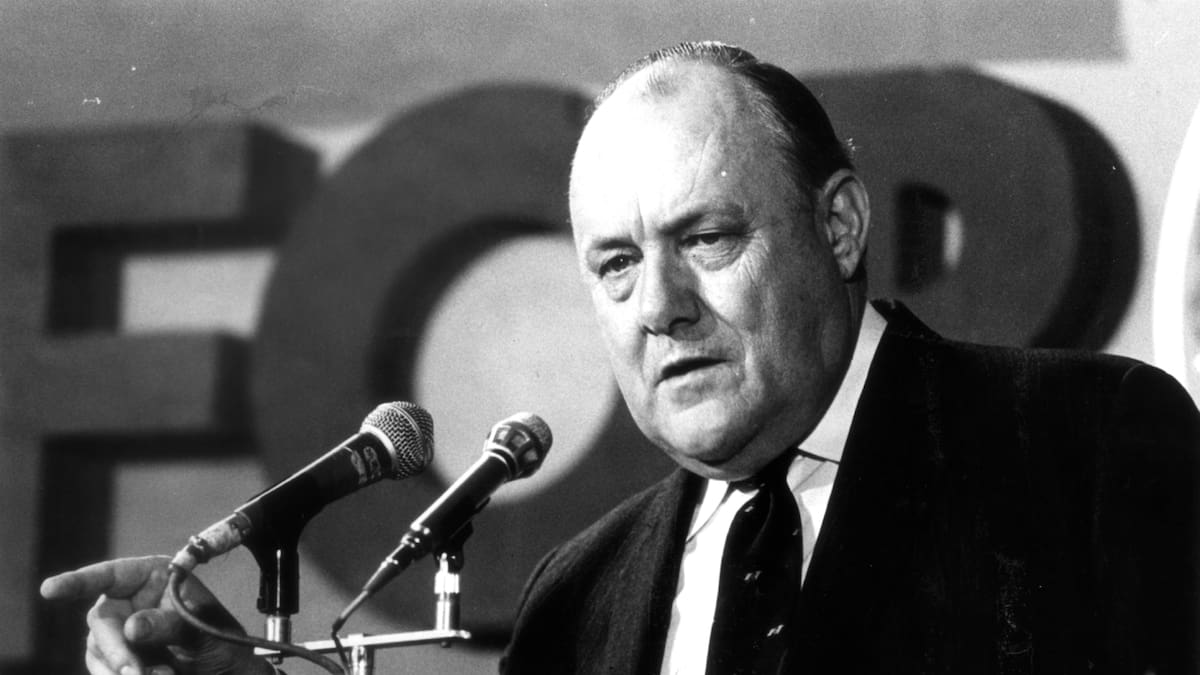
But here we are.
On Friday, Finance Minister Nicola Willis was asked about possible government moves if the fuel crisis moves from the current price shock to a genuine supply shortage requiring government management.
“The extreme kind of demand management tool of carless days or the like is right at the end of that escalating list,” she told Newstalk ZB’s Mike Hosking.
The country was currently in the first or second phase, which focused on “industry leading its management” and the Government co-ordinating and monitoring it, she said.
“There are many steps to go through before we’d be thinking about those sort of Muldoon-era steps.
“New Zealand currently has 50 days of fuel supply, but disruptions to shipments could lead to problems weeks or months down the track,” Willis said.
To be fair, this was a considered response to a question about a small but very serious risk that the Government has to prepare for.
But even discussing carless days will be triggering for anyone over the age of 55.
I’m concerned that headlines about the possibility of petrol shortages will exacerbate the damage this Iran conflict does to economic confidence.
For the record, the carless days policy was a disaster. As a strategy for managing petrol demand, it was as good as useless.
Nothing resembling the scheme that National implemented from July 1979 to May 1980 should be in the mix for managing an energy crisis in 2026.
Almost everyone in business was able to get an exemption.
News reports from the time suggest that about 25% of drivers were able to get an exemption.
Many of those who weren’t were prompted by the rules to buy a second car.
A file picture discussing carless day stickers. Photo / Bay of Plenty Times
My family, who had hitherto managed to get by with the Holden station wagon and dad’s Honda motorbike, splashed out on a secondhand Morris 1100.
Many others just took the risk of driving when they weren’t supposed to.
The Government eventually claimed fuel consumption was reduced by 3% during the carless days period.
That’s a negligible impact on demand, considering the huge amount of effort and resources required to administer the scheme.
As well as being a big hassle for the entire country, you have to assume it would add to the sense of panic about the oil shock, with negative effects on business and consumer confidence.
The current energy crisis is not as dramatic as the one we faced in 1979 – even though the headlines are unnervingly similar.
“Oil shock from Iran war grips global economy,” said the banner headline on the New York Times website on Friday.
That could have been lifted straight from a newspaper in 1979.
The Iranian revolution, in that year, caused the second oil supply shock of the 1970s.
The previous one was when the oil-producing nations (Opec) came together to control pricing in 1973.
Fuel prices rose more than 10-fold in nominal terms between 1973 and 1980.
The combination of the two shocks put New Zealand into an inflationary spiral which, in the absence of targeted monetary policy, took decades to unwind.
New Zealand at that time imported some 40% of its petroleum directly from Iran.
So, as well as an immediate oil price spike of about 70% in a short space of time, we had to scramble to find new supply. I don’t doubt that concern about shortages was very real.
There are products that consumers can easily substitute, so even small price rises can have a big impact on demand.
In the short term at least, petrol is not one of them.
If the price of beef rises, people can eat more chicken.
Economists describe this as price elasticity.
Petrol is an inelastic product.
Over time, some elasticity will emerge with fuel consumption. A sustained higher price lowers demand as more people think twice about non-essential travel. They may be more likely to take a bus or get on their bike.
Eventually, we’re likely to see a rise in demand for electric cars, hybrids or other smaller fuel-efficient vehicles.
But there are limits to the elasticity at a macro-economic level because a large majority of the nation’s vehicle fleet runs on fossil fuels.
In a worst-case scenario, where Iran manages to keep the Strait of Hormuz closed for months, the world will have to reorganise its entire oil supply chain.
At that point, the shock would be more comparable to the 1970s situation.
Unfortunately, despite United States President Donald Trump’s bombastic proclamations about the US keeping the strait open, it has not.
US Treasury Secretary Scott Bessent attempted to calm markets with a more nuanced statement.
“My belief is that as soon as it is militarily possible, the US Navy, and perhaps with an international coalition, will be escorting vessels through,” he told Sky News on Friday.
I didn’t find that reassuring, and neither did oil markets – where prices continued to rise.
The implication in the statement is that the US hasn’t yet achieved the military success required to open the strait.
It makes a lie of everything Trump has been saying about decisively winning the war.
I’m still optimistic that this conflict will be brief – contained within the four to five weeks originally suggested by Trump.
I think the market and economic turmoil will prove too much for him. At some point, he’ll declare victory and attempt to move on.
But there is a risk that Iran has both the capacity and inclination to make the US economy sweat for longer.
That could require our Government to reach into its pockets to keep the economy on track.
Cutting the fuel tax is a bad option. It would do nothing to decrease petrol demand.
It would make more sense to subsidise public transport and encourage people to work from home.
We also learned in the pandemic that we can dramatically restrict travel and still keep the economy going.
In the short term, New Zealand’s fuel supply isn’t about to run out in the coming days, so we should not panic.
In the long term, global markets would find a way to reorganise supply chains and keep the world running on fossil fuels, with or without the Strait of Hormuz.
But there are medium-term supply risks we have to prepare for.
I’m confident we can do that better than we did some 47 years ago.
Liam Dann is business editor-at-large for the New Zealand Herald. He is a senior writer and columnist, and also presents and produces videos and podcasts. He joined the Herald in 2003.
Catch up on the debates that dominated the week by signing up to our Opinion newsletter – a weekly round-up of our best commentary.