
Far below where sunlight can reach, subtle marks in Moroccan stone suggest that life left a record in a place long assumed to be erased by time.
The finding matters because it challenges where scientists think fragile traces of early ecosystems can survive, and where they should still be looking for them.
Microbes in wrinkled sediment

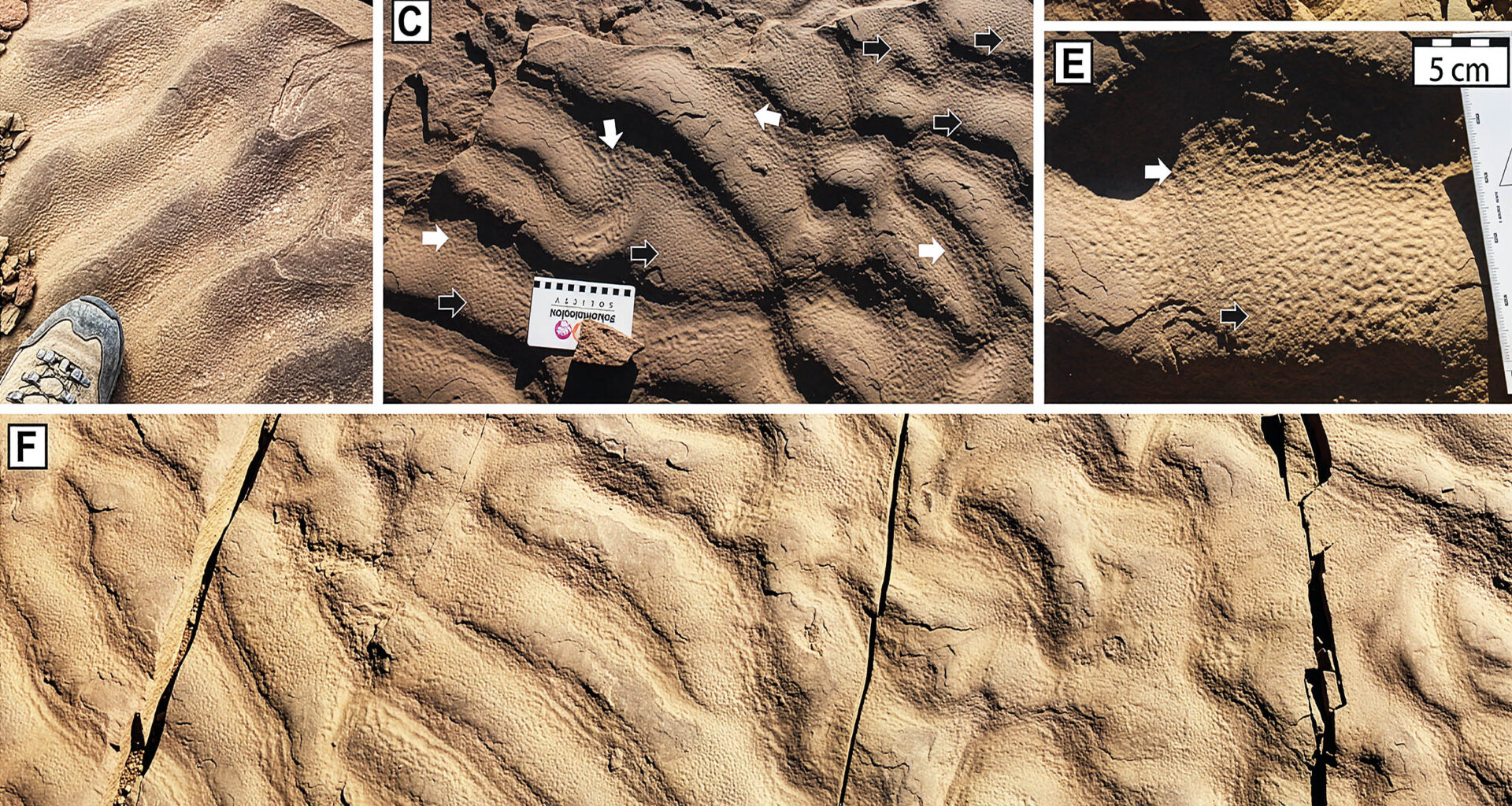
The marks appear as tiny ridges preserved in deep-water layers of sand and mud that settled on the seafloor roughly 590 feet (180 meters) beneath the surface.
Along the Dadès Valley in Morocco, rippled slabs showed extra small ridges that sat on top of the wave-like grooves.
The study was led by Dr. Rowan Martindale, an Earth scientist at the University of Texas at Austin who studies how seafloors preserve traces of ancient life.
Dr. Martindale’s research focuses on reefs and microbial systems, combining field observations with laboratory analyses.
This approach proved crucial because the texture appeared in rocks that seemed too dynamic to preserve microbial mats.
Wrinkle structures form in sediment
Wrinkle structures are ridges and small pits that form on sandy surfaces after microbes spread across wet sediment.
A microbial mat, a sticky layer of microbes that binds grains, can trap sand and stiffen the top few millimeters.
Many wrinkles measure 1 to 10 millimeters (a few hundredths to several tenths of an inch), so burrowing animals usually churn them away.
Because sunlight helps many mat builders, scientists mostly expect wrinkles in shallow water and tidal flats.
Dark seafloor, fast deposits
The Moroccan ripples formed in turbidites, deep-water beds laid by dense sediment flows, instead of beach sands.
Sediment clouds swept downslope and settled quickly, leaving layered sand capped by mud during calmer intervals.
These layers date to about 180 million years ago, when seafloor animals were common and tough on soft sediments.
That combination made a photosynthetic origin unlikely and made the survival of any wrinkles even harder to explain.
Sorting biology from physics
Dr. Martindale pushed her team to treat the texture as a test. “Let’s go through every single piece of evidence that we can find to be sure that these are wrinkle structures in turbidites,” she said.
The researchers confirmed that the beds were turbidites by tracking sediment layers, ripple forms, and where burrows appeared on the rock.
Without that context, similar-looking wrinkles could come from simple flow deformation and would not carry a biological signal.
Carbon fingerprints under ripples
Chemical checks in the study found extra carbon just below the wrinkled surface, rather than spread evenly.
That signal fits organic carbon – carbon from once-living material in sediments – because microbes leave residues as they grow and die.
Microscope images at UT Austin showed the wrinkles only affected the upper 0.08 inches (2 millimeters), matching a surface mat.
Carbon alone cannot name the microbes, but it strengthens the case that biology sat at the sediment-water boundary.
Life powered without sunlight
Deep below sunlight, some bacteria make their own food, and modern seafloor surveys show mats even in darkness.
Scientists call that food-making chemosynthesis, making sugars from chemical energy instead of sunlight, when bacteria run reactions on sulfide.
In the new work, the team paired chemistry with submersible video showing that mats can spread well below the sunlit zone.
Those modern examples helped them argue that the Moroccan mat builders drew energy from chemicals carried or released by the beds.
Chemical barriers to burrowing
Turbidity flows can bury fresh organic matter, and decay then drains oxygen from water trapped between grains in the new sediment.
As microbes break down that food, they can produce hydrogen sulfide, a toxic gas that harms many animals, in the mud.
High sulfide levels discourage grazing and burrowing, so mats survive longer and can wrinkle when bottom currents jostle them.
Only some beds reach those conditions, which helps explain why the same outcrop shows sharp wrinkles in one place and none nearby.
Rare preservation window
Even when mats form, the next flow usually scours the surface, so the wrinkles vanish before rock forms.
Preservation requires lithification, sediment hardening into rock as minerals cement grains, before erosion wipes the surface clean.
Calm gaps between flows let mats dry slightly and crack into small ridges, then a thin mud cap seals them.
That chain of events creates a taphonomic window, a short interval when preservation becomes easier, for mats on busy seafloors.
Sediment wrinkles and early life
Reports of wrinkles in other deep-water rocks have drawn debate, because many geologists assumed deep beds were poor places to look.
The new result adds criteria for judging wrinkles made by life, combining layer clues, chemistry, and modern comparisons instead of shape alone.
“Wrinkle structures are really important pieces of evidence in the early evolution of life,” said Martindale.
By treating turbidites as possible mat habitat, researchers can revisit old outcrops and search new basins for hidden chemical-powered ecosystems.
Together, the Moroccan wrinkles and the lab evidence show that deep seafloors can preserve microbial activity under the right chemistry.
Martindale plans lab experiments to watch mats wrinkle in controlled flows, and the team stresses care when similar textures lack carbon.
The study is published in the journal Geology.
—–
Like what you read? Subscribe to our newsletter for engaging articles, exclusive content, and the latest updates.
Check us out on EarthSnap, a free app brought to you by Eric Ralls and Earth.com.
—–