
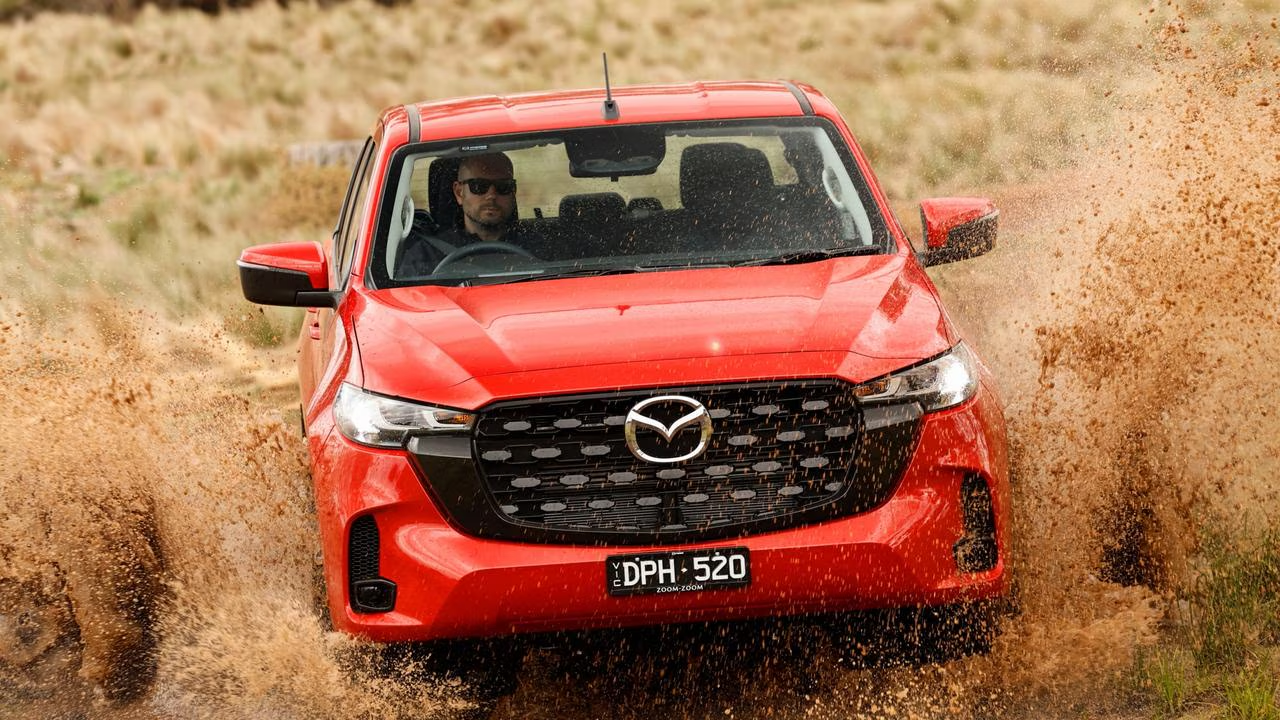
If you want to confuse a federal government bureaucrat, show them the 2026 Mazda BT-50.
While the New Vehicle Efficiency Standards were designed to push carmakers into shrinking engines or adding batteries, Mazda has decided the path to environmental salvation is, quite literally, to go bigger.
By evicting the puny 1.9-litre engine and installing a gutsier 2.2-litre turbo diesel, they’ve pulled off a brilliant piece of mechanical irony: more power, more pulling ability, and somehow, lower emissions.
This heart transplant nets a 10kW and 50Nm bump (now 120kW/400Nm), but because the engine doesn’t have to work quite so hard to shift the BT-50’s bulk, fuel consumption has actually dropped.
To be fair, Mazda didn’t exactly do this homework themselves. They just copied the Isuzu D-Max – its twin under the skin.
But the real kicker for buyers is the math. Opting for the cleaner 2.2-litre over its 3.0-litre big brother saves you a flat $2500 across the range. Think of it as a government-subsidised “accessories fund” to spend on a catalogue of bull bars and snorkels that is currently thick enough to serve as a structural support for your house.
While also available as a single or dual-cab chassis, the dual-cab range XS starts from just over $51k drive-away for the two-wheel drive version, but our family drove the four-wheel drive derivative which is about $59,500.
What do you get?
Choosing the entry-level XS grade is Mazda’s polite way of saying you’re here to work, not to swan around in leather-trimmed luxury. The interior is a shrine to the hose-out lifestyle, featuring vinyl floor coverings that are ready to embrace mud, coffee spills, or the general organic materials from a building site without a hint of judgment.
If you graduate to a four-wheel drive variant, Mazda generously replaces the construction site-spec steel rims with a set of 17-inch alloys.
While the seats are wrapped in black cloth, the real hero of the cabin is the absence of anything too precious to get dirty. It’s a toolbox with indicators.
However, Mazda hasn’t totally abandoned the 21st century, nestled among the utilitarian plastics is an 8-inch touchscreen that boasts wireless Apple CarPlay and Android Auto.
Unless you’re a purist for flat white, prepare to cough up a $695 premium for any of the mica or metallic hues. Peace of mind comes via a standard five-year warranty, while capped price servicing averages roughly $440 per visit over five.
If the standard kit feels a bit basic, you can always dive into an accessories catalogue that is thick enough to stop a bullet. Mazda offers a staggering array of accessories, from snorkels and fender flares to the ruggedly named “Thunder” bull bar. You could easily spend more time agonising over the Lightforce driving lights and retractable tonneau covers than you did on your wedding vows.
How was the drive?
Firing up the 2.2-litre turbo diesel is a noisy reminder that you’ve bought a tool, not a toy. It sounds more John Deere than Zoom-Zoom. This isn’t a ute for those who want to whisper through traffic; it’s marketed as a workhorse, and from the moment you hit the throttle, it lives up to that rugged reputation.
However, there is sophistication hidden behind that tractor-like hum. The new eight-speed automatic transmission is the star of the show, delivering slick, timely gear changes that keep the engine pinned in its peak power band. Despite its smaller displacement compared to its 3.0-litre big brother, the 2.2-litre unit has genuine grunt.
The 12.5m turning circle means navigating a tight multistorey car park is less about “driving” and more about giving your arms a CrossFit-level workout.
While it’s honest and capable, it lacks the on-road polish and interior refinement of a Ford Ranger or the new Kia Tasman.
We also couldn’t get close to the claimed fuel consumption numbers, averaging 8.1L/100km which was 1.5L thirstier than the official figure.
Would you buy one?
Kel: It’s not for me. Even in the base models, I’d be more keen on the smoother riding Ranger or the Tasman. I’m not a tradie, and while the interior is practical, I’d trade the vinyl floors for a bit more on-road polish and a ride that doesn’t feel quite so industrial.
Grant: It’s a “hose-out” special that prefers a muddy worksite to a fancy boulevard, and honestly, it’s all the better for it. It’s an honest, capable tool, but the Isuzu D-Max equivalent is slightly cheaper and comes with a six-year warranty. Currently, Mazda has a 2025 plate clearance offer on the table for the bigger 3.0-litre engine XT at $54k which I would take for better resale and overall pulling power.