
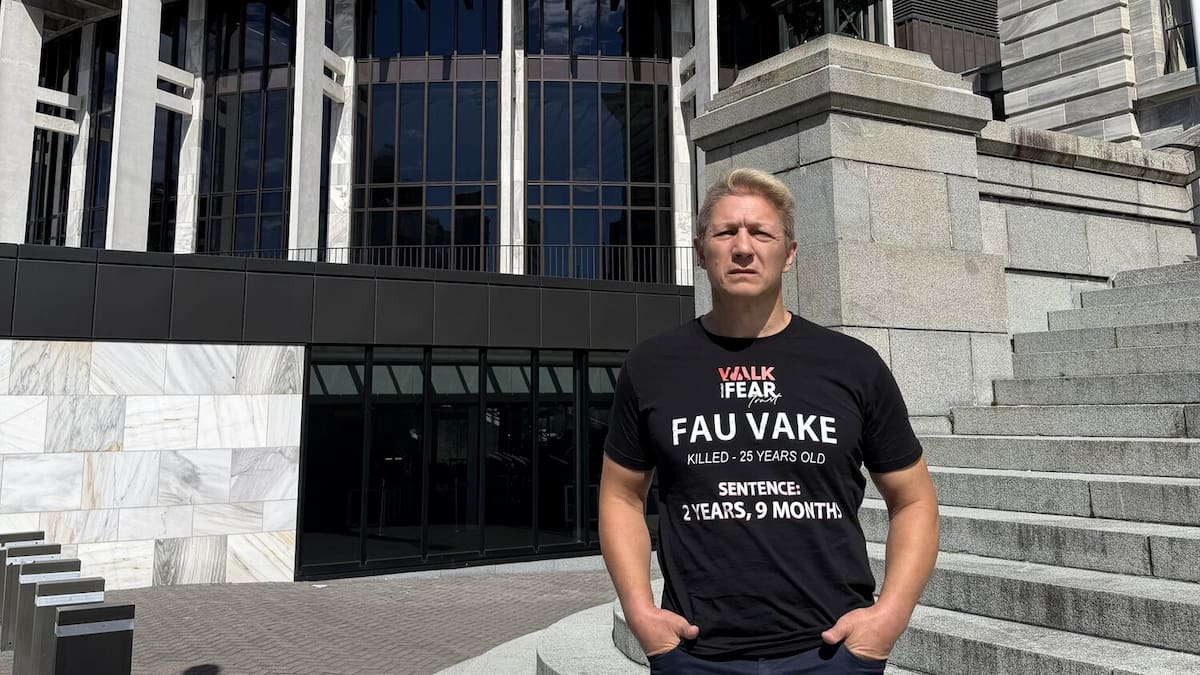
Trust secretary Mike Angove said the case highlighted what it called a “systemic failure” in New Zealand’s sentencing laws for coward punch killings.
The bill would create new coward-punch offences and toughen penalties for some one-punch attacks.
The Auckland-based organisation supported the proposed offences but said they would do little to change sentencing outcomes unless Parliament also introduced mandatory minimum prison terms.
Angove travelled to Wellington this week to present the submission, telling MPs Nganeko’s killing illustrated why the law needed to change.
Daniel Nganeko, 37, (insert) was killed by Daytona Thompson after being struck by a coward punch.
Angove said outcomes like Thompson’s sentencing reflected a sentencing framework that allowed penalties for fatal coward punch attacks to remain relatively low.
“These cases are not outliers,” he said.
“They are the product of a sentencing framework that has no minimum floor for taking a human life with a coward punch.”
Justice Paul Radich, who sentenced Thompson, noted during the hearing that he was required to apply sentencing law as it currently stood.
Angove said that reinforced the trust’s argument that the issue lay with legislation rather than judicial decision-making.
“Judges are constrained by the Sentencing Act and by precedent,” he said.
Walk Without Fear was established following the 2021 death of City Kickboxing athlete Fau Vake, who died after being punched while walking home with his brother in Auckland.
Vake spent nine days in an induced coma before life support was withdrawn. He left behind a young daughter.
Fau Vake. Photo / Supplied
His attacker was sentenced to two years and nine months’ imprisonment and was released on parole after about 11 months.
“Eleven months for a man’s life,” Angove said.
“His family serves a life sentence. The killer did not.”
According to figures included in the trust’s submission, the average prison sentence in New Zealand for manslaughter caused by a coward punch is three years and four months.
Offenders become eligible for parole after an average of about 14 months, while more than a quarter receive home detention instead of a custodial sentence.
The trust argued that those figures contrasted sharply with those in Australian jurisdictions that have introduced mandatory minimum penalties.
In New South Wales and Victoria, average sentences for similar offences exceed nine years, with non-parole periods commonly above six years, the trust said.
Trust chairman and City Kickboxing head coach Eugene Bareman told the committee that coward-punch attacks were widely recognised as uniquely dangerous.
“In combat sport, these strikes are absolutely prohibited because we know they are uniquely lethal,” Bareman said.
City Kickboxing head coach Eugene Bareman. New Zealand Herald photograph by Annaleise Shortland
“The circumstances of delivery – a relaxed jaw, an unbraced body and a hard surface on the way down – are what make them so dangerous.”
The organisation’s submission calls for a mandatory minimum non-parole period of eight years for manslaughter caused by a coward punch and tighter limits on sentencing discounts for repeat violent offenders.
Angove said public confidence in the justice system was being undermined by what many people saw as disproportionately low sentences for serious violent crime.
“When the average sentence for fraud is higher than the average sentence for killing someone with a coward punch, the system is sending an unmistakable message about the value it places on human life,” he said.
Tom Eley is a multimedia journalist at the Waikato Herald. Before he joined the Hamilton-based team, he worked for the Weekend Sun and Sunlive. He previously worked as a journalist at Black Press Media in Canada and won a fellowship with the Vancouver Sun.