
Back to Article List
The distant ice giant Uranus stands just a few arcminutes south of the similarly bright star 13 Tau, making it easy to find.
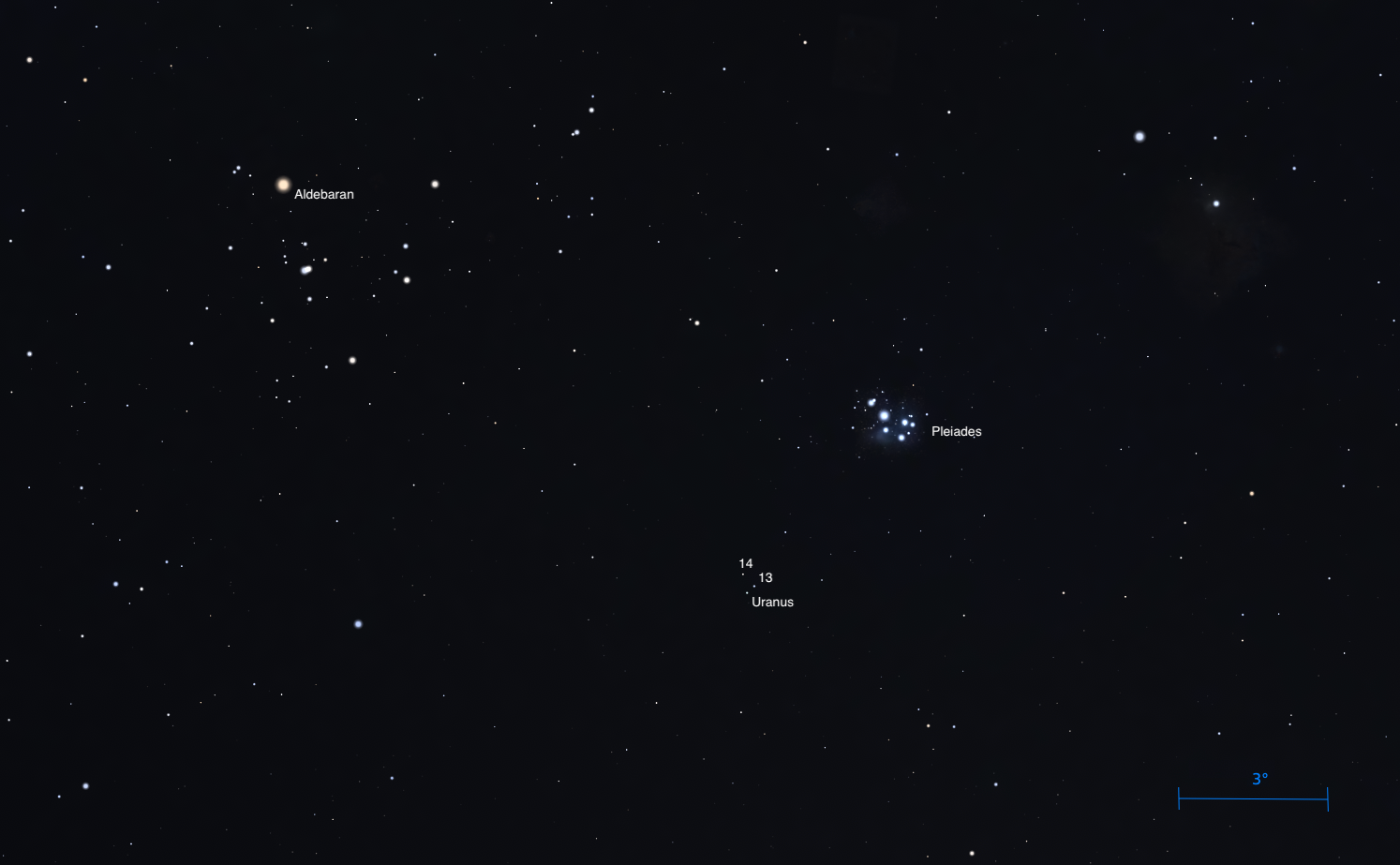
Uranus lies close to a field star of similar brightness not far from the Pleiades star cluster on March 15. This view shows a view of Taurus in the southwestern sky around 9 P.M. local daylight time on that date. Credit: Stellarium
Looking for a sky event this week? Check out our full Sky This Week column.
March 14: Io rounds Jupiter
The distant ice giant Uranus is located in Taurus right now, not far from the famous (and easy-to-find) Pleiades star cluster, cataloged as M45. Tonight, the planet also sits a short distance due south of a 6th-magnitude field star of roughly the same brightness, further aiding in its identification.
Around 9 P.M. local daylight time, you can easily spot the Pleiades 40° above the southwestern horizon, slowly preparing to sink lower in the west as the night goes on. From the Pleiades’ center, drop 4.5° south-southwest to land on a pair of 6th-magnitude stars in an east-west line. The easternmost star is fainter magnitude 6.1 14 Tauri, while the westernmost star is brighter magnitude 5.7 13 Tauri.
Magnitude 5.8 Uranus will appear like a twin to 13 Tau, sitting 12’ due south of this star. The distant planet may look “flatter” compared to the star’s pinprick-like light, with a tiny disk spanning 4” that may appear grayish-blue through your scope.
Sunrise: 7:11 A.M.
Sunset: 7:07 P.M.
Moonrise: 5:34 A.M.
Moonset: 3:36 P.M.
Moon Phase: Waning crescent (10%)
*Times for sunrise, sunset, moonrise, and moonset are given in local time from 40° N 90° W. The Moon’s illumination is given at 10 P.M. local time from the same location.