
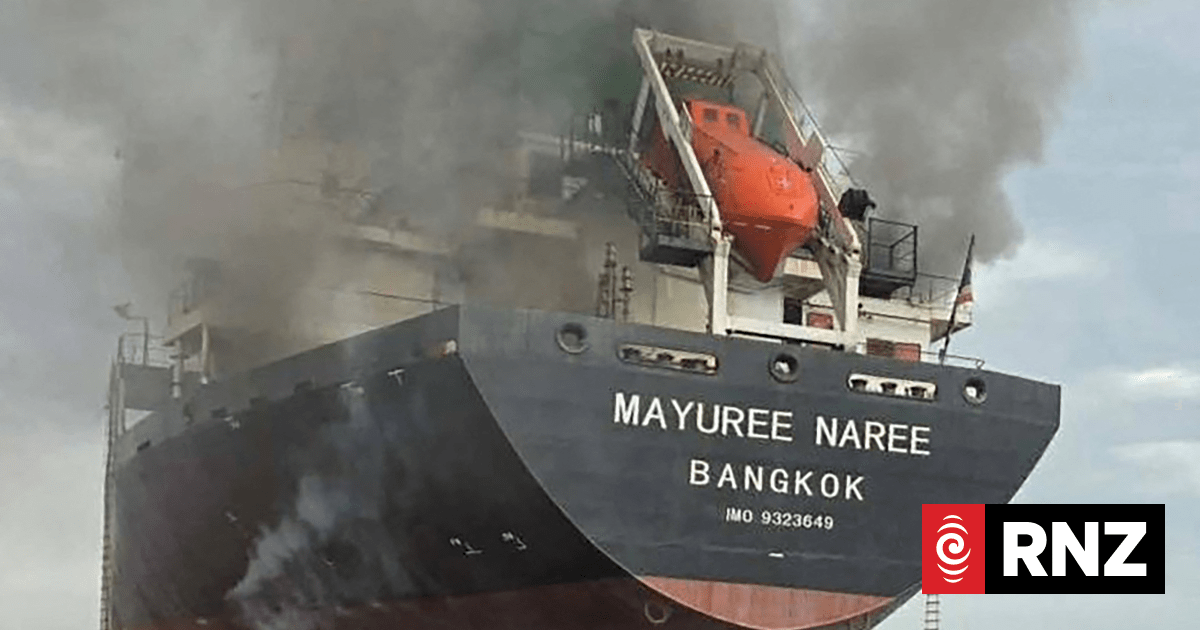
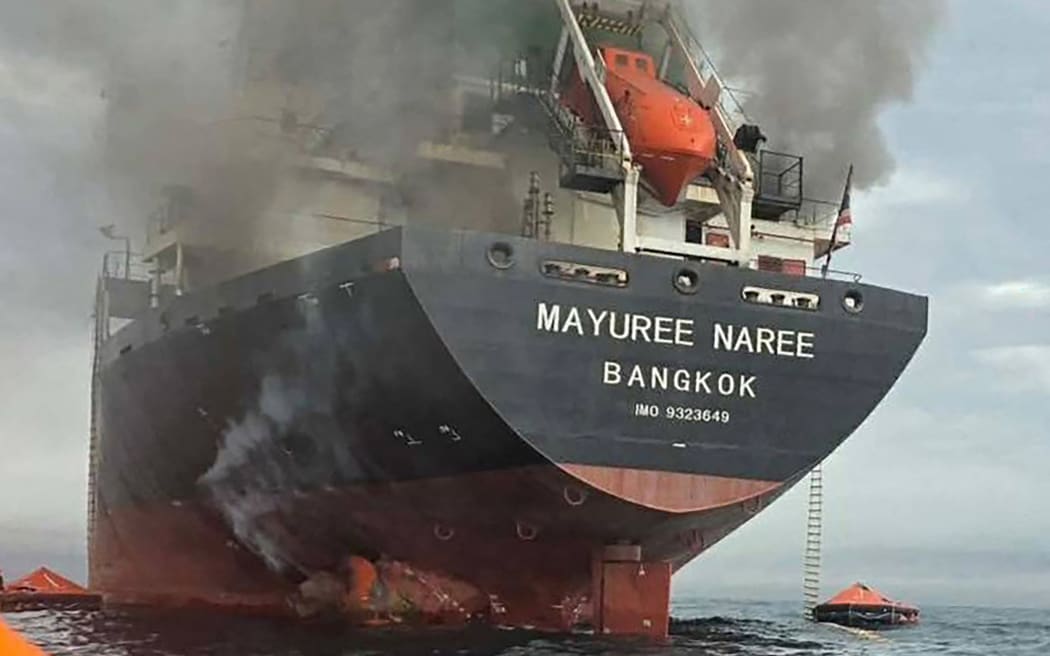
Smoke rising from the Thai bulk carrier ‘Mayuree Naree’ near the Strait of Hormuz.
Photo: ROYAL THAI NAVY / AFP
By Carla Teng-Westergaard, Asia Media Centre
As the conflict in the Middle East persists into March, the global energy market faces its most significant stress test in decades.
For Asia, the world’s largest consumer of Middle East crude, the primary concern centres on the Strait of Hormuz, a narrow waterway through which nearly 80 percent of Asia’s oil imports must pass.
With shipping disruptions and rising insurance premiums, Asian governments are now tapping into strategic reserves to prevent economic paralysis.
Japan
Reserve duration: 254 days
Japan maintains one of the world’s most sophisticated energy safety nets, divided between state-owned stockpiles and mandatory private-sector holdings.
This massive buffer is a direct response to Japan’s extreme vulnerability, as it relies on the Middle East for more than 90 percent of its crude oil.
To cope with the 2026 crisis, the Japanese government has authorised a “phased release” of these reserves to stabilise domestic prices and support refineries facing shipment delays.
Additionally, Tokyo is strengthening diplomatic energy ties with the GCC (Gulf Cooperation Council) to ensure ‘priority buyer’ status.
South Korea
Reserve duration: 208 days
South Korea’s strategic reserves are managed by the Korea National Oil Corporation (KNOC) and are designed to sustain the country for nearly seven months.
Given South Korea is the world’s fifth-largest importer of crude, the government has implemented a ‘Crisis Level 3’ protocol, which involves diversifying imports away from the Persian Gulf toward the Americas.
Seoul is also utilising state funds to subsidise freight costs for tankers taking the longer route around the Cape of Good Hope to avoid the Red Sea conflict zone.
South Korean President Lee Jae Myung said authorities would cap domestic fuel prices for the first time in nearly 30 years to contain a spike in prices, after the conflict in the Middle East sent global crude prices sharply higher.
China
Reserve duration: 120 days
China has spent the last decade aggressively building its Strategic Petroleum Reserve (SPR), which is now estimated to hold more than 1.2 billion barrels.
While China imports roughly half of its oil through the Strait of Hormuz, it has mitigated this risk by significantly increasing overland pipeline imports from Russia and Kazakhstan.
Beijing is currently leveraging its “all-weather” partnership with Iran and Russia to secure non-dollar-denominated oil, effectively creating a parallel energy market that bypasses traditional Western-influenced supply chains.
India
Reserve duration: 50-60 days
India’s energy security is currently a highwire act, as its underground strategic caverns hold only about nine days of supply, with the remainder held in refinery tanks.
To bridge the gap during the ongoing Middle East war, New Delhi has maximised its intake of discounted Russian Urals, which now accounts for nearly 40 percent of its total imports.
In recent days, Indian refiners have rapidly secured around 30 million barrels of Russian crude from the spot market, taking advantage of available cargoes, after disruptions to Middle Eastern shipments through the Strait of Hormuz and a temporary US waiver allowing the purchases.
The government is also fast-tracking the ‘Phase II’ expansion of its strategic reserves in Odisha and Karnataka to reach a 90-day target by 2028.
Thailand
Reserve duration: 60 days
Thailand relies heavily on imported fuel to power its transport sector and wider economy, leaving it vulnerable to global oil price shocks.
In response to the 2026 Middle East crisis, the government has frozen domestic diesel prices using the Oil Fuel Fund, which is spending billions of baht to cushion consumers from rising global crude prices.
At the same time, Bangkok is seeking alternative energy suppliers, and accelerating domestic gas production in the Gulf of Thailand and the Malaysia-Thailand Joint Development Area to reduce reliance on Middle Eastern imports.
The Philippines
Reserve duration: 60 days
Unlike its neighbours with large state-owned caverns, the Philippines relies primarily on mandatory minimum inventory requirements (MMIR) imposed on private oil companies.
The Department of Energy has recently tightened monitoring of these commercial stocks to prevent hoarding and ensure that the “two-month buffer” is strictly maintained.
To cope with the crisis, the government is incentivising the shift to electric public transport (e-Jeepneys) to permanently lower the nation’s daily fuel demand.
On 9 March, Philippine President Ferdinand Marcos Jr announced that the country currently maintained oil stockpiles sufficient to cover up to 60 days of supply.
The available reserves include enough diesel for about 50.5 days, fuel oil and gasoline for about 51.5 days each, kerosene for about 67.5 days, jet fuel for about 58 days and liquefied petroleum gas (LPG for about 29 days.
Marcos also outlined several interventions to mitigate the impact of potential oil price increases, including fuel subsidies for affected sectors, such as transportation and agriculture.
“As soon as oil prices breached 80 dollars per barrel, mayroon na tayong gagawin [we have something to do now] and we will use several of the funds,” he said. “For example, we will use the Pantawid Pasada Program, and the subsidy for the farmers and fisherfolk.”
The government is also looking at the possibility of easing the transport cost burden for commuters, especially the working public, by providing no-fare bus rides along major routes and holding fares down.
Indonesia
Reserve duration: 21-25 days
Indonesia’s reserve levels are among the leanest in the region, reflecting its transition from an OPEC member to a major net importer.
The government has labelled the current 25-day supply as “critical”, and has instructed state-owned Pertamina to seek long-term supply contracts with producers in Africa and Brazil.
To manage the crisis, Indonesia is aggressively blending domestic palm oil into its diesel (B35/B40 programmes) to reduce the total volume of crude oil needed from the Middle East.
Pakistan
Reserve duration: 28-30 days
Pakistan’s energy security is hindered by its “circular debt” and limited foreign exchange reserves, making it difficult to maintain a large strategic buffer.
The country is currently surviving on a month-to-month basis through credit lines provided by Middle Eastern allies, like Saudi Arabia and the UAE.
To extend its limited reserves, Pakistan has re-introduced mandatory early closures for commercial markets and is negotiating a long-term, fixed-price oil deal with Russia.
Vietnam
Reserve duration: less than 20 days
Vietnam’s petroleum buffer remains one of the thinnest in Asia.
Its dedicated national oil reserve is estimated at only about 7-9 days of net imports, with most fuel stocks instead held by commercial distributors, such as Petrolimex and refinery operators.
This means inventories are largely geared toward immediate market distribution, rather than long-term emergency storage.
The country’s refining system is also structurally exposed. Vietnam’s two major refineries, Nghi Son and Dung Quat, still rely on imported crude grades to operate at full capacity, leaving them sensitive to global supply disruptions and shipping shocks.
Recognising this vulnerability, Hanoi is now working on plans to expand petroleum storage infrastructure and build a national strategic reserve that could eventually reach the 90-day energy security benchmark by the end of the decade.
Malaysia
Reserve duration: 30 days
Malaysia is in a somewhat stronger position than many of its Southeast Asian neighbours.
The country produces light, sweet crude grades that command premium prices in global markets and exports a significant share of this output.
However, its refining sector still imports lower-cost crude, including heavier grades from the Middle East, meaning the country is not insulated from global supply disruptions.
Higher oil prices also present a mixed economic impact. While they boost revenues from Malaysia’s oil and gas sector, the government maintains extensive fuel subsidies to shield consumers from rising global prices.
Brunei
Reserve duration: Net Exporter
Brunei occupies a very different position from most Southeast Asian economies.
The country remains a significant exporter of oil and natural gas, with production far exceeding its small domestic energy demand.
Hydrocarbons dominate the economy, accounting for the vast majority of export earnings and government revenue.
As a result, Brunei faces little immediate risk of fuel shortages, even during a prolonged disruption in Middle Eastern supply.
Instead, the country’s main exposure lies in the volatility of global energy markets.
Higher prices could boost export revenues, but they also underscore Brunei’s heavy economic dependence on oil and gas.
Singapore
Reserve duration: Not publicly disclosed
Singapore’s exposure to the Iran conflict is already being felt through rising energy prices, rather than supply shortages.
DBS Bank chief economist Tamar Baig said told Channel News Asia (CNA) the shock from the escalating conflict, which had disrupted tanker traffic through the Strait of Hormuz, was already feeding into fuel prices in the city-state.
If the disruption persists for several weeks, Baig said the impact would likely spread beyond petrol prices. Consumers and businesses with gas contracts could begin seeing higher energy bills, while regulated electricity tariffs may adjust within a quarter, as global price volatility filtered into the domestic market.
However, the broader economic impact may remain contained. Energy costs account for only about 3-3.5 percent of Singapore’s consumer price index, meaning the current spike is unlikely to trigger the kind of broad inflation surge seen during the post-pandemic period or after the war in Ukraine.
In the event of a prolonged conflict, Baig noted that Singapore’s diversified energy sourcing could help cushion the shock.
While Qatar remains an important supplier of liquefied natural gas, the country also imports energy from Australia, the United States and Mozambique.
As a result, Singapore would likely face higher prices, rather than physical shortages, with alternative suppliers available, if disruptions in the Gulf persist.
Taiwan
Reserve duration: More than 100 days
Taiwan maintains a relatively strong energy buffer compared with many Asian economies.
The government says the island holds more than 100 days of crude oil reserves, comfortably above the statutory minimum of 90 days required under its energy security regulations.
As the Iran conflict disrupts tanker traffic through the Strait of Hormuz, authorities have stepped up monitoring of inventories and shipping schedules, while introducing price-stabilisation measures to limit the impact on consumers.
Taipei is also seeking to diversify supply by expanding energy imports from partners such as the United States, ensuring that oil and gas deliveries continue, even if disruptions in the Gulf persist.
– Asia Media Centre