

By Lucia Stein, ABC

Mojtaba Khamenei.
Photo: MORTEZA NIKOUBAZL / NURPHOTO VIA AFP
Late last week, Iran’s new supreme leader, Mojtaba Khamenei, broke his silence after days of intensifying rumours about his health and whereabouts, but it did little to put them to rest.
The mysterious 56-year-old cleric has not been seen since the start of the war, nor has he appeared in public since he was named as his father’s successor in Iran last Sunday, local time.
That day, he was set to deliver a speech, according to Iranian state media, but the hours passed with no public showing, fuelling speculation he was not just in hiding, but possibly incapacitated.
Then Mojtaba Khamenei issued his first public statement as supreme leader on Thursday night, with the remarks read out by a newsreader on Iranian state TV.
“My sincere thanks go to our brave fighters who … with their crushing blows, have blocked the enemy’s path and made them abandon the illusion of being able to dominate our dear homeland and possibly partition it,” the journalist said while an image of Mojtaba Khamenei was displayed on screen.
The cleric’s statement struck a defiant tone, but his absence from public view, or even a recording of him speaking, did little to dispel rumours about his well-being or whereabouts.
No explanation was given for why the new supreme leader was not delivering the words himself.
The bizarre episode has now prompted several questions: Where is Mojtaba Khamenei? What condition is he in? And is he really overseeing the regime while it is at war?
Khamenei reportedly injured
When Mojtaba Khamenei was announced as his father’s successor, crowds gathered in Tehran to chant, “God’s hand is still upon us, Khamenei is still our leader.”
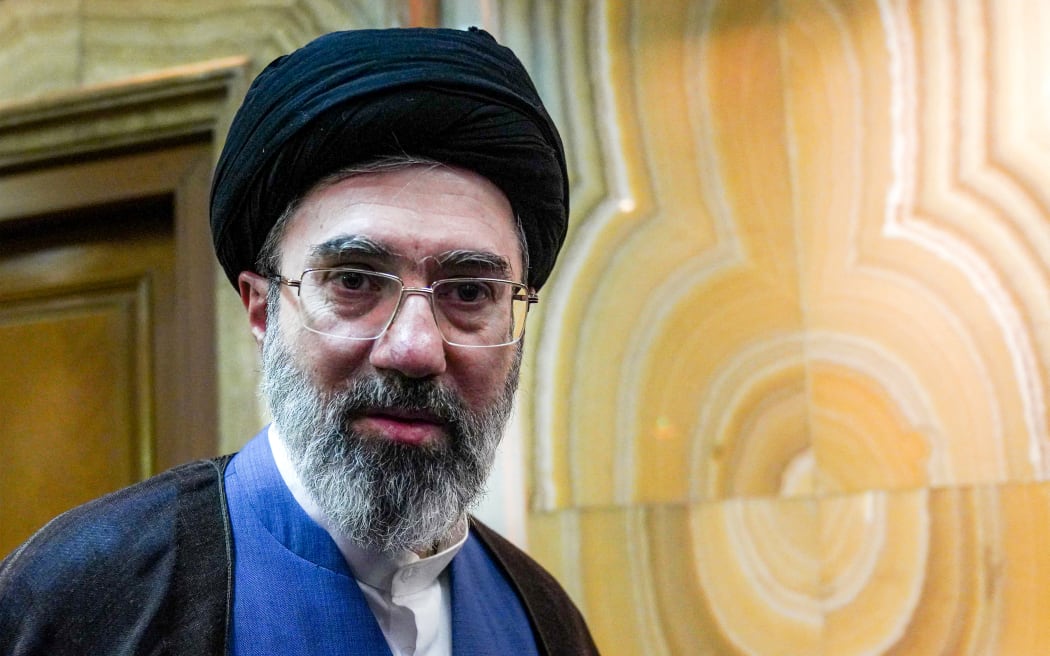
Mojtaba Hosseini Khamenei is the second eldest child of Ali Khamenei.
Photo: HAMED JAFARNEJAD / ISNA / AFP
But as days passed without a public message from the cleric, rumours swirled on social media that something was amiss.
Regime supporters said he, or those around him, were wary of tipping off Iran’s enemies about his whereabouts, a valid concern given the assassination of his father, wife and sister on the first day of the war.
Opposition groups in the diaspora, on the other hand, quickly claimed, without providing evidence, that he was in a coma, unaware he was now in charge of Iran and of the war that had killed most of his family.
Those unverified reports persisted after his public statement.
The reason for his absence could be somewhere between the two explanations: state media reported that the younger Khamenei was a “wounded veteran of the Ramadan war”, a reference to the US-Israeli strikes which began during the Muslim holy month.
US Defense Secretary Pete Hegseth has said the US believes he is “wounded and likely disfigured,” without providing evidence.
“Iran has plenty of cameras and plenty of voice recorders. Why a written statement? I think you know why. His father is dead. He’s scared, he’s injured, he’s on the run, and he lacks legitimacy.”
Alireza Salarian, Iran’s ambassador to Cyprus, told The Guardian that Mojtaba Khamenei was injured in the February 28 attack that killed his father.
“I’ve heard his legs and arms were injured,” Salarian said in an interview at the Iranian embassy in Nicosia.
“I think he’s in the hospital because he was wounded.”
Iranian officials also told the New York Times that Mr Khamenei “suffered injuries”, but they added he was alert and sheltering at a highly secure location with limited communication.
The full scale of his injuries and the time he may need to spend in recovery remains unclear.
AI images and secrecy add to the mystery
Other elements of the new leader’s public image drew scrutiny and intense speculation in the days since his appointment, including a new profile photo published by Iranian media.
The image appears to have been created with the help of AI, according to a BBC journalist, raising questions about why it was circulated in place of a real photo of Mojtaba Khamenei.
This image of Iran’s new Supreme Leader Mojtaba Khamenei, which has been widely published by Iranian media today and now appears on his new X account, appears to have been manipulated with AI.
Google’s SynthID finds watermarks in it that indicate it has been edited using Google… pic.twitter.com/cDbYLlKFVz
— Shayan Sardarizadeh (@Shayan86) March 12, 2026
Adding to the mystery around the new leader is the process by which the Assembly of Experts chose him, the 88-member panel tasked with selecting Iran’s supreme leader, which was shrouded in secrecy.
The younger Khamenei was deeply tied to his father’s regime, but did not appear in the media or release many sermons to the public before his appointment.
“The appointment of Mojtaba will cause some consternation,” Ali Ansari, professor of Iranian history and director of the Institute for Iranian Studies at the UK University of St Andrews, told the ABC.
“Not because it was wholly unexpected, but the reality of appointing a hereditary succession will have jarred with some, and there are some clear fissures in the elite.
“It also does not help that Mojtaba is not around [and] cannot make his presence felt.”
Iranian sources have since told media outlets that it was the powerful Islamic Revolutionary Guard Corps (IRGC) that engineered Mojtaba Khamenei’s selection, signalling a more aggressive stance abroad and sterner internal repression.
Iran’s ‘semi-informal network’ keeps it running
Even before the appointment of the younger Khamenei, the Iranian regime, already a complex and opaque institution, continued to operate without a public-facing leader.
Iran’s foes hoped to cut the head off the snake, assuming the body would die, but instead they found another grew in its place.
Several reasons explain why this was the case, but one simple explanation is that Iran’s Islamic Republic was deliberately designed to survive the death of a single leader, with authority dispersed across its clerical institutions, security apparatus and power networks.
“The resilience [of Iran’s regime in the face of attack] has relied on this semi-formal network of IRGC, Basij and other state services that have fulfilled multiple roles, including service provision, surveillance and repression,” Maryam Alemzadeh, associate professor in history and politics of Iran at St Antony’s College, Oxford, told the Guardian.
“Decapitation does close to nothing to affect this network. If anything, it creates a limited rally-round-the-flag effect amongst this particular group, but not the larger population.”
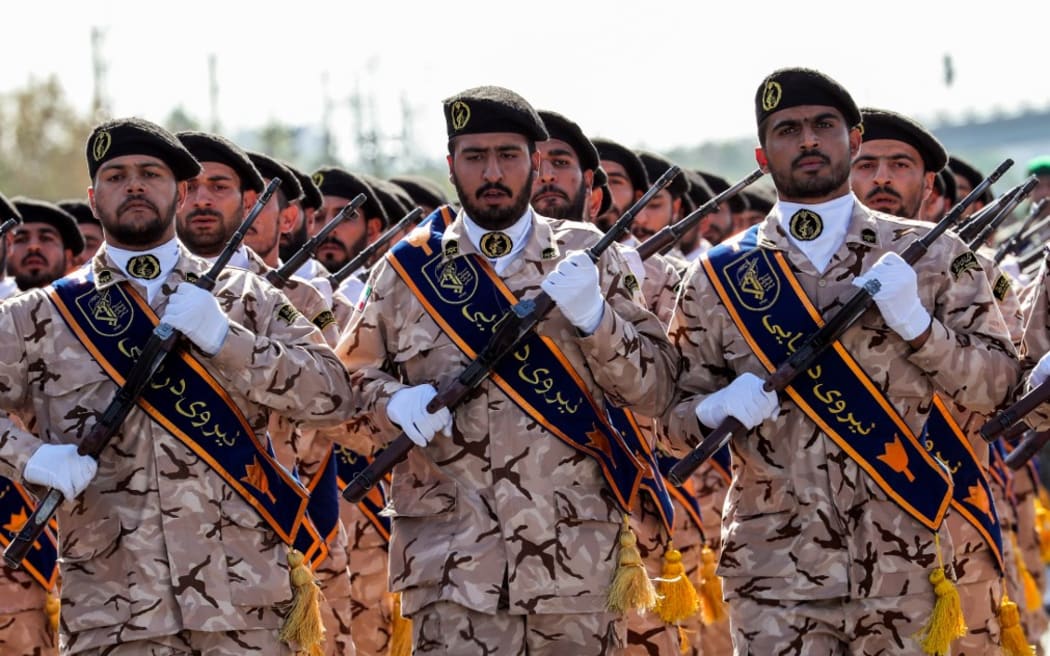
Iran’s powerful Islamic Revolutionary Guard Corps (IRGC) reportedly pushed for the appointment of the new supreme leader.
Photo: AFP
The IRGC controls the paramilitary Basij Resistance Force, which has helped suppress domestic dissent, including during the widespread and deadly protests held earlier this year.
They also oversee the Quds Force, which is responsible for military campaigns abroad and for managing proxy forces in countries including Afghanistan, Iraq, Lebanon, Yemen, and Syria, as well as powerful charitable foundations that run a considerable part of the economy.
Khamenei’s rise indicates the IRGC hardline core has strengthened its position, Professor Ansari said.
“I would not extend this to the entire IRGC; incidentally, these are not monoliths,” he added.
Regime opponents have denounced him for this very reason, seeing the IRGC’s push to quickly name him as a sign that they were desperate to install their man, despite the swirl of questions around his health.
A deepening resistance
While Motjaba Khamenei has not been publicly seen since his ascension, his face, at least, is everywhere in Tehran.
The cleric’s features adorn large banners and murals in Tehran, including in paintings alongside his father.
In launching the strike that killed Iran’s supreme leader and some of its top officials, the US commander-in-chief hoped to trigger the collapse of a regime that has long been an adversary of the United States and Israel.
But the Assembly of Experts’ choice not only signalled deep resistance to foreign interference, but that the US’s strategy may have backfired, at least in the short term.
“I assure everyone that we will not abandon seeking revenge for the blood of your martyrs,” Mojtaba Khamenei said in his statement.
“The revenge we have in mind is not only related to the martyrdom of the great leader of the revolution [Ayatollah Ali Khamenei]; rather, every member of the nation who is martyred by the enemy is an independent subject in the file of retribution.”
His message also called for the Strait of Hormuz to remain blocked, a move that has already spiked oil prices worldwide, to continue as needed.
Israel and US strikes continue to target the groups that oversee the repression of Iran’s dissent, but crippling the IRGC could take weeks or even months of additional air strikes and other military steps, analysts and Iranian opposition leaders told the Wall Street Journal.
In the meantime, many analysts have warned that Iran may become even more radicalised under Mojtaba Khamenei’s rule, and have questioned whether his leadership will be shaped more by vengeance over the death of his family than by strategy or reconciliation.
“What we are likely to see next is not regime change but a badly injured and equally anti-West Iran,” former Jordanian diplomat and Carnegie Institute vice president Marwan Muasher wrote.
“The conflict will leave behind an angry Iranian population, both among supporters of the regime who will be more anti-American than before and opponents of the system, who will feel that they were let down by the president.
“That is a formula for more instability and strife rather than one that offers hope for a better future.”
– ABC