
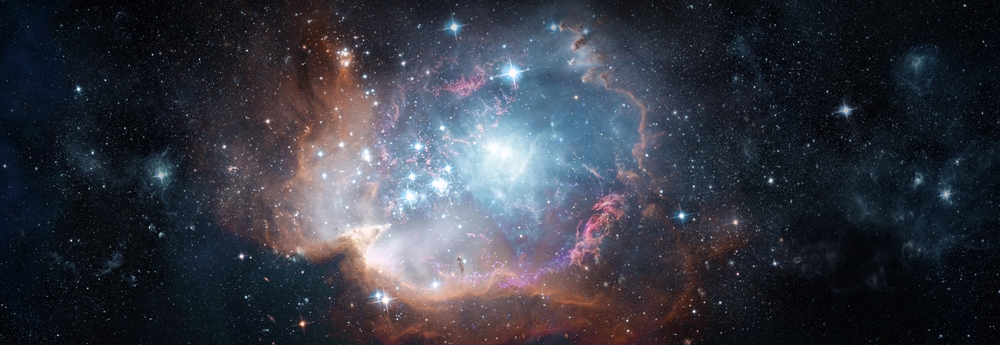
Using the James Webb Space Telescope (JWST), astronomers observed dry ice inside a complex planetary nebula known as NGC 6302.
This is the first time dry ice has ever been observed inside a planetary nebula.
Planetary nebulae (PNe) are expanding shells of gas and dust that have been ejected from a star during the process of its evolution from a main-sequence star into a red giant or white dwarf.
They are relatively rare but are important for astronomers investigating the composition of the interstellar medium (ISM).
Complex chemistry of a rare planetary nebula
NGC 6302, dubbed the Butterfly Nebula or the Bug Nebula, is a bipolar type PN located some 3,400 light-years away in the constellation Scorpius.
The nebula has a radius of at least 1.5 light-years and exhibits bright east-west-oriented bipolar lobes bisected by a massive dusty torus.
Previous observations of NGC 6302 have detected methyl cation (CH3+) in this nebula, a key driver of organic chemistry.
Moreover, some studies have found widespread polycyclic aromatic hydrocarbon (PAH) emission in NGC 6302.
These two findings suggest that the environment of NGC 6302 supports rich chemical processes and, therefore, makes it a particularly intriguing laboratory for exploring complex chemical pathways in PNe.
“This work utilises JWST MIRI/MRS observations of NGC 6302 covering the central star, torus, and innermost region of the bipolar lobes,” the authors stated.
A unique discovery of dry ice
Observations conducted with the MIRI medium-resolution spectrometer (MRS) revealed clear absorption features in the 14.8–15.2 µm range corresponding to gas-phase carbon dioxide.
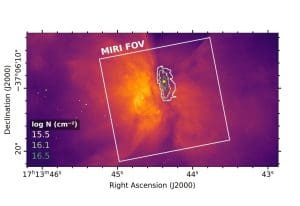 Location of carbon dioxide ice in NGC 6302. The image shows HST/WFC3 observations featuring filter F656N, which traces hydrogen-alpha emission. The JWST MIRI mosaic is indicated by the white frame. Contours show the column density of gas-phase carbon dioxide, with corresponding log N values (cm−2) provided in the lower left. Credit: arXiv
Further investigations revealed two key signatures of dry ice in the dusty torus of NGC 6302: a shallow, broad absorption band between 14.9–15.15 µm and a second absorption band between 15.2–15.3 µm.
The astronomers underline that the detection of carbon dioxide ice in NGC 6302 represents the first identification of an ice species more volatile than water in any planetary nebula.
They note that although molecular ices are abundant in cold, shielded environments, including dense molecular clouds, envelopes of young stellar objects (YSOs) and protoplanetary disks, the environments of PNe are generally hostile to fragile molecular species and ices due to intense ultraviolet irradiation.
This makes their detection unique.
More high-quality observations of planetary nebulae needed
According to the paper, the gas-to-ice ratio in NGC 6302 differs markedly from that observed in YSOs.
This indicates a distinct ice formation or processing mechanism in evolved stellar environments.
Summing up the results, the authors of the study underscore the need for high-spatial-resolution observations of PNe to constrain their chemical pathways, temperature structure, and ice-processing mechanisms.
This will be essential to establish whether ice chemistry is common in dense PN tori.