
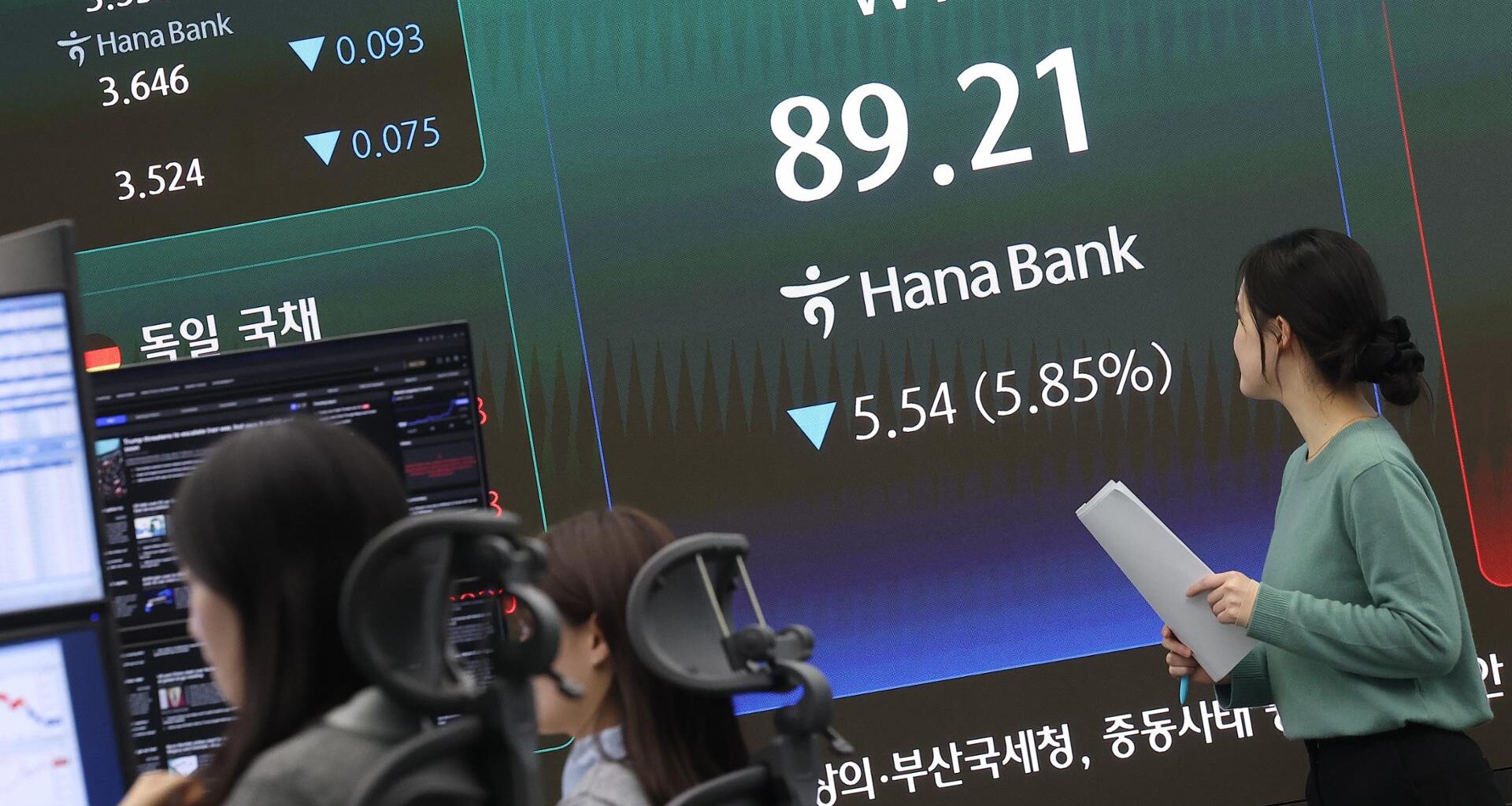
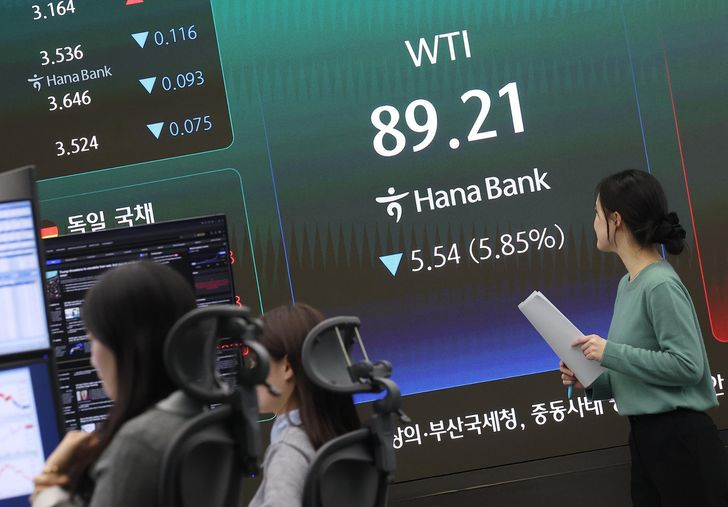
The price of Western Texas Intermediate (WTI) is seen on an electronic signboard at a Hana Bank dealing room in Seoul, Tuesday. Yonhap
Korea’s manufacturing sector is expected to face significantly increased cost burdens as the Middle Eastern crisis continues to push up global energy prices, a report showed Monday.
When international crude prices rise 10 percent, the average production cost of manufacturers here goes up by 0.71 percent, the Korea Institute for Industrial Economics & Trade (KIET), a state-run think tank, said in a report assessing the impact of the Iran crisis on the Korean economy.
In particular, the average production cost in the petrochemical industry will likely jump 6.3 percent, while that of chemical products are projected to increase 1.59 percent. Production costs of rubber and plastic products are expected to expand 0.46 percent.
Dubai crude prices, the benchmark for Middle Eastern oil, surged by over 40 percent since U.S. and Israeli airstrikes against Iran late last month, the KIET said, noting that Korea, in particular, is vulnerable to such a situation as the country imports around 70 percent of crude oil from the Middle East.
In case of exports, the Middle East accounts for only around 2-3 percent of Korea’s overall outbound shipments, but the KIET said Seoul’s exports will be exposed to various indirect impacts, such as a rise in shipping costs, supply chain disruptions and a possible global economic slowdown.
“Oil prices have a heavy impact on consumer prices,” said Hong Sung-wook, a senior researcher at KIET, stressing that market price stabilization policies will be needed in both the short and long term.
As part of such efforts, the government introduced a fuel price cap system last week, setting maximum prices for fuel products supplied by oil refineries to gas stations.