
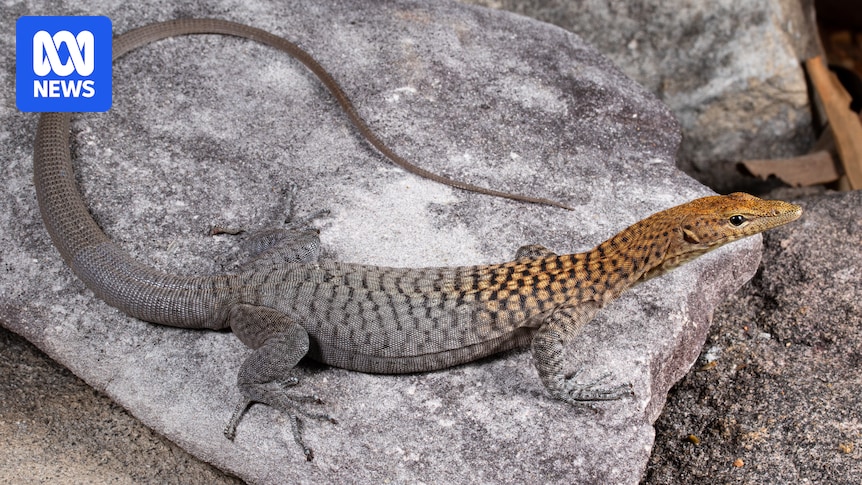
Three new species of rock monitor lizards have been confirmed in the rocky savanna of Far North Queensland.
But the reptile-obsessed scientist who co-authored the research paper describing them admits the remarkable findings come with a degree of trepidation.
One of the three new species — the yellow-headed rock monitor, now known scientifically as Varanus phosphoros — was well-known to reptile enthusiasts from North Queensland.
However, it was assumed to be a local adaptation of another species.
“They hadn’t really attracted the attention of researchers who work on monitor lizards,” evolutionary biologist Stephen Zozaya said.
“There was no genetic material, there were no specimens in museums for anyone to look at.”
The team of researchers who described the yellow-headed rock monitor also found two other, significantly less well-known species, the rainbow rock monitor Varanus iridis and the orange-headed rock monitor, Varanus umbra.
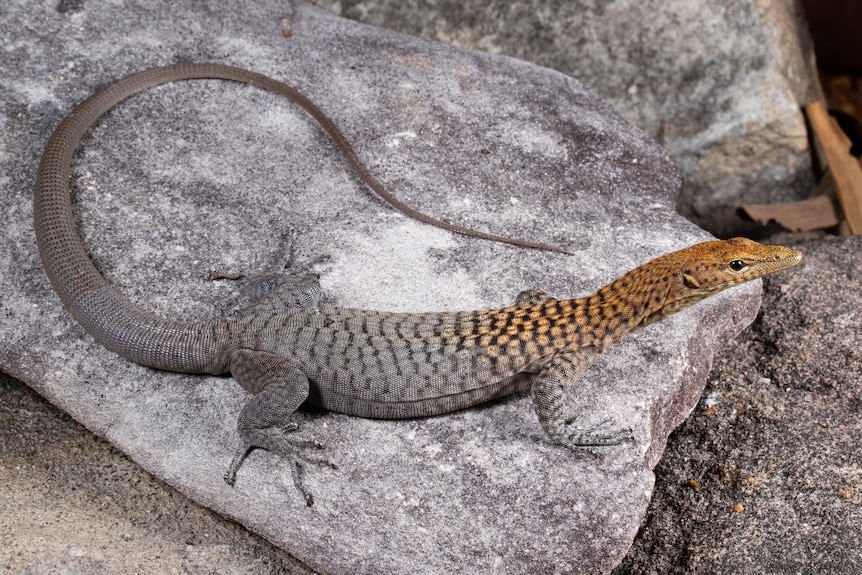
The orange-headed rock monitor, or Varanus umbra, is found in the savanna of north Queensland. (Supplied: Stephen Zozaya)
Dr Zozaya, a research fellow at the Australian National University, described the shock when his colleague Wes Read found an orange-headed rock monitor for the first time.
“I was like, ‘What is that?'” Dr Zozaya said.
“I had no idea these things existed, and it turns out a few photos had showed up online from nature enthusiasts.”Surprising genetic data
The three species are the first rock monitors known from savannas in eastern Australia.
Dr Zozaya said it might be the result of the species having evolved independently for millions of years.
“We were really shocked when the first genetic data came in,” Dr Zozaya said.
“Levels of genetic divergence between these three populations was much greater than many of the other species we already recognise.”
The yellow-headed rock monitor is found in a long strip of granite habitat where rainforest gives way to drier country, stretching from west of Cairns, up to Cape Melville.
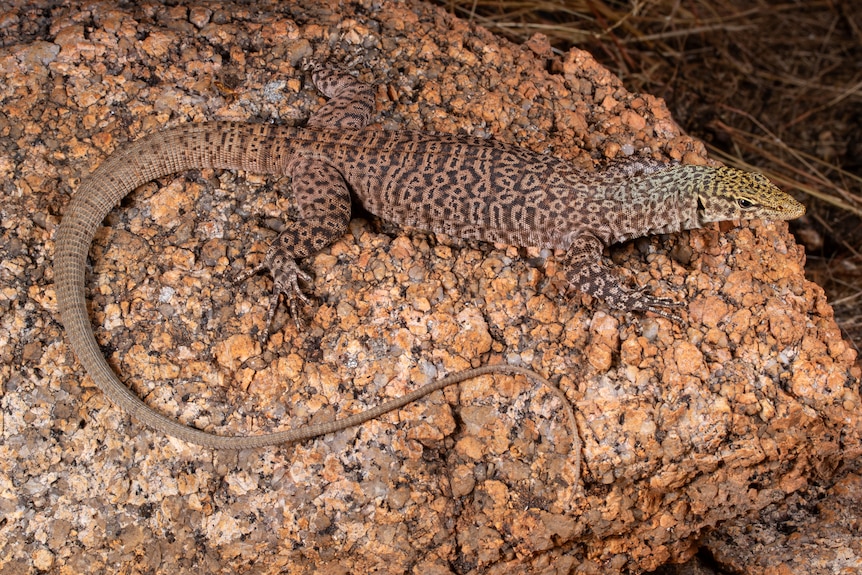
The rainbow rock monitor is found about 300km inland from Cairns, near landscapes such as Cobbold Gorge. (Supplied: Stephen Zozaya)
The rainbow rock monitor lives on granite-bouldered country north of Mount Surprise and Georgetown, more than 200 kilometres inland from Cairns, while the orange-headed monitor is known at a handful of sites in rugged sandstone escarpments of the Gregory Range.
The research has been published in the Zoological Journal of the Linnean Society.
Vulnerable to pet trade
Dr Zozaya said populations of the three “secretive” species were likely healthy, given their remote habitat was difficult to access by road and unsuited to cattle grazing.
However, he worries the monitors have appeal to “less scrupulous” reptile enthusiasts and the domestic and international pet trade.
Dr Zozaya said revealing critical information when describing a new species was a dilemma for scientists.
People searching for monitor lizards could make their habitat unsuitable simply by flipping over cap rocks in their search and failing to put them back, he said.
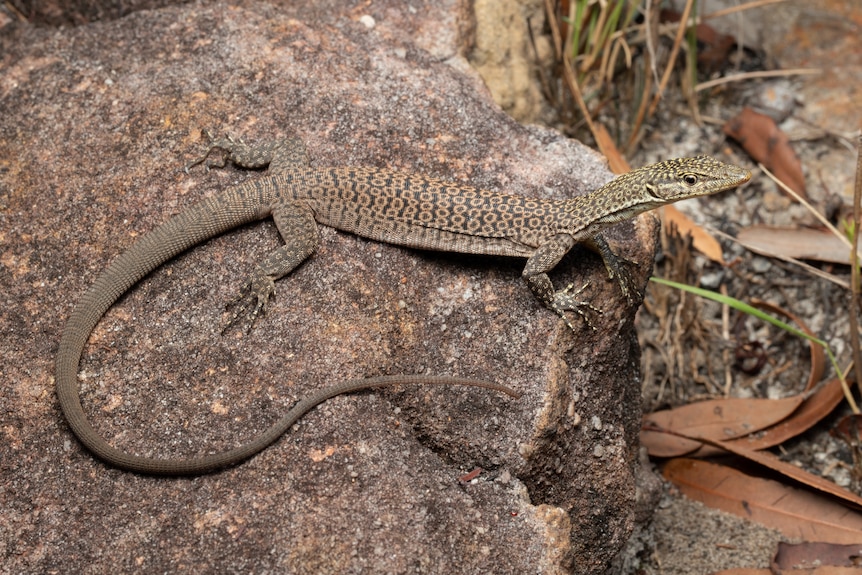
There is evidence of the yellow-headed rock monitor having been traded illegally. (Supplied: Wesley Read)
However, Dr Zozaya said the findings gave land managers and conservationists information that could help protect the reptiles.
Distinguished professor in zoology, Lin Schwarzkopf, who was not involved in the research, said while there was “some trepidation” about describing the new species, “we need to know about it for protecting them anyway”.
Professor Schwarzkopf said Queensland’s savanna country was “understudied and underloved” in comparison to the far north’s famous rainforests.
“There is a real focus in Australia on vulnerable and threatened [species] and less focus on understanding things before they become vulnerable and threatened,” she said.
“I feel like there is a real opportunity to learn more about our savanna species, which are under threats from all kinds of different things.
“The fauna up here is really poorly known and so it’s not unusual for people to discover a new species right there on people’s doorsteps.”