
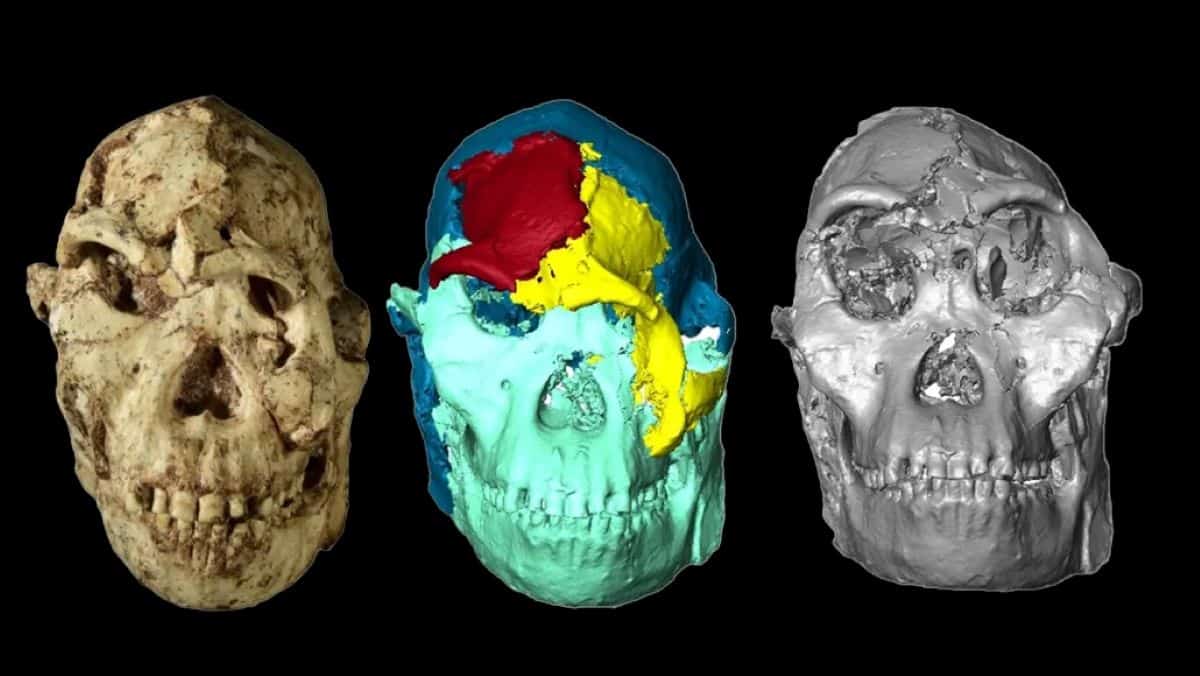
 Left to right: The original skull, digital scan, and reconstructed face of Little Foot. Credit: Amélie Beaudet
Scientists have finally revealed the face of “Little Foot,” a remarkably preserved early human ancestor who lived about 3.67 million years ago. Using advanced digital reconstruction technology, researchers pieced together her crushed fossilized skull.
This new virtual model gives us an unprecedented look at a member of the Australopithecus genus—a crucial ancestral group in our evolutionary family tree. Understanding how Little Foot looked helps us uncover how our ancient relatives interacted with their environment, what they ate, and how they eventually paved the way for modern humans.
3.67 Million Years Later
 Museum cast of Little Foot. Credit: Wikimedia Commons
Fossil hunters first discovered Little Foot’s tiny foot bones in a box of fossils in 1994. A few years later, they unearthed the rest of her nearly complete skeleton from the Sterkfontein Caves near Johannesburg, South Africa. While the specimen is roughly 90% intact, millions of years buried under heavy cave sediment severely crushed and distorted the skull. Physical reconstruction of the delicate bones was simply impossible.
To solve this, scientists shipped the fragile skull to England in 2019. There, they used a powerful machine called a synchrotron at the Diamond Light Source facility to scan the bones with bright, non-destructive X-rays. This process generated thousands of high-resolution images, allowing researchers to digitally separate the bone from the surrounding rock and visually realign the fragmented pieces into their proper anatomical positions.
“Now we have a very good reconstruction, something we could not do with the physical specimen,” says paleoanthropologist Amélie Beaudet of the French National Center for Scientific Research (CNRS), according to Science News.
Family Ties Across Africa
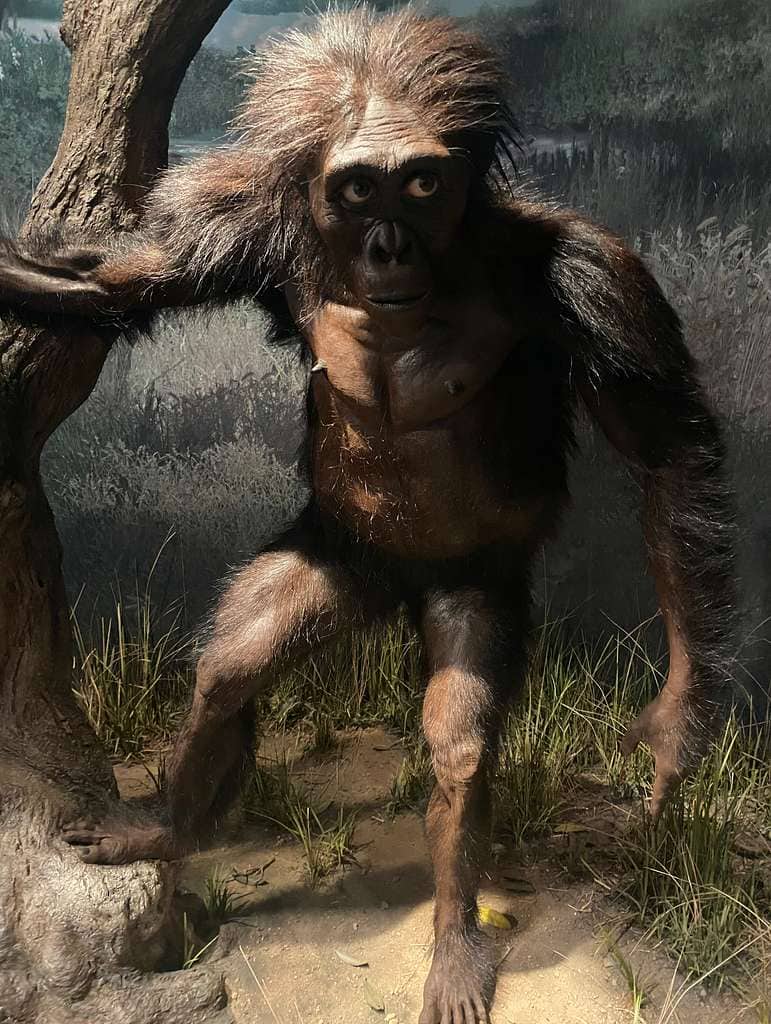 Museum reconstruction of Australopithecus africanus. Credit: Picryl
With the face digitally reassembled, the research team compared Little Foot’s features with other Australopithecus skulls and modern great apes like gorillas, chimpanzees, and orangutans. Interestingly, despite being found in South Africa, Little Foot’s face—particularly her distinctly wide eye sockets—shares more similarities with Australopithecus fossils found far away in East Africa.
This surprising resemblance suggests that Little Foot might belong to a larger population of early hominins across the African continent over 3.5 million years ago. Once settled in South Africa, her descendants may have developed distinct anatomical traits through local evolution.
“Rather than viewing early hominin evolution as occurring in isolated regions, the study supports the idea of Africa as a connected evolutionary landscape, with populations adapting to ecological pressures while remaining linked through shared ancestry,” says study coauthor Dominic Stratford, an associate professor at the University of the Witwatersrand.
×
Thank you! One more thing…
Please check your inbox and confirm your subscription.
However, researchers urge caution before jumping to massive conclusions. “We have only a few specimens, so we need to be really careful,” Beaudet says.
An Unsettled Place in History
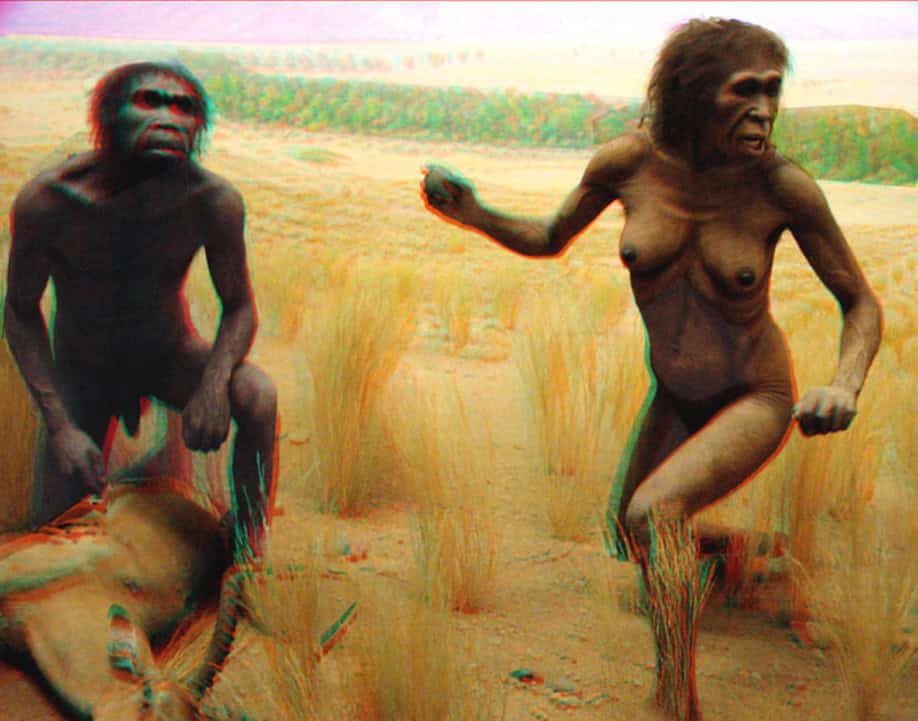 Australopithecus couple. Credit: Wikimedia Commons
By rebuilding Little Foot’s facial structure, scientists can see exactly how she breathed, ate, and viewed her prehistoric world. Her large orbits, for example, show she depended on keen vision to forage for food and navigate her environment.
Yet, while her face offers a better picture of her life, her exact taxonomical identity remains a mystery. Researchers still cannot agree on where Little Foot belongs on the human family tree. Some classify the skeleton as a species called Australopithecus prometheus, while others argue it might just be a variation of Australopithecus africanus, or possibly even an entirely unknown human relative.
“Many researchers, including myself, are skeptical about the current attribution of Little Foot to Australopithecus prometheus, in part because this species is generally considered to be the same thing as Australopithecus africanus,” Dr. Jesse Martin, an adjunct professor of archaeology at La Trobe University, told CNN. Martin also notes that the exact age of the fossil remains heavily debated.
To answer these lingering questions, this digital reconstruction is only the beginning. The scientific team plans to digitally reconstruct Little Foot’s braincase and teeth next. This future work could unlock further clues about her brain size, cognitive abilities, and dietary habits, potentially solving the puzzle of her origins once and for all.