
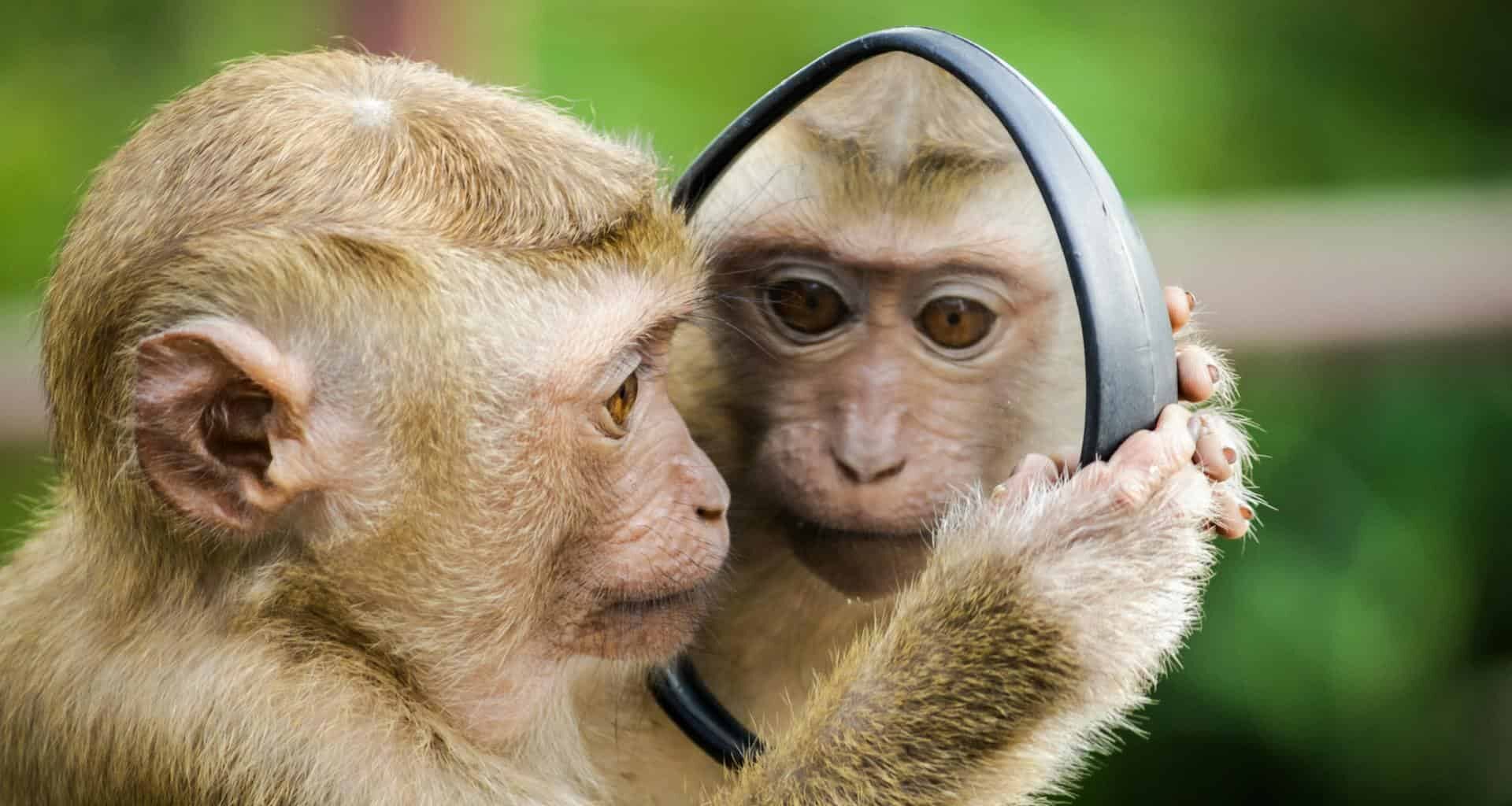
 A monkey looking in a mirror. Image credits: Andre Mouton/Pexels
Imagine watching a video of a chimpanzee. The ape pulls its lips back in a wide, playful grin. Without realizing it, the corners of your own mouth twitch upward. You smile back.
Scientists call this phenomenon emotional mimicry. Biologists and psychologists consider this automatic matching of another’s expression a crucial building block of empathy. We do it with other humans every single day.
Now, fascinating new research confirms we do it with other primates, too.
“Apes and monkeys are evolutionarily much closer to humans, and expressions are much more similar. So the question arose, how good are people at recognising non-human primate emotions, and will they also mimic these emotions?” Ursula Hess, a professor at Humboldt University, said in an interview.
Hess and her team’s new study tested this idea, and the results hint at a shared emotional language that runs deeper than expected.
A clever setup to catch reactions we don’t notice
The researchers designed an online experiment involving 212 participants. Each person watched very short video clips, just five to seven seconds long, showing monkeys and apes showing different expressions.
These included a playful happy face, a threatening face, and a neutral expression. The clips also showed the animals’ body posture, making the scenes feel more natural and easier to interpret.
As participants watched, their webcams recorded their faces. Instead of relying on human judgment, the researchers used an open-source facial tracking tool to detect tiny muscle movements.
This allowed them to capture subtle, unconscious reactions—moments where people might be mimicking expressions without even realizing it. After each clip, participants were asked to rate what they saw.
×
Thank you! One more thing…
Please check your inbox and confirm your subscription.
They judged whether the expression was positive or negative, identified specific emotions like happiness or fear, and reported how much they liked the animal and how emotionally close they felt to it.
Decoding the feelings behind the expression
 Examples for positive, neutral and negative expressions. Credit: Hess et al., 2026, PLOS One.
The results showed that people were not only able to recognize these expressions but also respond to them physically. Their facial movements often matched what they saw on screen.
“We found that humans are very good at rating the positivity or negativity of expressions shown by non-human primates. They also use human emotion labels that can be plausibly applied to the expressions,” Hess explained.
For instance, “they labeled a threat display as ‘anger’ and a ‘play-face’ as ‘happy’. The neutral expression was labelled as ‘sad’ – most likely because the primates did not move as much as they did when showing the other two expressions,” she added.
More interestingly, this mimicry depended on emotional connection. When participants felt closer to or liked the animal more—especially in response to positive expressions—their mimicry became stronger.
This highlights that emotional engagement plays a key role even in cross-species interactions. At the same time, participants were able to assign clear emotional labels to what they saw, suggesting that humans can interpret primate expressions in surprisingly nuanced ways.
“We were surprised by how well humans were able to apply emotion labels to the expressions,” Hess said.
The connection between mimicry and empathy
Humans express deep feelings towards other humans, but this study suggests that humans also connect and resonate with the emotional states of other primates.
“One assumption is that humans reserve the notion of “deep feelings” to other humans. In that sense, animal emotions are much less profound. That humans show empathy – a sharing of feelings – towards primates suggests a bridge between the two, which the common view would not have led one to expect,” Hess said.
From this angle, facial mimicry may be part of a much older, shared system of emotional communication, and a doorway to empathy.
For instance, in humans, copying another person’s facial expression is known to help us internally feel what they feel—it’s one of the mechanisms that allows emotions to be shared rather than just observed. So if the same process is triggered when we watch non-human primates, it suggests that our brains may be responding to them in a surprisingly similar way.
“Mimicry is a very important aspect of human-human communication. It is an element of empathy, and if humans mimic primates, there is a basis for empathy,” Hess added.
That said, the study has important limitations. The clips were very short and included body language, which may have influenced how participants interpreted the expressions. Also, this is an observer-based study, so we cannot know what the animals themselves were truly feeling based on their expressions alone.
Still, the work opens up new directions. Future research could explore other species and longer interactions to better understand how deep this emotional connection goes.
The study is published in the journal PLOS One.