
The minister has been in Canberra for annual meetings with her Australian counterpart, as well as alongside the countries’ two foreign affairs ministers.
A joint statement released after canvassed a range of issues, from the conflict in the Middle East, to the Pacific, to condemnation of Russia’s invasion of Ukraine.
Separately, Collins and Marles delivered a statement titled “Operationalising the Australia – New Zealand Alliance: Anzac 2035 – Closer Defence Relations”.
It outlined how the two countries’ defence forces would step up their engagement.
This includes moves to deepen co-operation on “force posture activities, combined operations and exercises, preparedness, defence industry integration, resilience, and Pacific security”.
“The Australian and New Zealand Defence Forces are operationalising our Alliance with a vision of being able to operate seamlessly as an increasingly integrated, combat capable Anzac force by 2035, while remaining respectful of our status as two sovereign countries,” the statement said.
“In the face of a sharply deteriorating security environment, we must be ready to meet the security threats we face today and in the future.”
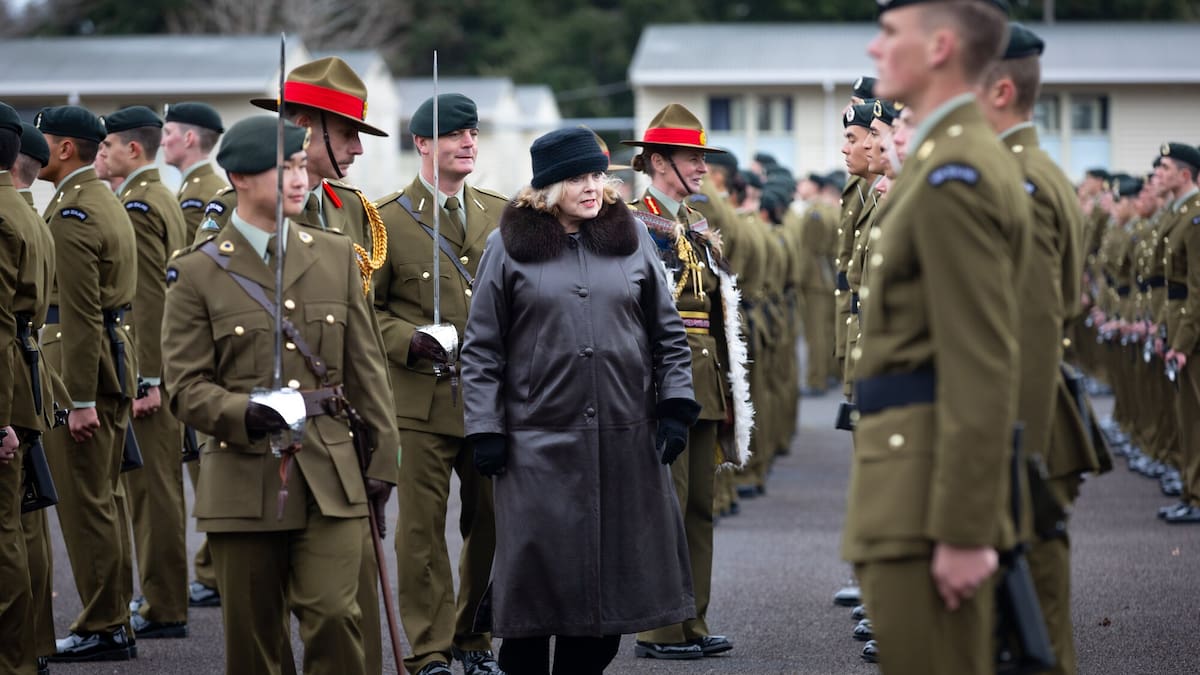
Defence Minister Judith Collins says it makes sense for the two countries to work together. Photo / Mark Mitchell
Collins told the Herald NZ and Australia are already working closely together – for example, the second-in-command of Australia’s Joint Operations is a Kiwi and our equivalent is an Australian – but there was more to do in an “increasingly challenging world”.
“The fact is that Australia has a lot more kit and a lot more people than us, and there are certain things that we can really add value with,” Collins said, later speaking of New Zealand’s “competency” working in the Pacific.
Last year, Collins announced the MH-60R Seahawks were NZ’s preferred option to replace the existing maritime helicopters. These are the same helicopters used by Australia.
“We know that they fit on the frigates,” Collins said on Wednesday.
“We know that our pilots, they could fly the Australian ones if we need to. The Australians can fly ours if we need to.
“It makes a lot of sense, if we can afford it, to in many cases, buy the same as them. Sometimes it doesn’t. Sometimes it’s best if we do something complimentary.”
Under the AUKUS agreement, Australia is set to acquire up to five Virginia-class nuclear-power submarines from the United States in the early 2030s.
Asked how New Zealand may work alongside those subs, given our country’s general nuclear-free sentiment, Collins said that was a “hypothetical” for now.
“We’re not in that situation right at the moment … I think people would need to consider it.”
Australian Foreign Affairs Minister Penny Wong said her country was not taking offensive action against Iran. Photo / Mark Mitchell
Conflict in the Middle East
The annual meeting came as war continues in the Middle East, after the United States and Israel’s strikes on Iran and the Iranian regime’s retaliatory attacks on neighbouring countries which host US bases.
Collins said neither New Zealand nor Australia have “much information” and neither country had received any “requests for help” from the United States.
“Obviously there’s limitations on what we can provide anyway, so any decisions like that would have to go through Cabinet and whatever it is, it’s got to be in New Zealand’s best interest,” she said.
If such a request was to emerge, Collins said she’d expect New Zealand and Australia would co-ordinate closely.
Australia has sent an E-7A Wedgetail plane to the United Arab Emirates (UAE) “to help protect and defend Australians and other civilians”, said Foreign Affairs Minister Penny Wong.
This was “in support of the collective self-defence of Gulf nations”.
“The Albanese Government has been clear that we are not taking offensive action against Iran and we have been clear that we are not deploying Australian troops on the ground in Iran.”
With Collins having announced her retirement from politics, the meeting in Canberra will be one of her last international engagements.
She said she had been “overwhelmed by how incredibly positive and friendly” people had been.
“I was enjoying it so much yesterday that I had this terrible urge to say, ‘look, I’m only kidding, guys, I’m staying’, but that’s how friendly we are with each other, but I didn’t do that.”
Collins said she believed “this is probably the best relationship we’ve seen between Australia and New Zealand, at a political level, that we’ve ever seen”.
Jamie Ensor is the NZ Herald’s chief political reporter, based in the press gallery at Parliament. He was previously a TV reporter and digital producer in the Newshub press gallery office. He was a finalist in 2025 for Political Journalist of the Year at the Voyager Media Awards.