
In 2024, $60m was ring-fenced from the Regional Infrastructure Fund for this, and the Government announced last week Todd Energy was the preferred lead contractor to drill New Zealand’s first exploratory “superhot” geothermal well near Taupō.
In his Rotorua speech, Jones said the strategy was about doubling geothermal energy’s contribution to electricity and providing an energy source for manufacturing by 2040.
The $50m fund would focus on “small-to-medium projects that provide practical outcomes” and enabling landowners with geothermal potential “to make that potential available”.
Jones said the fund would allow the Bay of Plenty to “watch the expansion of energy production”.
Specialist renewable energy developer Eastland Generation‘s Taumanu and Kopura geothermal projects near Rotomā and Kawerau had been approved for up to $20m.
Jones said this would enable underground surveys, exploration and well drilling.
The work could confirm whether the resource was “strong enough to stand intense use”, capable of being monetised, and if landowners and investors were capable of standing up the project.
Jones said the funding would be matched by another $20m in co-investment from Eastland Generation.
Regional Development and Resources Minister Shane Jones spoke to media in Rotorua on Tuesday about the Government’s geothermal strategy. Photo / Megan Wilson
Regarding the Whakatāne exploratory wells, Jones said there was “energy of a lower heat” in the area, capable of being exploited and meeting the costs of manufacturing power.
The Whakatāne Geothermal Temperature Gradient Well Programme is a project run by the University of Auckland through the Geothermal Institute.
Jones said the data would be made public to the benefit of the manufacturing sector.
“The Crown has borne the cost and then they can seek to exploit it, turn it into a form of energy, and start to regrow manufacturing in this part of New Zealand.”
Jones told media it would be “several years” before the two Eastland Generation projects could start generating electricity.
“We need to ensure that any additional exploitation of our geothermal resource does not undermine the sustainability of the resource.”
An Eastland Generation statement said its projects near Rotomā and Kawerau “have the potential to be small- to medium-sized geothermal power stations”.
Chief executive Alice Pettigrew described the loans – up to $10m for each project – as “visionary” and said they would allow the sites’ geothermal resources to start being assessed.
“Our team is beginning the next stage of the Taumanu and Kopura projects alongside the landowners. Together, we aim to realise the potential of the resource below their whenua.”
The company recently completed its fourth geothermal power plant, the 49MW TOPP2, on the Kawerau Geothermal Reservoir.
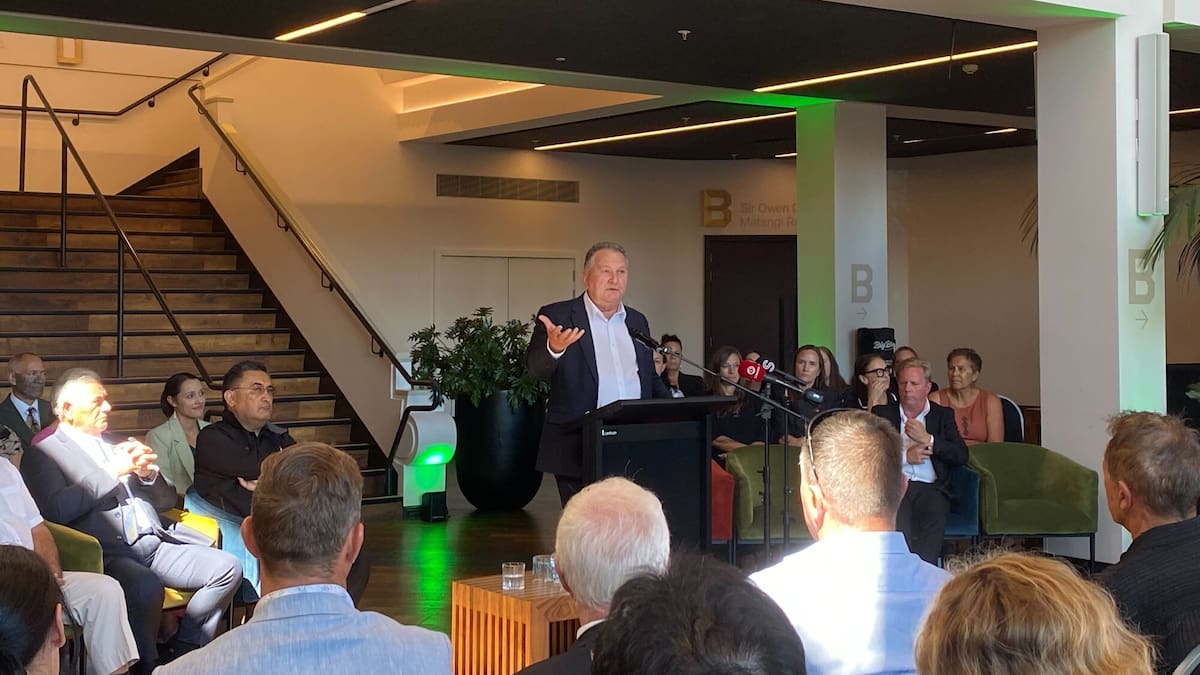
Rotorua MP Todd McClay speaking at the Sir Howard Morrison Centre as the Government launched its geothermal strategy. Photo / Megan Wilson
In his speech, Rotorua MP Todd McClay said when energy was of scarce availability and prices increased, “our ability to be self-sufficient and have energy security is paramount for all New Zealanders”.
“We are lucky … to have an abundance of energy below us in the ground.”
McClay said the strategy was “extremely important” and cited a visit to Rotorua Primary School, which had solar panels.
“I mentioned to them it was not that many years ago actually, they used heat from geothermal here in the school to heat the classrooms for all the kids.”
He said cost and other challenges meant this was no longer possible.
“Wouldn’t it be wonderful if every single school in Rotorua, the kids were warm in winter, and the classes were heated with the geothermal energy?”
He said he believed that was “[no] longer out of the question”.
Expansion of Ngā Tamariki Geothermal Station completed
Jones, also the Associate Minister of Energy, officially opened the new generation unit at Mercury’s Ngā Tamariki Geothermal Station in Reporoa near Taupō on Tuesday.
The $220m expansion involved adding the station’s fifth electricity generation unit. Construction started in early 2024.
A Mercury statement said it lifted the station’s annual average generation output to about 1120GWh, enough to power the equivalent of all residential homes in Christchurch.
Mercury chief executive Stew Hamilton and the Associate Minister of Energy Shane Jones officially opened the fifth generation unit at Mercury’s Ngā Tamariki Geothermal Station near Taupō on Tuesday. Photo / Supplied
Mercury had also drilled two new geothermal wells – one to provide additional steam supply for the new unit and the second for injection of geothermal fluid to support sustainability of the reservoir.
Chief executive Stew Hamilton said adding more renewable energy was key for meeting future demand growth, building resilience and ultimately helping with energy affordability.
Mercury was also working with the Government on its investigation into supercritical geothermal energy, he said.
Megan Wilson is a health and general news reporter for the Bay of Plenty Times and the Rotorua Daily Post. She has been a journalist since 2021.