
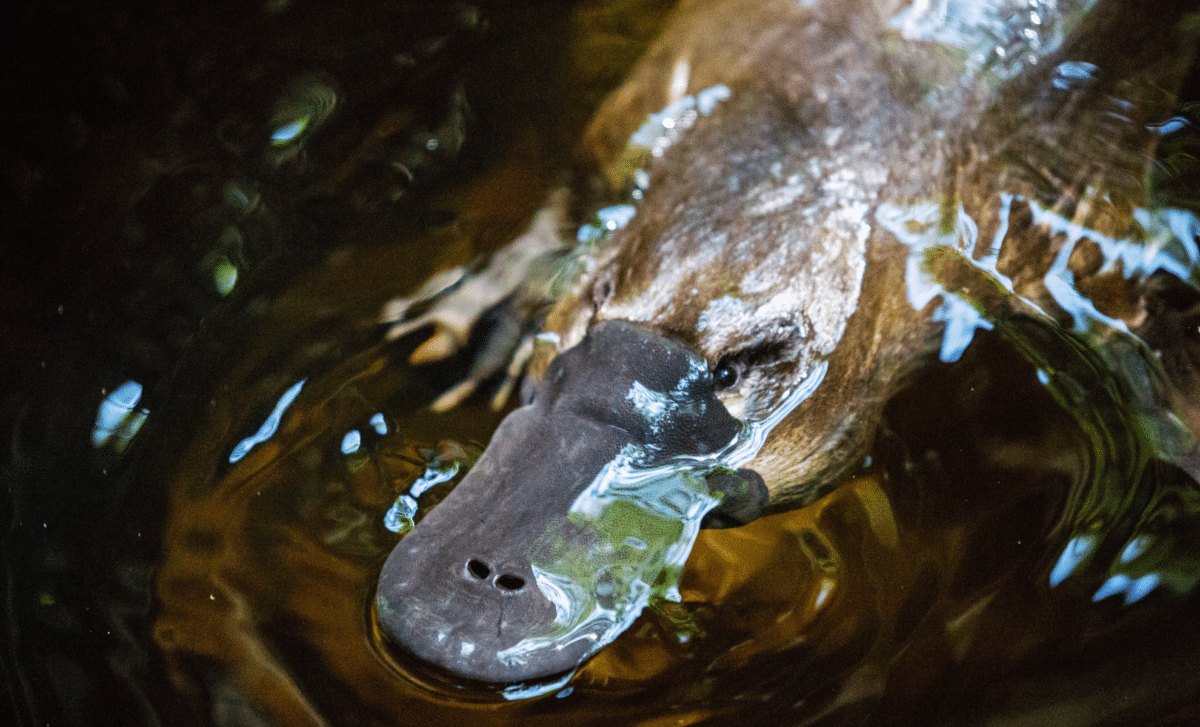
Platypuses, one of the most peculiar creatures on Earth, continue to defy the boundaries of what scientists know about mammals. A new study published in Biology Letters has uncovered yet another surprising trait of the egg-laying mammal: hollow melanosomes. These pigment-producing structures, once thought to be exclusive to birds, are now found in the platypus, raising significant questions about the evolution of color and adaptations in this unique species.
Platypus Melanosomes: The Unlikely Discovery That Shakes Up Mammal Biology
For centuries, the platypus has baffled scientists with its strange mix of traits, egg-laying, venomous spurs, and a bill resembling that of a duck. But a recent discovery has added another extraordinary feature to the list: hollow melanosomes inside its cells. Melanosomes are microscopic structures responsible for producing pigment in animals. Until now, hollow melanosomes were thought to be found only in birds, where they play a role in producing vibrant colors and iridescence.
Jessica Leigh Dobson, a researcher at Ghent University, and her team used high-resolution microscopy to analyze the platypus’s hair and discovered a type of melanosome never before seen in mammals.
“This was totally unexpected,” says Leigh Dobson. “Hollow melanosomes have never been found in mammals before, and the combination of hollow and spherical is not seen anywhere else as far as we know.”
The platypus’s melanosomes, unlike those in other mammals, are hollow and spherical, which seems to contradict existing knowledge about how melanosome shape relates to color. This new trait adds another layer of mystery to the already enigmatic platypus, offering a glimpse into a unique evolutionary pathway that has enabled the species to thrive in its aquatic environment.
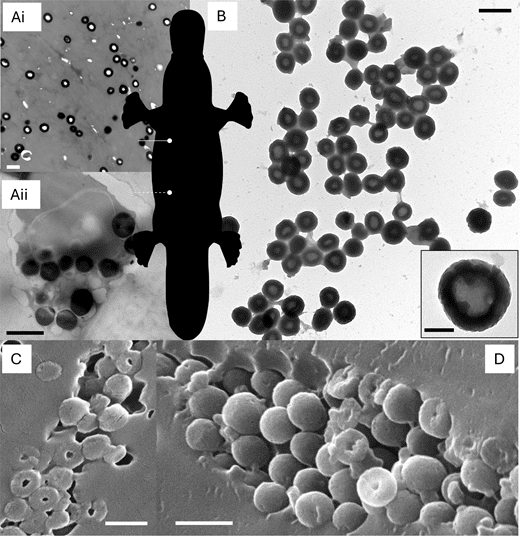 Morphology of melanosomes in the hairs of the platypus Ornithorhynchus anatinus. (A) Transmission electron micrographs of hair cross sections taken from (i) dorsum, scale bar = 500 nm, (ii) stomach, scale bar = 1 µm. (B) Transmission electron micrograph of multiple melanosomes extracted from dorsal hairs, showing a mixture of hollow and full melanosomes, scale bar = 500 nm. Insert shows a magnified view of an individual extracted hollow melanosome, scale bar = 100 nm. (C) Scanning electron micrograph of cross section of a dorsal hair, scale bar = 1 µm. (D) Scanning electron micrograph of longitudinal section of a dorsal hair, scale bar = 1 µm. Platypus silhouette from Phylopics.
Credit: Biology Letters
What Makes Platypus Melanosomes So Special?
Melanosomes are typically either solid or hollow, with hollow structures organizing into nanostructures that produce iridescent colors in birds. These structures are vital for creating brighter, more vibrant colors. However, platypuses, despite having hollow melanosomes, do not display the vivid colors seen in birds. Instead, their fur remains a relatively dull brown.
“This doesn’t really conform with what we currently know about how melanosome shape correlates with colour,” says Leigh Dobson.
The discovery raises a significant puzzle: why would the platypus have these unusual melanosomes if they don’t serve the same function as they do in birds? Dobson plans to continue investigating the role of these hollow melanosomes to uncover their evolutionary significance.
Unlike birds, which use hollow melanosomes to enhance brightness and produce iridescence, the platypus’s melanosomes appear to serve a different purpose. The study, Biology Letters, does not yet have definitive answers, but the unique structure of these melanosomes could be an adaptation to the platypus’s aquatic lifestyle, providing some form of insulation or offering other benefits that remain to be explored.
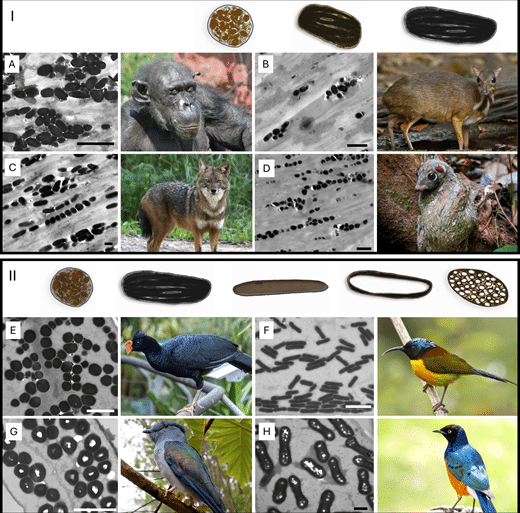 Melanosome diversity in (i) mammals and (ii) birds. Illustrations are representative of the melanosome shapes found in (i) mammals and (ii) birds. Transmission electron micrograph cross sections of melanosomes found in (A) chimpanzee Pan troglodytes (photo: Gerd W. Schmölter), TEM scale bar = 2 µm, (B) water chevrotain Hyemoschus aquaticus (photo: Dave Curtis), TEM scale bar = 1 µm, (C) golden jackal Canis aureus (photo: Jan Ebr & Ivana Ebrová), TEM scale bar = 500 nm, (D) Sunda flying lemur Galeopterus variegatus (photo: Petre Kimbely), TEM scale bar = 1 µm, (E) razor-billed curassow Mitu tuberosum (photo: Animalia CC BY-SA 3.0), TEM scale bar = 500 nm, (F) green-tailed sunbird Aethopyga nipalensis (photo: Animalia CC BY-SA 4.0), TEM scale bar = 500 nm, (G) cuckoo-roller Leptosomus discolor (photo: Oleg Rozhko), TEM scale bar = 1 µm, (H) superb starling Lamprotornis superbus (photo: Tong Mu), TEM scale bar = 200 nm.
Evolutionary Implications of Hollow Melanosomes
The finding of hollow melanosomes in the platypus also raises important questions about the animal’s evolutionary history. Platypuses are part of a small group of egg-laying mammals known as monotremes, which also includes echidnas. Interestingly, researchers found that echidnas, despite being closely related to platypuses, do not possess hollow melanosomes. This suggests that the hollow melanosomes in platypuses might be an ancient trait that was retained due to their aquatic lifestyle, while echidnas, which evolved as land-dwelling creatures, may have lost this feature over time.
The platypus’s ability to thrive both in water and on land may be linked to a unique combination of traits, including these extraordinary melanosomes. As researchers delve deeper into the significance of hollow melanosomes, they hope to uncover more about how evolutionary pressures shaped the platypus’s peculiar biology. Understanding these adaptations could also shed light on the broader evolution of mammals and other egg-laying species.