
Animals rely on taste to decide whether food is safe or harmful. Some brain cells involved in taste respond to both pleasant (appetizing) and unpleasant (aversive) signals. But scientists still don’t fully understand how these cells sort out such conflicting information to guide eating behavior.
A new study on fruit flies (Drosophila melanogaster) has uncovered a surprising mechanism that helps explain this process. Researchers in the lab of Brown University professor Gilad Barnea have identified a pair of neurons, called subesophageal LK, or SELK, that make this critical choice.
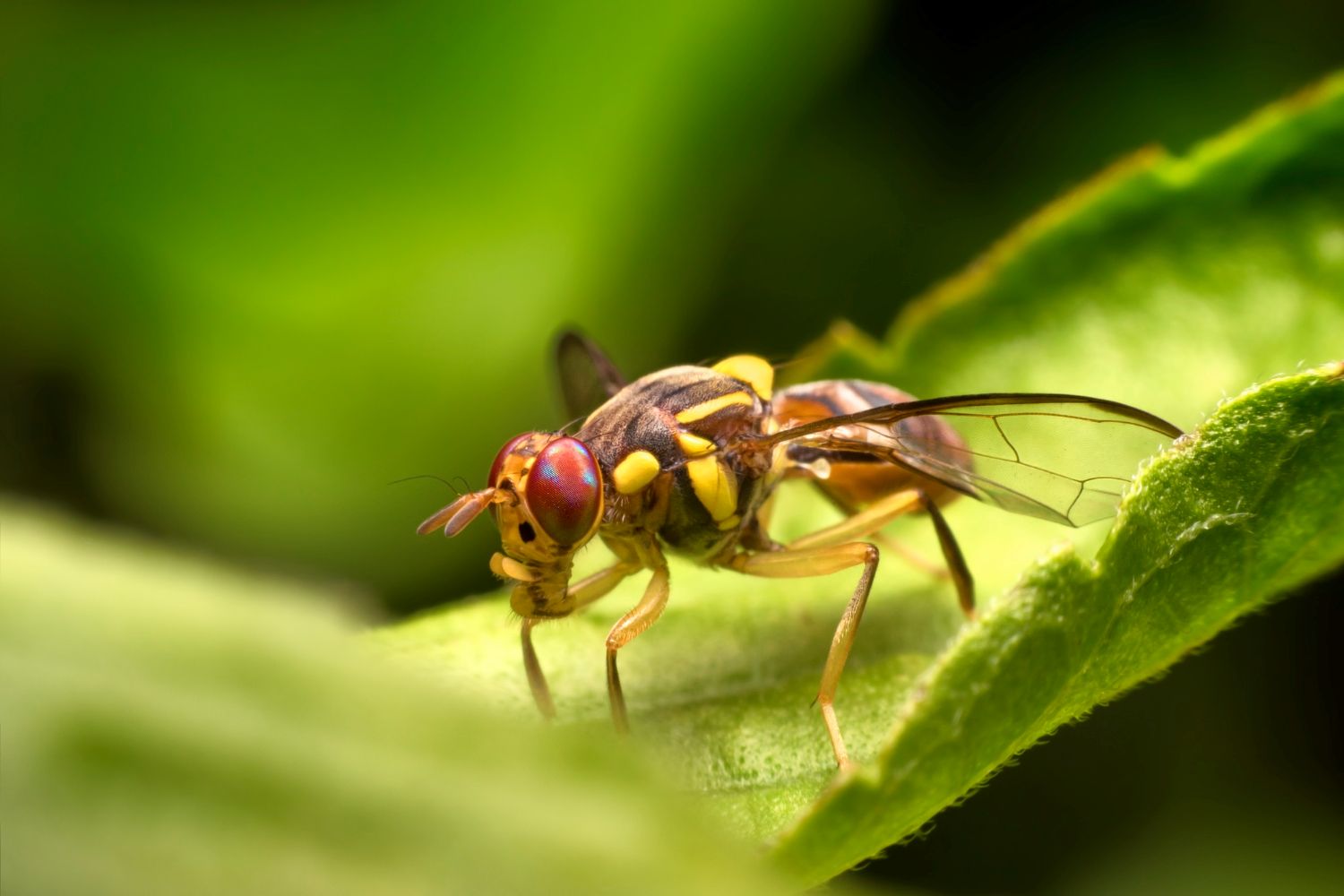
For fruit flies, taste is a matter of survival. They don’t just taste with their mouths. They have taste sensors on their legs, abdomen, and even the edges of their wings. When a fly lands on fruit, it quickly detects whether the food is sweet or bitter. Sweetness signals energy and encourages feeding. Bitterness signals potential toxins and makes the fly move away.
Brown University professor Gilad Barnea stated, “If a fly makes just one mistake about what to eat, it may die. So the decision is super important.”
Scientists found that SELK are directly connected to taste receptor neurons. This connection means SELKs receive taste information and help decide whether the fly should eat or avoid food.
New type of taste cell discovered in taste buds
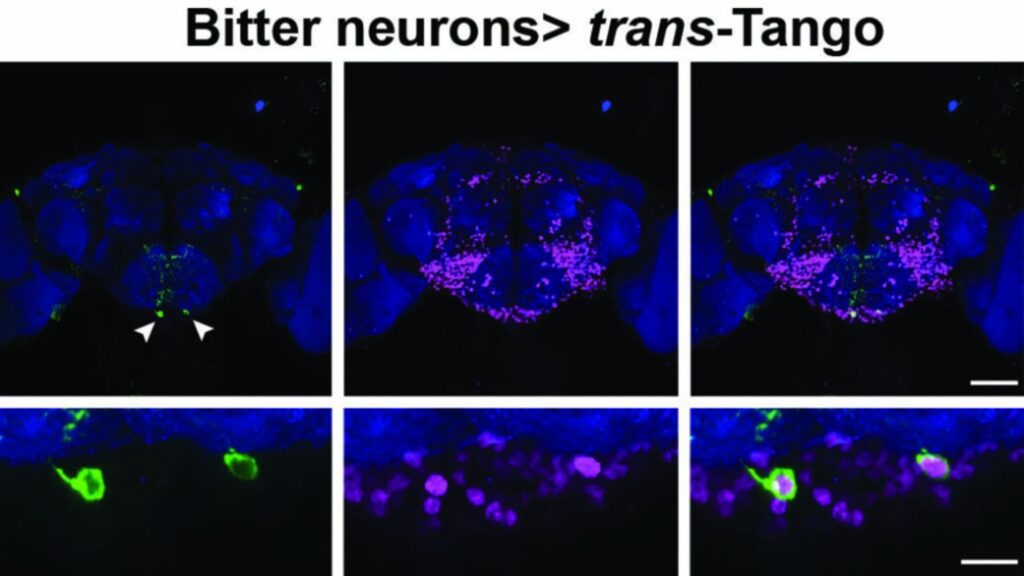 SELK neurons, shown here in green, are among the many partners of bitter- and sweet- sensing taste neurons, highlighted here in magenta. Image credit: Doruk Savas/ Brown University
Bitter- and sweet-sensing neurons communicate with SELKs at different strengths: bitter signals are stronger, sweet signals are weaker. SELKs then decide what happens next by releasing different chemical messengers. For sweet signals, SELKs release a neurotransmitter, acetylcholine, which tells the fly to eat. On the other hand, for bitter signals, SELKs release the neuropeptide leucokinin (LK), which signals to the fly to stop feeding.
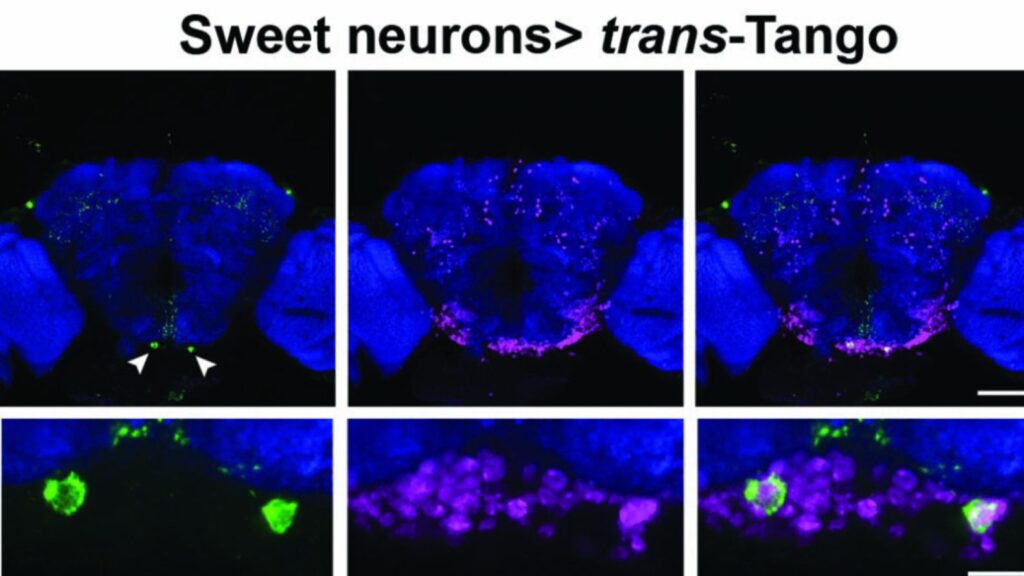 SELK neurons, shown here in green, are among the many partners of bitter- and sweet- sensing taste neurons, highlighted here in magenta. Image credit: Doruk Savas/ Brown University
Lead study author Doruk Savaş said, “The mainstream understanding in the field was that sweet-sensing neural populations only ‘talk’ to a certain subset of neurons, and bitter-sensing populations only talk to a different subset, and there’s really no interplay between them.”
“But what I was seeing was that there’s a neuron that is ‘listening’ to both,” he continued.
Barnea said, “This newly discovered mechanism illustrates the impressive level of computation that a single neuron can do.”
Recent studies have found a similar taste-processing mechanism in the mouse brain. This suggests that the way animals decide whether to eat or avoid food might be shared across many species, possibly even humans. Identifying such neurons in humans could become a promising target for pharmaceutical intervention.
Smell and taste interaction begins on the tongue, study
Journal Reference:
Savaş, D., Okoro, A.M., Moșneanu, R.A. et al. Feeding decision-making by a single neuron via disparate neurotransmitters. Nat Commun (2026). DOI: 10.1038/s41467-026-69443-8