
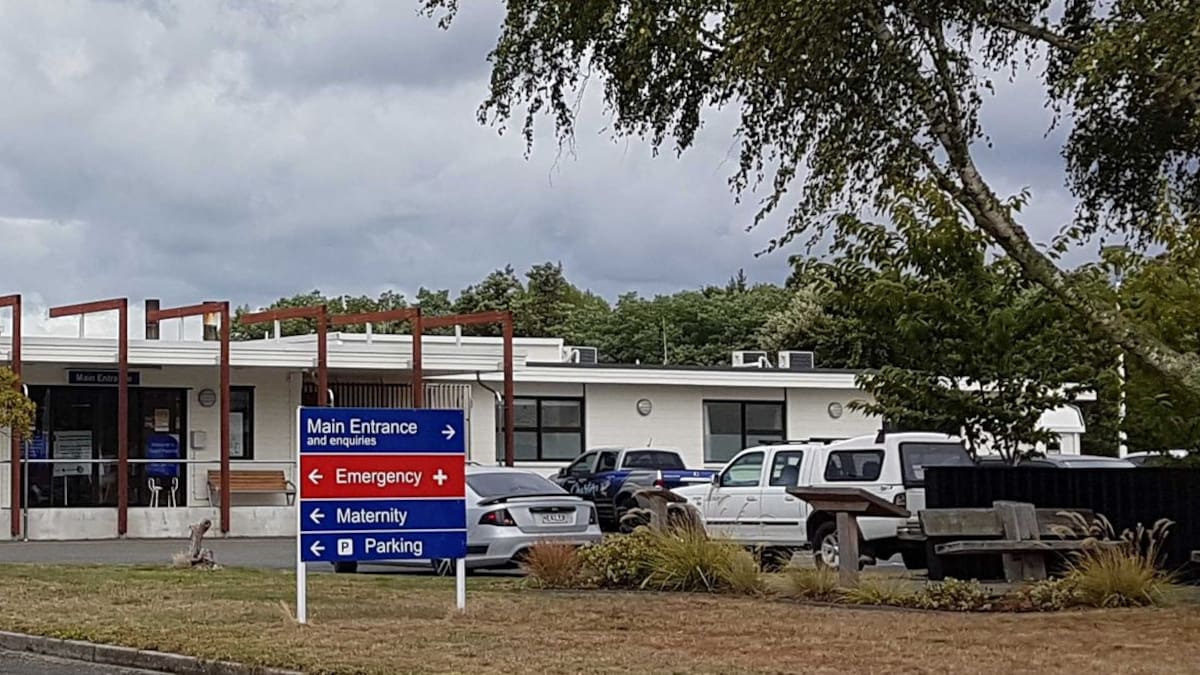
She said in her view, compared with Rotorua Hospital, “we’re like a poor neighbour”.
Gretton reduced her hours this year from 0.6 full-time equivalent (FTE) to 0.4 FTE “because I can’t deal with it”.
“I’ve been a nurse for 50 years … this is the worst I’ve ever seen it.”
Taupō Hospital district nurses (from left) Debra Gretton, Rebecca Hornblow, Holly Rigby and Marie Higgison wore red T-shirts for their month-long “visibility strike”.
Gretton said she took part in a month-long “visibility strike” when nurses swapped their uniforms for T-shirts to expose “the need for better and safer staffing”.
A letter from Taupō Hospital district nursing staff to Health NZ Lakes operations group director Alan Wilson in July said staff were feeling “overwhelmed with workloads”.
“There is not enough staff to support them taking the time off that they need to support their health and family commitments.”
It said Taupō did not have a team lead, administration support or a healthcare assistant, which “we believe could go some way to lessening the issues that this service is experiencing presently and has done for a number of years”.
Recruitment underway for healthcare assistant
Wilson said Health NZ acknowledged the concerns and it had been working with Taupō nurses to strengthen local support.
“Taupō operates at a smaller scale than Rotorua, and services are configured accordingly, as is typical across rural and urban healthcare settings.”
Wilson said administrative and healthcare assistant support had historically been based in Rotorua “and provided across the wider service”.
“Taupō has not had the same level of on-site support, and this is being addressed.”
Wilson said Health NZ was recruiting a Taupō healthcare assistant and had trained additional administrative staff across the Lakes integrated community health service to provide increased support.
“We are also reviewing rostering, workload distribution, and processes to reduce non-clinical demands on nurses where appropriate.”
Dr Ayesha Verrall, the Labour Party’s health spokeswoman, says patients are “struggling to get the care they need”. Photo / Mark Mitchell
Meanwhile, Health NZ data showed that less than half of registered nurse graduates who applied for a job in the Lakes district last year were employed.
While Health NZ said the employment numbers depended on vacancies, Labour health spokeswoman Dr Ayesha Verrall said patients were “crowded into hospital corridors and struggling to get the care they need”.
Verrall said nurses wanted to care for their communities but were having to look overseas for work.
She said Prime Minister Christopher Luxon had left hospitals “overcrowded and understaffed, and nurses unemployed”.
The Government had found no money to hire locally trained nurses, she said.
Health Minister Simeon Brown said about 1800 graduate nurses are being hired across the country this financial year alone. Photo / Mark Mitchell
In response, Health Minister Simeon Brown said Labour had six years to develop a “credible workforce plan and they failed”.
“Instead, they chose to restructure the entire healthcare system in the middle of a pandemic.”
Brown said the “restructure without a plan” left $28 billion “managed on a single Excel spreadsheet, waiting lists ballooning, and frontline staff under increased pressure”.
He said about 1800 graduate nurses were being hired this financial year nationally and Health NZ was “well on track to meet that target”.
About 2000 additional nurses and “hundreds more doctors” had been employed at Health NZ since 2023.
“This progress is encouraging, but we know there is still more work to do to ensure patients are seen sooner.”
Brown said the focus was on “backing frontline staff” and ensuring more resources reached patients.
How many registered nurse graduates are getting jobs?
Health NZ data provided to the Labour Leader’s Office under the Official Information Act on January 22 shows 59 registered nurse graduates applied to work in the Lakes district in 2025 through the Advanced Choice of Employment (Ace) programme, which matches nurses to positions in the health system.
Of those applicants, 23 – 39% – were employed.
In previous years, 34 were hired in 2024 (71%), 21 in 2023 (72%), 19 in 2022 (53%), 21 in 2021 (37.5%), and 22 in 2020 (47%), Health NZ official information on September 10 showed.
The provisional figures did not include applicants who declined offers or withdrew their applications.
Wilson said it followed a “nationally co-ordinated” recruitment process for graduate nurses through Ace.
For the 2026 intake, Lakes shortlisted applicants who live or whakapapa to the region and interviewed those who had done clinical placements within Lakes.
Fifty-three applications were received and 36 applicants were interviewed, Wilson said.
Through Ace, 21 graduate nurses were employed in Rotorua and two in Taupō. Several applicants were matched to roles in other districts or chose alternative employment, he said.
Wilson said it was recruiting a further three graduates from the national talent pool.
Lakes aimed to employ as many graduates as possible, with numbers dependent on vacancies, he said.
Megan Wilson is a health and general news reporter for the Bay of Plenty Times and Rotorua Daily Post. She has been a journalist since 2021.