
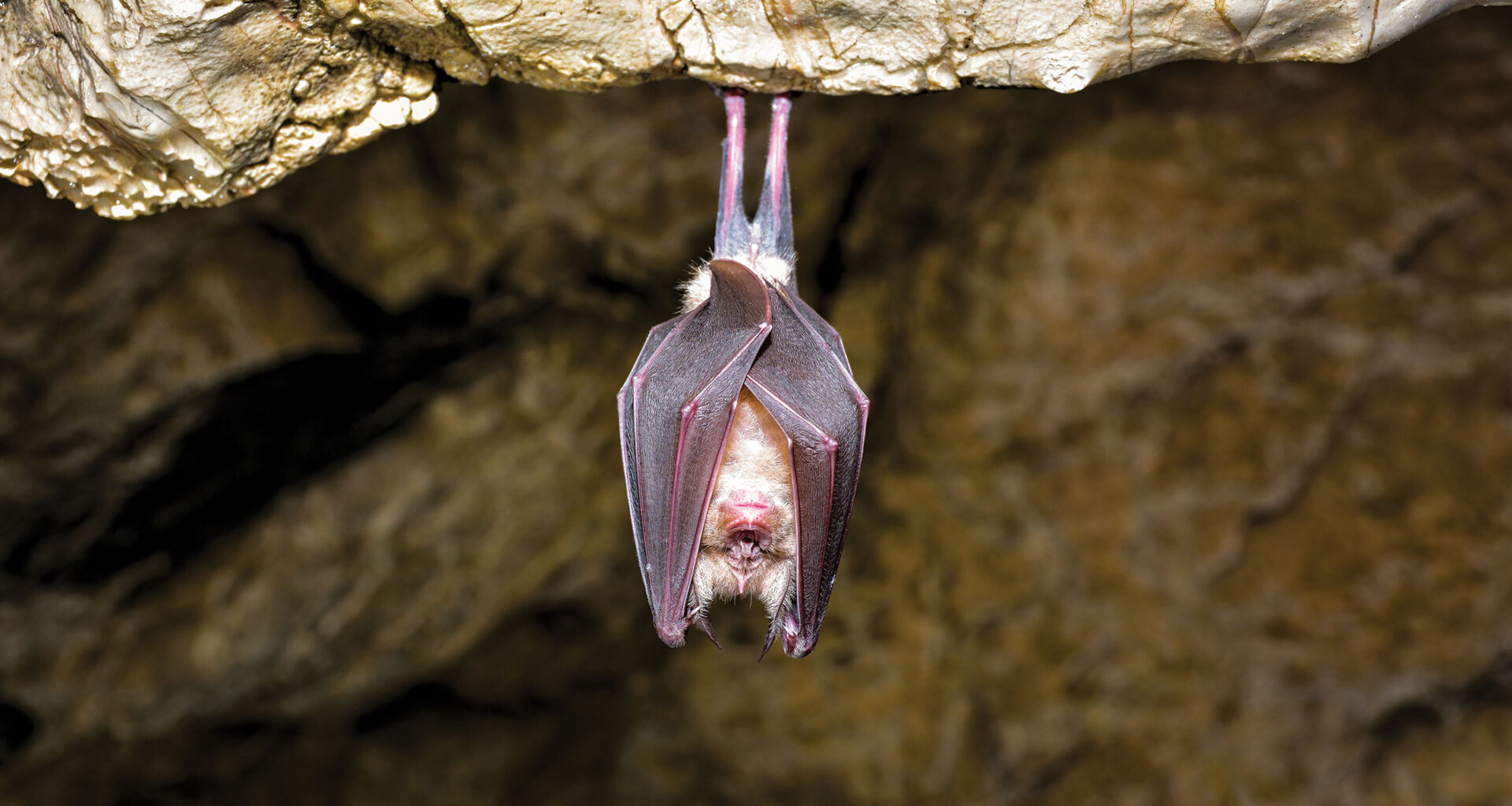
Scientists have long aspired to vaccinate wild bats to prevent the circulation of deadly viruses. These mammals harbor rabies, Ebola, Nipah, Marburg, and coronaviruses that can cause severe disease and death in humans. Immunizing bats “is a good way to control the virus before it spills over into human populations,” says Aihua Zheng, a virologist at the Chinese Academy of Sciences’ Institute of Zoology.
In a recent study published in Sci. Adv. (2026, DOI: 10.1126/sciadv.aec0269), Zheng and his colleagues revealed a vaccination strategy that deploys vaccine-laced salt traps to attract and immunize bats and that leverages mosquitoes to deliver vaccines to these mammals. The team found that in laboratory settings, vaccinated bats developed neutralizing antibodies against Nipah and rabies viruses
The concept is very novel, and very unorthodox, says Arinjay Banerjee, a virologist at the University of Saskatchewan who wasn’t involved in the work. “But to me, the real-world applications are a lot more challenging.”
Researchers have previously tested intramuscular and oral vaccines as well as gel-based vaccines that are applied to bats’ fur, muzzle, ears, and wings, and spread via social grooming among bat colonies. But the logistics of using those vaccines in the wild and on larger scales “is not so easy,” Zheng says.
So, he thought “maybe we can modify the mosquito into a tool.” His team sterilized Aedes aegypti mosquitoes and fed them blood mixed with live, attenuated, vesicular stomatitis virus–based rabies and Nipah vaccines. The researchers thought mosquitoes were well suited for vaccine delivery because many bat species prey on the insects, which themselves feed on bat blood.
To mimic bats eating mosquitoes, Zheng and his colleagues mashed these vaccine-carrying mosquitoes into a soup, which they administered to rodents and insectivorous bats via pipettes. In a separate experiment, they also allowed vaccine-carrying mosquitoes to bite these animals.
In both approaches, the team found that mice and bats elicited an immune response postvaccination and remained protected when they were deliberately infected with the rabies virus. Hamsters, which are typically used for Nipah virus studies, showed a similar response. But the researchers couldn’t perform a similar Nipah virus challenge in bats because doing so would require a higher-level biosafety lab.
Next, Zheng and his colleagues simulated field conditions using enclosures in which they exposed two insectivorous bat species—caught from caves in suburban Beijing—to vaccine-carrying mosquitoes. In similar enclosures, they orally vaccinated bats by placing saline traps—a flat-bottom container filled with a mix of saline solution and the vaccine, as well as a humidification device that generates salt mist to attract the mammals. “When they drink [the liquid], they will be vaccinated,” Zheng says.
The saline traps may be particularly useful for fruit bats such as flying foxes that are the main reservoirs of Nipah virus and typically don’t eat mosquitoes. The technique exploits the mineral-seeking behavior of fruit-eating bats, Zheng says.
The researchers found that inoculating bats via both mosquitoes and salt traps induced a strong protective immune response in bats that lacked any preexisting antibodies against Nipah and rabies viruses.
But “we don’t know how long this response will live,” Banerjee says. Thus, he adds, “how often do you have to vaccinate bats?” (In this study, Zheng and his colleagues measured the postvaccination neutralizing antibody levels in mice for 6 months and in bats for up to 42 days.)
Banerjee also wonders whether there’s enough interaction between bats and mosquitoes in the wild to vaccinate sizable bat populations. Such knowledge is important because the vaccine strategies used by Zheng’s team don’t allow for bat-to-bat vaccine dissemination.
Meanwhile, the researchers are thinking about which mosquito species are best-suited for vaccine delivery, depending on the various environments and bat colonies they may want to target. Banerjee says that though there are still many unknowns and Zheng’s strategy is “certainly not close” to use in the wild, the study “does open up the idea of whether we can broadly vaccinate wildlife.”
Daniel Streicker, a viral ecologist at the University of Glasgow who wasn’t involved in the project, thinks Zheng and his colleagues’ approach is innovative but says there’s a larger ethical question involved.
“Mosquitoes bite many things other than bats, including humans,” he says. Even if there were no off-target safety concerns when these vaccine-carrying mosquitoes bite humans and other animals—which the researchers will need to demonstrate—“there’s still an issue that you’re removing individual consent,” he says. For Streiker, such interventions merit demonstrated demand, “both in terms of the burden of the disease” and “demonstrated inability of conventional methods to manage those diseases.”

Priyanka Runwal is an associate editor and an award-winning environment and health reporter at C&EN.
Chemical & Engineering News
ISSN 0009-2347
Copyright ©
2026 American Chemical Society