
Australia’s economy will grind to a halt and supermarket shelves will be left empty if the nation runs out of diesel within the next month, an economist warns.
Macrobusiness Chief Economist Leith van Onselen said Australia is uniquely exposed to a fuel crisis because it holds very low reserves and imports most of its refined fuels from Asia.
He said Australia’s fuel storage levels were the lowest in the developed world — so low that they breached the International Energy Agency’s (IEA) requirement that members must hold 90 days of net oil imports.
“We’ve completely dropped the ball on fuel storage,” Mr van Onselen told news.com.au on Thursday.
“Australia is dangerously exposed to running out of diesel, which literally powers the economy across mining, freight, agriculture, essential services and backup power generation.
“If we run out of diesel, the economy stops, and supermarket shelves go bare.”
The Albanese government has insisted that fuel shipments to Australia have continued as normal and that the country’s fuel supply is “secure”.
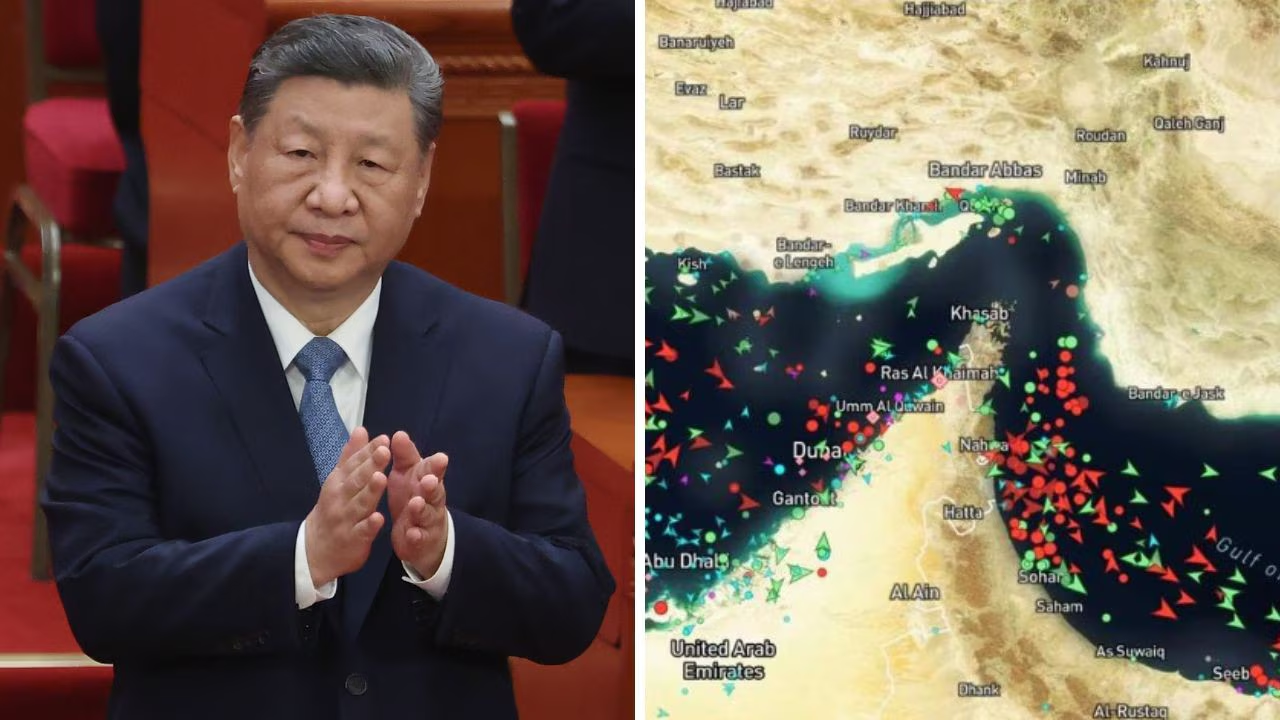
But Mr van Onselen said Australia was particularly vulnerable to disruption in the Strait of Hormuz, a chokepoint effectively closed since war broke out between US-Israeli forces and Iran on February 28.
This is because Australia imports refined fuels from South Korea, Singapore, Malaysia, Japan and China — the countries hardest hit by the strait’s closure.
China imports about half of its oil through the strait, while at least 70 per cent of Japan’s oil also passes through the route.
Australia was once far less reliant on imported fuel, running seven oil refineries in the early 2000s.
Nowadays, it operates just two refineries in Victoria and Queensland.
“Most of Australia’s liquid fuel supplies come from refineries in Asia. Yet, 80 per cent of the oil volumes that flowed through the Strait of Hormuz went to Asia,” Mr van Onselen said.
“I really can’t see how or why Asian refineries are going to be allowed to ship fuel to Australia when home country supply is at risk.
“This raises the likelihood that Australia will lose a much larger share of its fuel supply than the 15 per cent of global supply offline.”
China has reportedly already instructed its oil refineries to halt exports, leading Energy Minister Chris Bowen to reassure the public on Tuesday that “every ship” carrying fuel to Australia had so far arrived.
Meanwhile, Prime Minister Anthony Albanese, under increasing pressure as petrol prices skyrocket, has appointed a fuel supply task force co-ordinator and held an urgent national cabinet meeting with state and territory leaders on Thursday.
How much fuel does Australia really have?
Australia’s fuel stocks are often reported in terms of “days of cover”: the number of days the current supply could meet national consumption at normal rates.
The Minimum Stockholding Obligation (MSO), set by the federal government, requires fuel companies to hold a minimum volume of petrol, diesel, and jet fuel.
At the latest reporting on March 10, gasoline stocks covered 37 days, diesel 30 days and kerosene (jet fuel) 29 days.
But the MSO is largely an accounting measure. It doesn’t represent actual, refined fuel stored in tanks and ready to be used by consumers.
It includes “stocks on water in Australia’s exclusive economic zone and some crude oil and unfinished stocks at refineries”, according to the MSO’s methodology.
Mr van Onselen worried Australia’s fuel stocks would quickly dry up as Asian countries began to prioritise domestic demand.
“The nightmare scenario is that resource nationalism overruns the oil market globally,” he said.
The economist argued policymakers had “stood by silently” as the nation shut down its fuel refineries, and left Australia “highly exposed” by ignoring IEA requirements.
The MSO is next due to report fuel stocks on Friday.
PM says panic buying is the biggest risk
Speaking in Hobart this week, the Prime Minister said that panic buying itself, not a shortage of fuel, was creating problems.
“There is not less fuel in Australia today than there was three weeks ago,’’ he said.
“Every single ship that was due to land here has landed here. There is not less supply.
“This is has been an issue of increased demand. A doubling of demand, and in some cases much more than doubling in areas, that can mean there are shortages in some areas.”
PM’s ‘message to service stations’
Pressed during a media conference on Wednesday, Mr Albanese declared that “we do have fuel security”.
“My message to service stations which are overcharging is that the ACCC will take action against any inappropriate behaviour,” he said.
“My message to Australians as well is to not take more fuel than you need. That is how you can help. Think of others.”
He went on to say that Australia has “fuel security … but we need to be sensible about these issues and that’s my message”.
“But there’s no place for any company to try to take advantage of this to increase their profits at the expense of Australians,” he said.
Woolworths weighs in
Woolworths chief Amanda Bardwell says the retail giant is not facing any immediate fuel shortages or issues.
But she’s called on the government to ensure retailers are kept in the loop in real time to any developments that could hit supply chains.
“We’re less than three weeks into this situation,” she said.
“What we want to make sure is that we’re responding now, we’re thinking about what this means in the midterm and we’re also focused on it for the long-term.
“As we look forward right now, we’re not concerned.”