
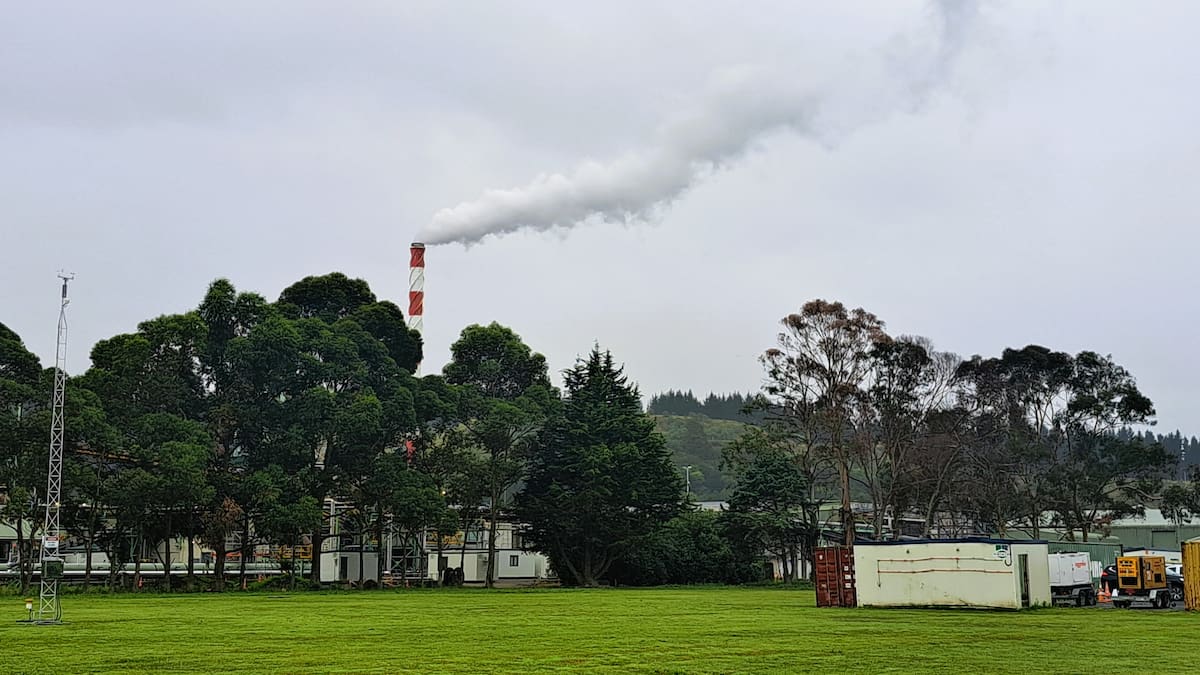
Hastings District Council and Napier City Council first approached the mill in 2019 to explore whether its boilers could be used to burn treated timber, to minimise the region’s waste.
About 10% of all waste disposed at the Ōmarunui Landfill – Hawke’s Bay’s biggest dump – is a mix of treated and untreated timber.
Rubbish being compacted at the Ōmarunui Landfill. Photo / Warren Buckland
Some of the region’s treated timber waste is also sent north, near Whangārei, to be burned in a kiln operated by Golden Bay Cement.
Treated timber is timber that has been coated with chemicals to stop it rotting, or to protect it from burrowing insects.
Treated timber is used for the likes of building homes, decking or for outdoor projects and structures.
Some of the chemicals used to treat timber can be harmful to humans if burned and inhaled, such as arsenic.
Arsenic is a key component in a commonly used preservative known as CCA.
Many councils around New Zealand urge residents not to burn treated timber in fireplaces for that reason.
Pan Pac’s high-temperature boiler, which is being used for the trial, is different to household fireplaces.
Pan Pac environmental manager Reece O’Leary said the boiler had “a baghouse filter” to manage emissions.
“It is very important to note that the boiler combustion process does not produce smoke or the type of emissions you would get when burning wood in a fireplace or outdoor space,” O’Leary said.
“Our boilers are designed to generate process steam and we follow strict requirements around air quality and monitoring.”
The boiler has a stack (chimney) and emissions will be monitored throughout the trial, including for any potential health impacts.
Two independent air quality experts have advised that it is safe to run the trial, according to Hastings District Council.
An air quality expert will also supervise the trial.
Part of Pan Pac’s mill, north of Napier. Photo / NZME
None of the treated timber will come from Pan Pac. Rather, the aim is to dispose of waste from the likes of construction or demolition in the region.
O’Leary said Pan Pac received very little benefit from the project.
The boilers produce electricity that helps power the mill, but O’Leary said the treated timber would provide a relatively “insignificant” amount of fuel for the boiler.
Untreated wood is already being used as fuel for the boilers.
Hastings District Council says the trial will only proceed if approved by Hawke’s Bay Regional Council, and it will be “independently monitored to ensure community health and environmental safety”.
Pan Pac has yet to lodge a resource consent application with Hawke’s Bay Regional Council for the trial, but plans to do so soon.
Hastings District Council expects the trial to go ahead sometime in the second half of 2026, and local residents have been notified.
The council’s regional construction and demolition waste minimisation lead Geoff Gibson said when treated timber was buried in landfill, it produced methane.
“The trial with Pan Pac is about exploring whether there’s a better local option for this waste that could reduce landfill emissions and benefit our construction and rural sectors,” Gibson said.
“The opportunity to find an alternative, less harmful solution to deal with this waste created across Hawke’s Bay is supported by the councils’ [Napier and Hastings] joint waste management and minimisation plan.
“If the trial shows it’s not viable, it will not progress any further.”
Treated timber ranges from H1 to H6. The higher the number, the higher the intensity of the treatment.
The trial will look at three different scenarios. Scenario one is burning H1.2-treated timber only.
Scenario two is burning H3- and H4-treated timber only, which includes timber treated with the likes of CCA (which contains arsenic).
Scenario three is burning a mix of all treated timber types.